Aurora Cannabis Revenue Slips as International Medical Sales Rise in First Quarter
Key Takeaways
- •Aurora Cannabis posted 1Q FY27 net revenue of C$67.6 million, a 9% year-over-year decline driven primarily by a roughly 30% Canadian federal medical reimbursement rate reduction and the planned exit from consumer cannabis.
- •International medical cannabis revenue grew 17% to C$43.3 million, accounting for 64% of total net revenue, with Germany serving as the company's largest and fastest-growing market.
- •Adjusted EBITDA fell 68% year-over-year to C$3.4 million but remained positive, while the consolidated adjusted gross margin of 58% reached the upper bound of full-year FY27 guidance.
- •The Safari acquisition contributed positively to adjusted EBITDA in its first quarter and secured a three-year EU-GMP certification, enabling internal supply to European and other regulated international markets.
- •Aurora maintained C$149.1 million in cash, restricted cash, and short-term investments with no loans or borrowings, while management reaffirmed FY27 guidance and expects sequentially higher second-quarter revenue and adjusted EBITDA.
Aurora Cannabis Revenue Slips as International Medical Sales Rise in First Quarter
TLRY +2.93%
CRON +0.98%
ACB +0.34%
CGC +4.07%
SNDL +2.50%
Download the Complete Report Here
Aurora Cannabis Inc. (ACB)
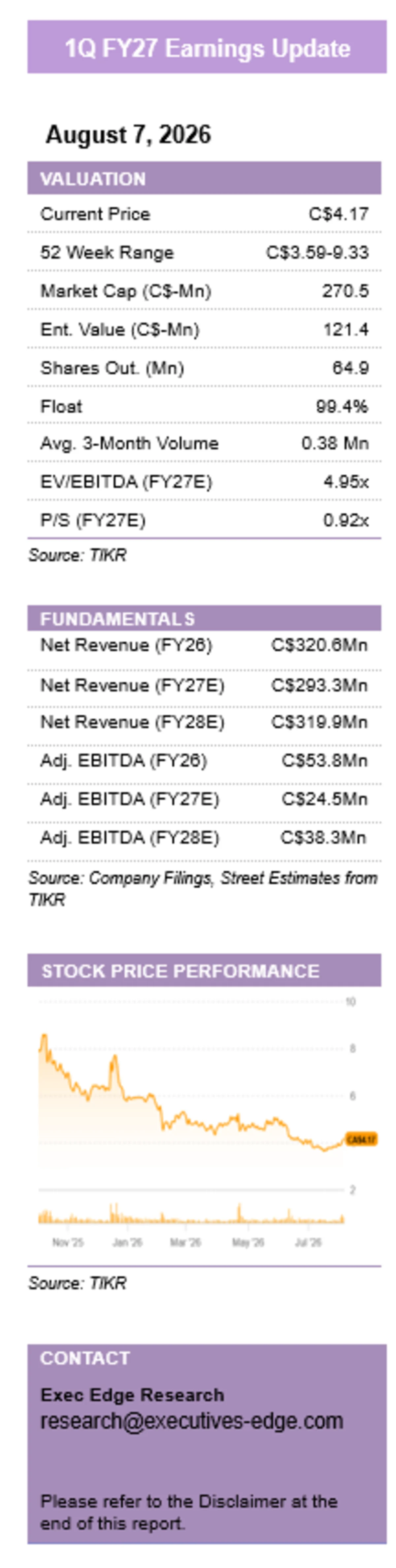
Key takeaways: International medical cannabis revenue increased 17% to C$43.3 million in 1Q FY27, underscoring Aurora Cannabis' position in global medical markets. Adjusted gross margin reached 58%, the high end of FY27 guidance, despite the initial impact of a roughly 30% Canadian reimbursement cut. Safari contributed positively to adjusted EBITDA in its first quarter, while three-year EU-GMP certification expands internal supply for higher-margin international markets. Management expects higher 2Q revenue and adjusted EBITDA, while Street estimates point to FY28 growth and positive free cash flow as scale and efficiencies build. Valuation remains attractive at 0.92x FY27E P/S and 4.95x FY27E EV/EBITDA despite strengthening international fundamentals and a debt-free balance sheet.
International medical cannabis growth continued to strengthen Aurora Cannabis' global medical-first platform and support its growth strategy. The company reported 1Q FY27, for the quarter ended June 30, 2026, net revenue of C$67.6 million, down 9% from C$74.1 million in the prior-year period and down 20% sequentially from C$84.8 million in 4Q FY26. The decline was mainly driven by the April 1 reduction in Canadian federal medical reimbursement rates and the planned wind-down of the consumer cannabis business, rather than weaker international demand. The strategic pivot toward international medical markets mirrors a broader trend among Canadian licensed producers, several of which have shifted focus away from domestic recreational channels after years of pricing pressure, excess cultivation capacity, and competition from the illicit market eroded profitability in Canada since federal legalization in 2018.
Medical cannabis revenue was broadly stable at C$64.0 million, compared with C$64.8 million a year earlier, as a C$6.2 million increase in international medical revenue offset C$7.0 million of Canadian medical pressure. Medical cannabis accounted for approximately 95% of consolidated net revenue, up from 87% in the prior-year quarter and 91% in 4Q FY26. That shift reflects how the Bevo divestiture and consumer wind-down have advanced Aurora's transition into a focused global medical cannabis company.
International medical cannabis remained the main growth engine, rising 17% to C$43.3 million from C$37.1 million, led by stronger sales in Germany. International medical revenue represented 64% of total net revenue, compared with about 50% in the prior-year period and 58% in 4Q FY26, reflecting organic growth abroad and the contraction of lower-return Canadian channels.
Germany remained Aurora's largest and fastest-growing international market, supported by rising patient demand, two proprietary cultivars ranking among the five highest-selling products, and continued strength in the core and premium price tiers. Germany's medical cannabis market has expanded significantly since the April 2024 implementation of the Cannabis Act, which removed medical cannabis from the narcotics schedule and simplified the prescribing process, contributing to a surge in patient enrollment and pharmacy dispensing. Pricing pressure remains concentrated in the value segment, while core and premium pricing has held up relatively well because stricter GMP requirements limit qualified supply. Aurora has responded by selectively expanding its value offering without abandoning the core and premium categories that account for most of its German volume.
Strong operating discipline kept adjusted EBITDA positive despite the full initial impact of the Canadian reimbursement reset. Adjusted EBITDA was C$3.4 million, down 68% from C$10.8 million a year earlier and down 63% from C$9.2 million in 4Q FY26. The adjusted EBITDA margin fell to 5.1% from 14.6% a year earlier and 10.8% sequentially. The C$7.4 million year-over-year decline primarily reflected an C$8.3 million reduction in adjusted gross profit, partly offset by C$1.0 million of adjusted SG&A savings.
Adjusted SG&A declined 3% to C$35.1 million from C$36.1 million, as lower general and administrative spending more than offset an 8% increase in sales and marketing to C$15.6 million. The higher selling investment was directed toward international growth markets, while the broader cost base remained controlled during the transition.
Adjusted gross margin reached the high end of FY27 guidance, supported by international mix and continued manufacturing discipline. Consolidated adjusted gross margin declined from 64% in the prior-year quarter and 60% in 4Q FY26, while adjusted gross profit fell 17% to C$39.5 million from C$47.7 million. Medical cannabis adjusted gross margin declined to 61% from 69%, reflecting the roughly 30% Canadian reimbursement reduction, although the strong contribution from international medical markets kept consolidated performance within the guided range.
Gross profit before fair-value adjustments was C$29.2 million, compared with C$38.8 million a year earlier, with the reported 43% margin down from 52%. Reported gross profit increased to C$35.6 million from C$33.5 million, reflecting higher biological-asset fair-value gains. Adjusted gross profit remains the more relevant measure of underlying performance.
Cost control and higher other income helped preserve positive adjusted net income despite lower gross profit. Adjusted net income fell to C$3.8 million from C$6.6 million a year earlier, driven by an C$8.3 million decline in adjusted gross profit before fair-value adjustments, partly offset by C$1.0 million lower adjusted SG&A and C$3.4 million higher other income.
Free cash flow turned negative as lower gross profit flowed through cash generation. Free cash flow was an outflow of C$5.8 million in 1Q FY27, compared with an inflow of C$6.8 million in the prior-year period. The C$12.6 million year-over-year decline was mainly driven by a C$9.7 million reduction in gross profit before fair-value adjustments.
Genetics and integrated production remain important levers for margin recovery and operating efficiency. Aurora said proprietary genetics can improve yields by up to 40% on the same cost base while also improving product quality, lowering production costs, and supporting pricing. Combined with its vertically integrated production model and the rollout of proprietary cultivars across Safari and Leuna, management expects higher internal utilization and continued manufacturing efficiencies.
Liquidity remains a meaningful competitive advantage, with C$149.1 million of cash, restricted cash, and short-term investments and no loans or borrowings. At June 30, cash and cash equivalents were C$69.3 million, restricted cash was C$49.1 million, and short-term investments were C$30.7 million. About C$46.4 million of restricted cash is expected to become unrestricted after the company winds up its segregated self-insurance cell by 3Q FY27, which would materially increase immediately deployable liquidity without requiring external financing. On a pro forma basis, unrestricted cash and short-term investments would rise from about C$100.0 million to C$146.4 million, subject to movements before completion.
This liquidity gives Aurora the ability to complete Safari and Leuna investments, absorb the Canadian reset, and pursue additional medical-cannabis acquisitions without adding financial debt.
Safari contributed positively to adjusted EBITDA in its first quarter and is moving from strategic capacity to an operating contributor. Aurora completed the acquisition in April for C$15.0 million in cash and 2.4 million shares valued at C$11.6 million, with C$2.0 million of the cash consideration tied to EU-GMP certification conditions and a provisional C$0.7 million working-capital adjustment receivable. Safari's 59,000-square-foot Ontario facility received a three-year EU-GMP certification on July 23, advancing integration by enabling supply to Germany, Poland, Australia, and the U.K. while expanding Aurora's internal capacity and reducing reliance on third-party production. EU-GMP — the European Union's Good Manufacturing Practice standard — is the manufacturing-quality certification required for pharmaceutical-grade cannabis to enter regulated European medical markets, making it a critical asset for any producer seeking to compete internationally.
Safari's strategic value extends beyond capacity because it improves speed to market, internal supply control, and the scalability of Aurora's European platform. The facility adds EU-GMP flower capacity at a time when Germany faces limited availability of consistently high-quality product and should reduce reliance on third-party sourcing. Applying Aurora's proprietary genetics and operating practices could improve yields by up to 40% on a comparable cost base, lower manufacturing costs, and expand supply of core and premium flower. With planned capex of C$3.5 million over three years against C$149.1 million of liquidity, Safari should support international revenue growth and margin improvement without materially constraining financial flexibility.
Best-in-class global medical operations continue to diversify Aurora's growth profile beyond Canada. Leadership positions in Germany, Poland, Australia, and New Zealand, together with a focused U.K. strategy and longer-term U.S. optionality, reinforce the scalability of Aurora's international medical platform and reduce reliance on any single market.
Aurora's German position remains differentiated by local production, direct supply capabilities, and a regulatory infrastructure that becomes more valuable as compliance standards tighten. Germany is Aurora's largest and fastest-growing international market and one of the most stringent globally, with strict GMP standards governing market access. Aurora is one of only three active in-country producers holding German production and R&D licenses and has operated in the market since 2018, creating established relationships with wholesalers, distributors, pharmacists, and regulators. The market is mainly structured around flower and oil, with the Leuna expansion now in its final phase and expected to double the facility's annual flower output as proprietary cultivars are introduced. Combined with Canadian EU-GMP production and Safari's newly certified capacity, Leuna should improve product availability, shorten supply chains, and support further share gains in a market where high-quality GMP flower remains scarce. Regulatory proposals affecting prescribing and distribution remain worth monitoring, although Aurora's focus on cultivation and wholesale rather than retail or telehealth limits direct exposure to the downstream channels most likely to be affected.
Poland, Australia, and New Zealand provide additional international growth vectors and reduce reliance on a single European market. Aurora retains the number-one share position in Poland, where increased annual import limits and a loyal patient base support further growth despite earlier restrictions on telemedicine prescribing. The company's experience navigating Poland's regulatory transition provides a relevant precedent for potential changes in Germany, as tighter market structures tend to favor scaled operators with established registrations, reliable supply, and pharmaceutical-grade manufacturing.
In Australia, Aurora is shifting its mix toward core and premium offerings as physician and patient demand moves to higher-tier products, while the market's broad range of permitted formats allows the company to commercialize products beyond flower and oils. New Zealand is also producing encouraging growth as Aurora expands its assortment in another tightly regulated medical market. Together, Germany, Poland, Australia, and New Zealand support the expectation that international growth will remain the main offset to Canada during FY27.
The U.K. strategy remains deliberately focused on premium medical supply rather than downstream clinic or pharmacy ownership. While several competitors have vertically integrated into online clinics and pharmacies, Aurora continues to prioritize genetics, product development, and GMP manufacturing, where it believes its capabilities and returns are strongest. Regulatory engagement with the MHRA and evolving quality standards should favor suppliers with established pharmaceutical-grade capacity, while the U.K.'s self-pay market places a premium on consistent, high-quality medical products. Aurora therefore does not need to replicate competitors' downstream infrastructure to participate in the market's growth; instead, its large GMP supply base can support multiple channels while preserving capital and maintaining focus on higher-return cultivation and wholesale economics.
The Canadian medical decline was consistent with the expected reimbursement-rate reset and does not appear to signal deterioration in patient demand or competitive position. Canadian medical revenue declined 25% to C$20.7 million from C$27.7 million as changes to the federal reimbursement program lowered applicable reimbursement rates by about 30% effective April 1. The C$7.0 million year-over-year revenue reduction was closely aligned with the pricing change, while patient eligibility, covered volumes, and authorization mechanics were not identified as material sources of pressure. Canadian medical represented 31% of consolidated revenue versus 37% a year earlier, and the shift was the main factor behind lower adjusted gross profit and EBITDA.
While the reimbursement change creates a meaningful near-term earnings reset because cultivation and fulfillment costs do not fall proportionately with realized pricing, the first-quarter result supports the view that the issue is mainly economic rather than demand-driven.
Canadian medical retains an underlying share-growth opportunity despite the reimbursement reset, with Aurora's veteran-service expertise potentially portable across markets. Veteran medical-cannabis penetration has increased from about 4% to 8% over the past four years, while new patients continue entering the system across age groups, genders, and medical indications. Although management did not provide a natural penetration ceiling, it continues to see room for Aurora to gain share through its service model, product availability, and direct patient relationships. The operating insight also extends beyond Canada, as veteran communities in the U.S., Australia, and New Zealand show similar interest in medical cannabis and maintain close cross-border connections.
The U.S. remains a longer-duration strategic and partnership opportunity rather than a near-term earnings driver. Aurora identified three potential avenues from federal rescheduling: expanded research collaboration, partnerships leveraging its GMP and medical-grade manufacturing standards, and longer-term import-export opportunities between the U.S. and the international medical markets it already serves. The U.S. Drug Enforcement Administration's ongoing review of cannabis rescheduling from Schedule I to Schedule III under the Controlled Substances Act represents a potential regulatory inflection point for the industry, though timing remains uncertain. While U.S. operators could eventually become competitors in international markets, Aurora believes its decade-plus experience in EU-GMP manufacturing, integrated cultivation model, and established presence in regulated markets such as Germany provide meaningful advantages and could also position it as a partner to operators lacking comparable international regulatory and supply-chain capabilities. However, no specific partnership, investment, or revenue timeline was provided, leaving the opportunity as longer-term optionality pending regulatory clarity.
The consumer cannabis wind-down continued to improve business quality, although clearance activity pressured the remaining segment's margin. Consumer cannabis revenue declined 74% to C$2.1 million from C$7.9 million as Aurora exits lower-margin Canadian recreational channels and reallocates resources to medical cannabis. Consumer adjusted gross margin declined to 20% from 33%, largely because products were sold at reduced prices to minimize inventory impairment during the wind-down. Consumer cannabis now represents only 3% of consolidated revenue, compared with 11% a year ago, limiting its future impact on reported results and positioning Aurora for a cleaner medical-only earnings base. Wholesale bulk cannabis revenue was C$1.5 million versus C$1.4 million a year earlier, leaving the company's revenue mix overwhelmingly concentrated in medical channels with greater regulatory barriers, better visibility, and structurally higher margins.
Capital allocation remains focused on international capacity and selective M&A, although recent equity issuance increases the importance of per-share returns. Aurora issued 1.58 million shares through its ATM program at an average gross price of C$4.29, raising C$6.7 million net, while 2.42 million shares were issued as consideration for Safari. As a result, shares outstanding increased 7% during the quarter to 63.31 million from 58.95 million. The issuance provides additional flexibility for acquisitions and internal investment, but future capital deployment should be assessed against revenue, EBITDA, and free-cash-flow accretion given Aurora's substantial liquidity and debt-free balance sheet.
Management reaffirmed FY27 guidance, with international growth and manufacturing efficiencies expected to partially offset the Canadian pricing reset. FY27 remains a transition year as the VAC reimbursement change pressures revenue and adjusted EBITDA, although Aurora expects to gain share in Canadian medical while continued growth in Germany, Poland, Australia, and New Zealand supports sequential improvement. Germany remains the largest and most visible growth driver, supported by strong patient demand and limited availability of high-quality EU-GMP flower. On the cost side, Aurora continues to target efficiencies through proprietary genetics and facility optimization, with certain cultivars capable of improving yields by up to 40% while also enhancing quality, potency, and terpene profiles. The 58% adjusted gross margin in 1Q reached the high end of the annual target range, and Aurora reiterated that 2Q revenue and adjusted EBITDA should be substantially higher than in 1Q.
Street estimates continue to frame FY27 as a transition year before growth reaccelerates in FY28. Based on Street estimates sourced from TIKR, revenue is projected to decline from C$320.6 million in FY26 to C$293.3 million in FY27E, reflecting lower Canadian medical reimbursement rates and the company's exit from lower-margin businesses. Adjusted EBITDA is expected to decline to C$24.5 million from C$53.8 million in FY26, with margins compressing to 8.3% as the reimbursement changes flow through results. The first quarter contributed C$67.6 million of revenue and C$3.4 million of adjusted EBITDA, representing 23% and 14% of the respective full-year estimates.
Looking further ahead, Street estimates imply that growth and profitability should begin to recover in FY28 as the Canadian reimbursement reset is absorbed and international capacity scales. Revenue is estimated to increase 9.1% to C$319.9 million in FY28E, while adjusted EBITDA is expected to rise 56.5% to C$38.3 million, implying a margin of 12.0%. EPS is projected to improve to C$0.02, and free cash flow is expected to return to positive territory at approximately C$11.0 million. The recovery is supported by a full year of Safari contribution, higher output from the Leuna expansion, continued growth in Germany and Poland, and lower reliance on third-party sourcing as internally produced EU-GMP supply increases.
Overall, the medium-term growth outlook remains intact despite the near-term earnings reset. Aurora's recovery through FY28 continues to be supported by: 1) sustained expansion across international medical cannabis markets, particularly Germany, Poland, Australia, and New Zealand; 2) incremental EU-GMP capacity from Safari and Leuna, improving product availability and supporting lower sourcing costs; and 3) continued gains from proprietary genetics, manufacturing efficiencies, and a more focused medical-only business mix. The expected sequential improvement in 2Q revenue and adjusted EBITDA will be an important early indicator of whether this recovery path is beginning to take hold.
Aurora Cannabis' current valuation may understate the quality and long-term earnings potential of its international medical cannabis platform despite the near-term Canadian reimbursement reset. On a forward basis, ACB trades at 0.92x FY27E price/sales, below both its historical multiple and cannabis peers. While lower Canadian reimbursement rates are expected to pressure FY27 earnings, the impact remains mainly pricing-driven rather than demand-driven, with international medical growth, led by Germany, continuing to offset domestic weakness.
The current multiple appears to assign limited value to Aurora's expanding EU-GMP manufacturing platform, growing international footprint, and improving earnings mix. Applying a 1.40x FY27E P/S multiple to the Street revenue estimate of C$293.3 million implies an equity value of about C$410.6 million, or roughly C$6.3 per share. The 1.40x multiple is above Aurora's three-year mean but remains well below its three-year peak of 2.29x. The premium is supported by Aurora's increasingly focused medical-only business mix, leadership across regulated international markets, debt-free balance sheet, and expanding EU-GMP capacity through Leuna and Safari. This is not a formal price target, but it illustrates the valuation gap between Aurora's current market value and its longer-term earnings potential.
Aurora also trades at 4.95x FY27E EV/EBITDA, which appears undemanding relative to its balance-sheet strength and medium-term earnings recovery potential. The company has no loans or borrowings and approximately C$149 million of cash, restricted cash, and short-term investments, while international medical growth, Safari integration, genetics-led production efficiencies, and higher internal EU-GMP supply provide visible levers for margin improvement. As FY27 progresses and international growth increasingly offsets Canadian pricing pressure, the quality and visibility of EBITDA should improve, creating room for the multiple to rerate as the earnings base recovers.
Overall, current valuation levels appear to understate Aurora's competitive positioning and the improving quality of its international earnings base. Key differentiators include: 1) leadership positions in Germany, Poland, and Australia, with international markets contributing 64% of 1Q revenue; 2) a GMP-led operating model supported by proprietary genetics, integrated production, and regulatory expertise; 3) no loans or borrowings and approximately C$149 million of liquidity; and 4) expanding internal EU-GMP capacity through Leuna and Safari. While FY27 remains a transition year, continued international growth, manufacturing efficiencies, and a more favorable revenue mix should support margin recovery and create room for valuation multiples to move toward historical and peer levels over time.
Disclaimer: Exec Edge does not publish proprietary estimates, ratings, price targets, or investment recommendations. The valuation discussion above is illustrative only and is based on company filings, management commentary, and third-party data and estimates. It does not constitute a recommendation, price target, rating, or prediction of future pricing.

