Audi Unveils Q9 Flagship SUV: Seven-Seat Challenger to Range Rover and BMW X7
Key Takeaways
- •The Audi Q9 is the manufacturer's largest production vehicle, measuring 5.31 metres in length and offering three rows of seating configured for either six or seven occupants.
- •The UK launch model is equipped with a 3.0-litre V6 turbodiesel engine producing 295bhp and 465lb ft of torque, supplemented by a 48-volt mild-hybrid system contributing an additional 24bhp.
- •At 2.21 metres wide, the Q9 exceeds the 2.13-metre width of standard UK road restrictors, a challenge Audi addresses with rear-wheel steering and adaptive air suspension.
- •Audi has not confirmed UK pricing or an on-sale date, though the Q9 is positioned against the BMW X7 and Range Rover, which start at approximately £85,000 and £105,000 respectively.
- •The Q9 launches with a conventional combustion powertrain, while Audi continues to offer the fully electric Q8 e-tron alongside it for buyers seeking an electric luxury SUV.
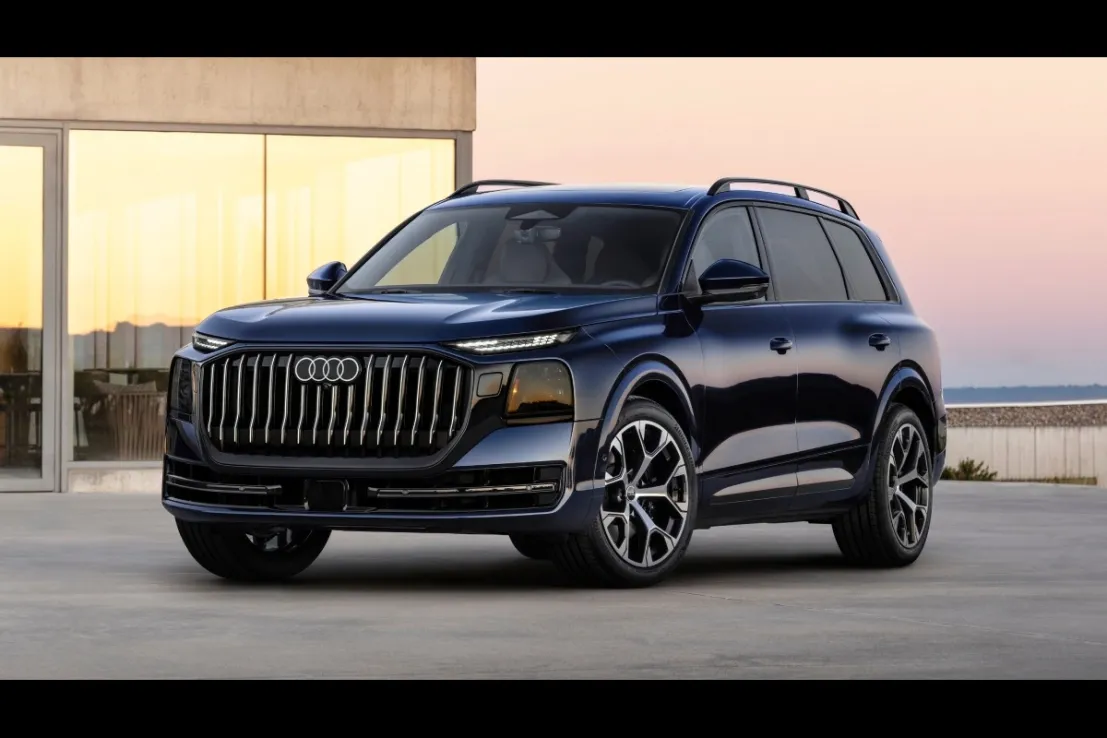
Audi has revealed its new range-topping Q9, described by the manufacturer as the largest vehicle it has ever produced. The seven-seat luxury SUV measures 5.31 metres in length and is positioned directly against the BMW X7, Mercedes-Benz GLS, and Range Rover in the premium full-size SUV segment — a category that has continued to generate strong sales and margins even as the broader industry shifts toward electrification.
The Q9 is configured with three rows of seating, offering either six or seven seats depending on the layout chosen. Audi is marketing the vehicle as a "mobile living space," with cabin materials including Nappa leather, Dinamica microfibre, and open-pore wood trim. The manufacturer says the panoramic glass roof fitted to the Q9 is the largest it has ever installed in a production vehicle. The Q9 crowns Audi's Q-badged SUV hierarchy, sitting above the Q8 and Q8 e-tron, and effectively fills a gap that the brand has left open while rivals such as BMW and Mercedes-Benz have fielded dedicated flagship SUVs for several years.
Design and Dimensions
The Q9's front end is dominated by Audi's Singleframe grille with thick vertical bars, while S line models receive a more aggressively styled front fascia. At the rear, the vehicle features a full-width light bar, an illuminated four-ring Audi badge, and what the company says are its first curved digital OLED tail lights, capable of projecting an indicator graphic onto the road surface. Wheel options extend up to 23 inches in diameter.
The vehicle measures 2.21 metres wide — slightly exceeding the 2.13-metre (7-foot) width restrictors commonly found on London streets. Audi has addressed manoeuvrability concerns by fitting rear-wheel steering and adaptive air suspension, which the company says reduce the turning circle and ease navigation in confined spaces. Rear-wheel steering has become increasingly common in this segment, with BMW offering similar technology on the X7, as manufacturers seek to make physically large vehicles more viable in European urban environments.
Interior and Technology
The Q9's dashboard incorporates a 12.3-inch driver's display, a 14.5-inch central touchscreen running Android Automotive software, and an additional 12.3-inch display for the front passenger. Second-row seats are electrically adjustable on higher trim levels, and all seats slide, recline, and fold electrically. The doors can also be opened remotely via a smartphone.
Audi notes that buyers seeking a fully electric luxury SUV should continue to consider the Q8 e-tron, which remains in the lineup alongside the combustion-engined Q9. The decision to launch the Q9 with a conventional powertrain reflects a broader pattern across premium manufacturers, several of which continue to invest in large combustion-engined SUVs alongside their electric offerings, particularly for markets and buyers where long-distance cruising, towing capacity, and rapid refuelling remain priorities.
Engine and Performance
For the UK market, the Q9 will launch with a 3.0-litre V6 turbodiesel engine producing 295bhp and 465lb ft of torque. A 48-volt mild-hybrid system contributes an additional 24bhp under acceleration. An electrically powered compressor spools boost in a claimed 1.2 seconds, which Audi says eliminates turbo lag when accelerating from low speeds.
Quattro all-wheel drive and an eight-speed automatic transmission are fitted as standard. The powertrain is tuned for motorway cruising comfort rather than off-road performance. Diesel remains the default choice for many buyers in the full-size luxury SUV segment, where high torque output and motorway efficiency are valued for long-distance travel and towing.
UK Suitability
At 2.21 metres wide, the Q9 exceeds the width of standard 2.13-metre restrictors used on many UK roads, meaning the body alone — excluding mirrors — is wider than some barriers permit. The vehicle will also extend approximately half a metre beyond a standard parking bay. However, Audi's rear-wheel steering system is designed to mitigate these constraints in urban environments.
Pricing and Availability
Audi has not yet confirmed UK pricing or a firm on-sale date for the Q9. Given its positioning against the BMW X7 and Range Rover, industry observers expect the starting price to reach well into six figures once options are factored in. For reference, the BMW X7 starts at approximately £85,000 in the UK, while the Range Rover begins around £105,000. The company has advised that any figures circulating prior to its official announcement should be treated as speculative.
Full specifications are available on Audi's official Q9 page.

