ASX 200 Erases Morning Losses to Trade Flat as 4.7% September Jobless Rate Signals Delayed RBA Hike; US Futures in the Red
Key Takeaways
- •September's 4.7% unemployment rate and underemployment above 6% led markets to view a near-term RBA rate hike as less likely.
- •Australia's 10-year bond yield dropped roughly one tenth of a percentage point intraday to 5.2% after the jobs data, having touched a high of 5.36%.
- •The materials sector headed for a three-month low as copper, lithium and iron ore fell overnight, with Rio Tinto and BHP each losing more than 4% intraday.
- •ASIC has dropped its investigation into WiseTech over insider trading and governance matters that had centred on founder Richard White.
- •Consumer staples led sector gains at 3.3%, followed by financials at 2.25%, with Bank of Queensland's Q1F27 report widely welcomed despite a significant drop in home lending.
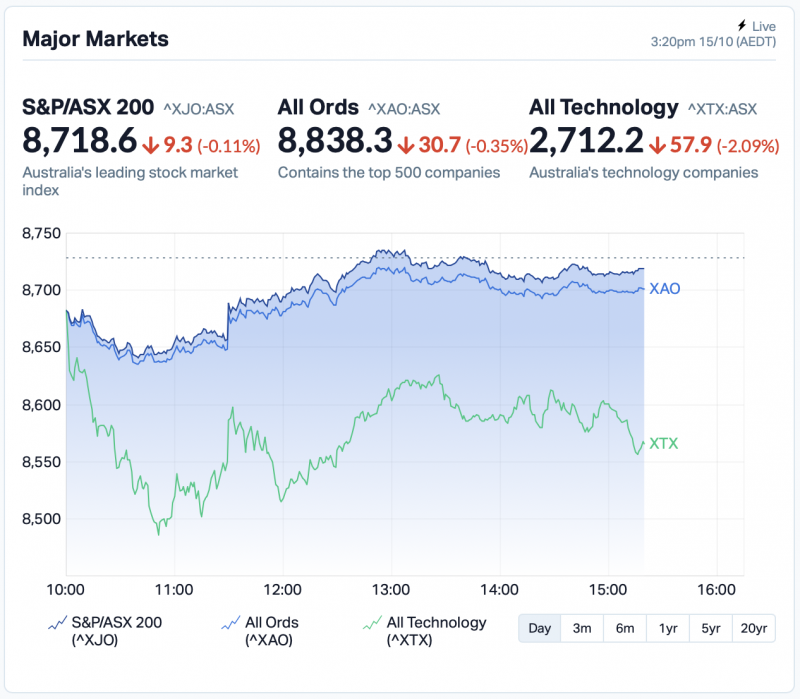
The S&P/ASX 200 (XJO) pared back its morning losses to trade flat heading into the final 40 minutes of Thursday's session, after Australian Bureau of Statistics (ABS) data showed the unemployment rate at 4.7% in September — a print the market happily accepted as a signal that the Reserve Bank of Australia (RBA) may not need to raise interest rates again any time soon.
The benchmark index traded in the mid-to-upper 8,600-point range through the morning. Earlier in the day, expectations had been that the labour force report would attract little attention, but the data proved to be the session's turning point. Monthly jobs figures from the ABS are among the most closely watched releases on the Australian economic calendar, feeding directly into the RBA's policy deliberations. Alongside the 4.7% jobless rate, the underemployment rate climbed above 6%, and the market gradually floated back to breakeven intraday.
The reason for the market's favourable reaction is that an unemployment rate drifting toward 5% suggests the RBA may not need to hike interest rates in the near term. The central bank has a dual mandate — managing the labour market and managing the inflation rate. Having spent considerable effort on inflation management, if September's labour force data does not prove to be transient, it appears that the "economic chemotherapy" of rate hikes is working.
The market's growing suspicion that a rate hike this year is less likely was also reflected in Australian bond yields, which fell on the back of the September data release. The Australia 10-year bond yield dropped by roughly one tenth of a percentage point intraday once the data was published — government bond yields acting as a real-time gauge of where investors see policy heading. The yield stood at 5.2%, after touching an intraday high of 5.36%.
The failure to flip green was largely down to the materials sector — a heavily weighted corner of the local bourse — which is on track for a three-month low. Copper, lithium and iron ore all fell back overnight, and both Rio Tinto and BHP, two of the world's largest miners, clocked intraday losses of more than 4%.
Ongoing technology-sector fears also continued to drag on the tech index (XTX), with South Korea's KOSPI index — home to some of the world's biggest memory-chip makers — once again acting as the canary in the coalmine for the enthusiasm of the AI trade. Heading into the final half hour, the tech index was down more than 4%.
WiseTech investors, at least, saw some reprieve on Thursday, as the logistics software provider revealed that the Australian Securities and Investments Commission (ASIC) has dropped its investigation into the company on insider trading and governance grounds, which had centred on founder Richard White.
Consumer Staples, traditionally viewed as a defensive corner of the market, was the best-performing sector of the day, up 3.3%, followed by financials, up 2.25%, which helped to offset the slump in materials. Bank of Queensland (BOQ) was a winner within the financials sector, with the regional lender's first-quarter fiscal 2027 (Q1F27) report widely welcomed by investors, even after home lending dropped significantly.
As of about 3:30pm AEDT, US futures were in the red, with NASDAQ futures set to drop by around 1% overnight — though a lot can change in the space of an evening. Futures give traders an early read on sentiment ahead of Wall Street's cash open, and S&P 500 futures were down four tenths of a percent at the time of writing.
The material provided in this article is for information only and should not be treated as investment advice. Readers are encouraged to conduct their own research and consult with a certified financial adviser before making any investment decisions.
Source: The Market Online Australia — ASX Today: XJO pares losses to trade flat as 4.% jobless rate suggests delayed RBA hike; US futures red

