Asia-US East Coast Container Rate Reaches New High of $9,400/FEU
Key Takeaways
- •Asia-U.S. West Coast container rates rose 11% to $6,826 per FEU, while East Coast rates reached a new yearly high of $9,144 per FEU in the latest Freightos Baltic Index.
- •The U.S.-Iran conflict over the Strait of Hormuz remains unresolved after six months, with Iran demanding a ban on U.S. vessels, transit fees, and war reparations.
- •Major carriers CMA CGM, Maersk, and Mediterranean Shipping Co. continue expanding or returning to Red Sea routes despite recent projectile strikes on commercial vessels off Yemen and in the Gulf of Oman.
- •The National Retail Federation reversed its earlier forecast of an August import decline and now projects sustained elevated shipping demand through September.
- •Current Trans-Pacific container rates remain well below the pandemic-era peaks that surpassed $20,000 per FEU in 2021, when port congestion and equipment shortages disrupted global trade.
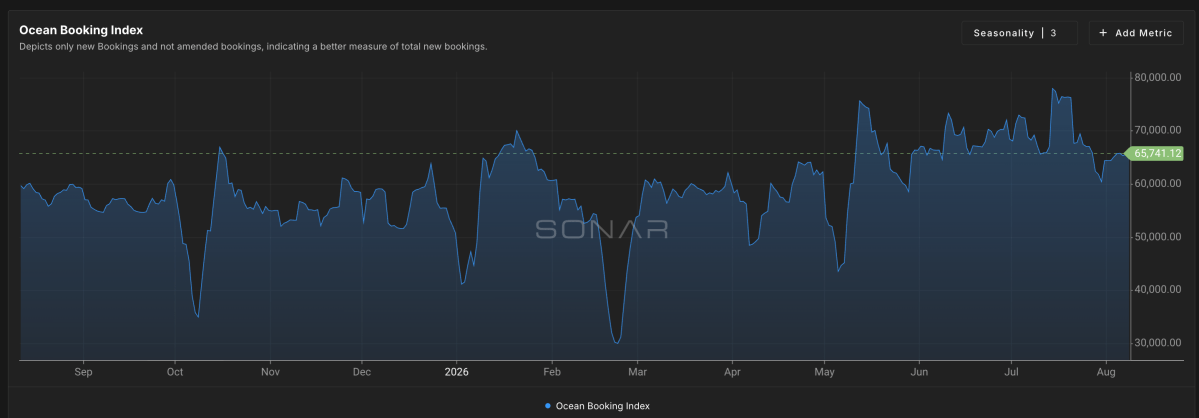
Container rates on the benchmark Asia-to-U.S. trade lanes continue to climb, driven by surprisingly resilient consumer demand following an early peak shipping season.
That demand persists as inflationary pressures push up the cost of retail goods and industrial products, while a range of supply chain and geopolitical factors continue to weigh on global ocean shipping. Though elevated, current Trans-Pacific rates remain well below the pandemic-era peaks that exceeded $20,000 per FEU in 2021, when port congestion and equipment shortages paralyzed global trade.
In the Middle East, the stalemate over control of the Strait of Hormuz shows no sign of abating. As the U.S.-Iran war stretches into its sixth month, President Donald Trump's command-by-social-media-post approach has failed to produce the framework of a reasonable exit strategy, leaving Tehran in a position to dictate terms. Iranian leadership stated this week that they would wait out the remaining two-plus years of the Trump administration if necessary.
Iran's escalating demands now include a ban on U.S. vessels, transit fees, and war reparations. However, that has not deterred global liners CMA CGM, Maersk (OTC: AMKBY), and Mediterranean Shipping Co. from expanding or returning to the Red Sea, despite renewed attacks in the region.
The United Kingdom Maritime Trade Operations security monitor reported two incidents on Tuesday. A cargo vessel off the coast of Yemen in the southern Red Sea was struck by an unknown projectile, while a container ship was targeted by military forces in the Gulf of Oman. No further details were available.
Asia-U.S. West Coast container rates rose 11% to $6,826 per forty-foot equivalent (FEU) in the latest Freightos Baltic Index. Asia-U.S. East Coast prices edged up 1% to $9,144 per FEU, marking a new high for the year. The persistent East Coast premium reflects the longer transit times of roughly ten to fourteen additional days via the Panama Canal or Suez Canal routings, as well as the concentration of major warehousing and distribution hubs serving the densely populated eastern seaboard.
Trans-Pacific rates that had been moving in tandem with Asia-Europe prices since the early peak season began in late May have recently diverged.
"East Coast rates which had been about stable since hitting the $9,000/FEU mark in early July are up to a new high of $9,400/FEU so far this week," said Judah Levine, chief analyst for Freightos (NASDAQ: CRGO), a contributor to SONAR data. "West Coast prices – which fell through most of July, possibly due more to capacity additions than volume drops in retrospect – have climbed $1,300/FEU since the start of the month to about $7,400/FEU so far this week, though rates are $200/FEU below their July high."
The unexpected surge prompted the National Retail Federation to revise its outlook. The organization had previously forecast a significant import decline in August and into September but now projects more even, elevated demand through September.
"This shift may reflect some shippers – who had been frontloading ahead of the July tariff deadline – extending their ordering now that a sharp duty hike did not materialize," Levine said. "Others who may have been cautious with their peak season ordering due to so much economic uncertainty, may be increasing shipments as consumers continue to show resilience despite elevated rates of inflation."
