ASEAN Women Economic Summit 2026 Calls for Concrete Action on Women's Economic Empowerment
Key Takeaways
- •AWES 2026 took place on Nov. 10 at Okada Manila during the Philippines' 2026 ASEAN chairmanship, drawing representatives from all 11 ASEAN member states, including newest member Timor-Leste, which joined the bloc in October 2025.
- •The summit adopted the AWES 2026 Recommendations, a document outlining 10 action points for ASEAN governments, businesses, and regional institutions under five priority areas ranging from women's leadership in economic decision-making to data and accountability.
- •Panel discussions examined the Digital Economy Framework Agreement, which ASEAN leaders have described as the world's first comprehensive regional digital economy pact and which aims to roughly double the region's digital economy to $2 trillion by 2030.
- •Breakout sessions focused on the care economy as a growing source of employment and investment, workforce mobility and skills recognition in an economy shaped by artificial intelligence, and strengthening regional supply chains against climate-related disruptions.
- •The recommendations reaffirmed the ASEAN Community Vision 2045 adopted in May 2025, and the summit concluded with a handover to Singapore, which will host the 2027 ASEAN Women Economic Summit as the next chair of the bloc.
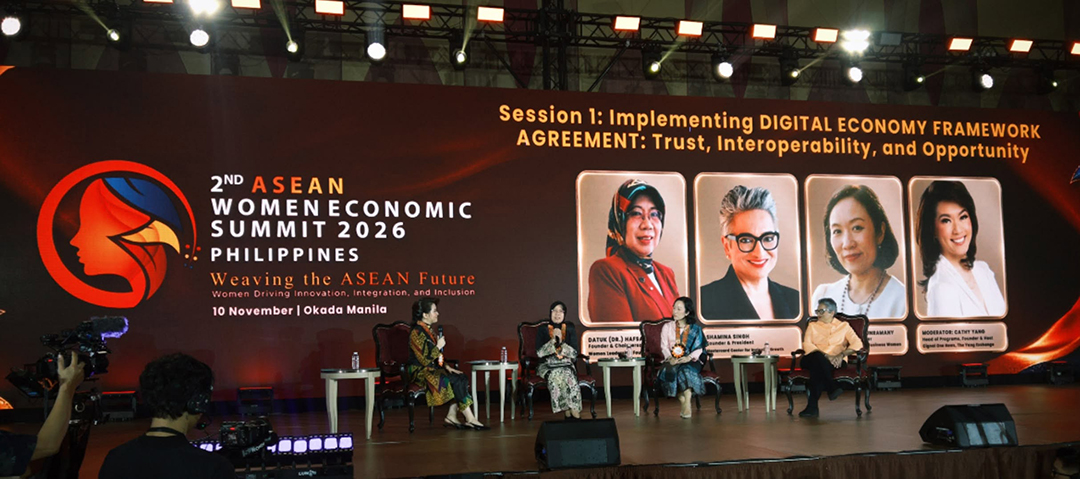
Women business leaders and policymakers from across Southeast Asia called for deeper regional cooperation and greater female participation in economic decision-making at the second ASEAN Women Economic Summit (AWES 2026), held on Nov. 10 at the Grand Ballroom of Okada Manila in Pasay City.
Convened under the theme "Weaving the ASEAN Future: Women Driving Innovation, Integration and Inclusion," the summit served as a regional platform for advancing women's economic leadership during the Philippines' 2026 ASEAN chairmanship. ASEAN's annually rotating chairmanship hands the host country a year of agenda-setting influence over the bloc — collectively one of the world's largest economies — and Manila has used the platform to elevate women's economic participation as a regional priority.
The event opened with an entrance parade led by First Lady Louise Araneta-Marcos, joined by representatives of the 11 ASEAN member states, accompanied by their respective ambassadors and delegates. The 11-strong roster reflects ASEAN's expanded composition since Timor-Leste was admitted as the bloc's newest member in October 2025.
Setting the agenda
In her opening remarks, Rhoda Castro-Caliwara, chairperson of AWES 2026 and of the Women's Business Council Philippines (WomenBizPH), said the Philippines' ASEAN chairmanship offered an opportunity to advance women's economic participation as a development priority. She emphasized that women are major contributors to Southeast Asia's economy, particularly through their role in micro, small, and medium enterprises (MSMEs), employment, innovation, and business leadership. The emphasis is grounded in scale: MSMEs account for roughly 97 percent of all enterprises across ASEAN and employ the majority of the region's workforce, giving women's engagement in the sector a direct bearing on the bloc's economic base.
On that basis, she framed the summit's discussions on digital trade, inclusive innovation, workforce development, and climate-resilient value chains as interconnected, since economic growth depends on people's ability to take part in emerging industries and markets.
Rosemarie Bosch-Ong, AWES 2026 co-chairperson and president of WomenBizPH, introduced the Filipino word habi (weave) as the inspiration behind the theme. She explained that each thread in a woven fabric has its own strength, color, and purpose, yet their combination produces something stronger and more enduring — a comparison she drew to the differing strengths, cultures, and experiences of women across ASEAN member states.
"Leadership is not measured only by what we build for ourselves. It is measured by how many others we help rise with us," Ms. Bosch-Ong said. "Let us weave not just the future we hope for, but the future we dare to build for women."
In a message of support, Jose Ma. A. Concepcion III, chairman of the ASEAN Business Advisory Council (ASEAN-BAC) Philippines, called for greater recognition of women's contributions to economic activity and stressed the need for practical solutions to the difficulties smaller enterprises face.
"Prosperity cannot just be for the rich. Prosperity has to be for everybody. It [should be our] passion to serve and help our MSMEs, because that is the only way that our country will grow. MSMEs are really the backbone of our country," Mr. Concepcion said.
Department of Trade and Industry (DTI) Secretary Ma. Cristina A. Roque presented the government's advocacy agenda for women's economic empowerment, underscoring the importance of giving women opportunities to establish and participate in businesses across industries. She encouraged women entrepreneurs and business representatives to engage with the government and its programs to access assistance and opportunities in domestic and international markets.
Four panels on regional priorities
The summit's four main panel sessions explored how regional policies, investments, and technological developments could support more inclusive economic growth.
The first session examined how ASEAN could translate the Digital Economy Framework Agreement into practical benefits for businesses through digital trust, interoperable systems, and cross-border trade. Speakers focused on strengthening connections among national digital systems and creating an environment in which MSMEs could participate in regional commerce, and on how digital integration could help women-led businesses reach new customers and markets across Southeast Asia. The DEFA, which ASEAN leaders have described as the world's first comprehensive regional digital economy pact, carries a stated ambition of doubling the region's digital economy to roughly $2 trillion by 2030 — a goal that makes interoperable national systems and access for small firms central to its delivery. The panelists were Datuk Hafsah Hashim, founder and chairperson of the Women Leadership Foundation in Malaysia; Shamina Singh, founder and president of the Mastercard Center for Inclusive Growth in the United States; and Bouphamany Chounramany, executive board member of the ASEAN Women Entrepreneurs Network (AWEN) Secretariat and of the Laos Business Women Association.
The second session looked at the relationship between sustainability and regional economic growth, focusing on energy cooperation, food security, and the blue economy. Panelists Satoko Kono, chief executive officer (CEO) of Arun Seed in Japan; Dawn Marie Francisco-Cabigon, CEO of Fairs & More, Inc.; and Kim Tol Tan, founder and chief executive officer of Grow4Growth in Cambodia, emphasized the importance of local knowledge and inclusive leadership in shaping climate policies and economic initiatives that respond to the needs of communities and businesses.
The third session examined how broader participation in innovation could raise productivity and strengthen ASEAN's competitiveness, highlighting the need to expand access to innovation. Speaking on the panel were Kunihiko Hirabayashi, secretary-general of the ASEAN-Japan Centre; Dr. Erika Legara, managing director and chief artificial intelligence and data officer of the National AI Council; and Mariana Beatriz Zobel de Ayala, managing director and senior vice-president of Ayala Land and Ayala Corp.
The fourth session explored ASEAN's economic prospects amid geopolitical developments, technological competition, and shifting global investment patterns. Speakers included Andrew Jeffries, country director of the Asian Development Bank; Irene Boey, data mining expert at AWEN Singapore; Helen Brand, chief executive of the Association of Chartered Certified Accountants in the United Kingdom; and June Cheryl Cabal-Revilla, executive director and chief finance, risk, and sustainability officer of Metro Pacific Investments Corp.
Care economy, skills, and climate-resilient supply chains
The forum's breakout sessions provided opportunities for focused discussions on economic sectors and policy areas that directly affect women's participation in the workforce and business.
The first breakout session examined the care economy as a major source of economic activity, investment, and employment across ASEAN, covering healthcare systems, support for aging populations, digital health, and preventive care. The sector has drawn rising attention across Asia-Pacific as populations age and demand for health and support services grows. The speakers were Dr. Meredith Labarda, director and professor of the Social Innovation in Health Initiative; Senator Shelly Calvo of the 38th Guam Legislature; Dr. Hartini Osman, president and group leader of Malaysia's Prihatin Ehsan Group of Companies; and Dr. Diana M. Edralin, general manager of Roche (Philippines) Inc. Pharmaceuticals.
The second breakout session addressed workforce mobility, skills recognition, and lifelong learning in an economy increasingly shaped by artificial intelligence and digital technologies. It was led by Jose Francisco Benitez, secretary of the Technical Education and Skills Development Authority; Miko David, president of the Digital Market Association of the Philippines; and Alexandra V. Ryabykh, head of the Project Office for Environmental Communications at Russia's Rosatom State Corp.
The third breakout session looked at how ASEAN could strengthen regional supply chains against climate-related disruptions while improving trade continuity and economic competitiveness. The discussion featured Paulo Campos, founding managing general partner of Kaya Founders; Lorelie S. Astrera, senior policy adviser in the energy program of the International Institute for Sustainable Development; Mary Jean Pacheco, undersecretary of the DTI; and Faith Tang, head of APAC marketing for Process Industries at Watson-Marlow Fluid Technology Solutions in Malaysia.
The summit also featured a ministerial talk titled "ASEAN 2030 Cooperative Leadership for a Shared Economic Future," alongside a regional address by H.E. Dr. Kao Kim Hourn, secretary-general of ASEAN, titled "Advancing ASEAN 2030: Regional Perspectives on Economic Cooperation and Inclusive Growth."
Nora Terrado, senior adviser for women at ASEAN-BAC Philippines, also presented the ASEAN-BAC Commitment on Women's Economic Empowerment and Gender Mainstreaming.
Recommendations adopted
Among the summit's major outcomes was the adoption of the AWES 2026 Recommendations on Advancing Women's Leadership in Driving Economic Innovation, Integration and Inclusion. Presented by Mylene Abiva, director of the Women's Business Council Philippines and AWES 2026 program lead, the document outlined 10 action points for ASEAN governments, businesses, and regional institutions under five major areas: women's leadership in economic decision-making; markets, finance, and standards; digital trade and skills; care, health, and resilience; and data and accountability.
The recommendations reaffirmed the ASEAN Community Vision 2045 — the long-term blueprint ASEAN leaders adopted in May 2025 — which recognizes women's full participation and contribution to regional development and decision-making.
Philippine Commission on Women Chairperson Ermelita V. Valdeavilla delivered a statement of support for the AWES 2026 recommendations on advancing women's leadership in economic innovation.
Follow-through will be the measure of those recommendations: implementation rests with ASEAN governments, businesses, and regional institutions, whose uptake of the 10 action points will shape how the five priority areas develop under the incoming chairmanship.
The summit concluded with the AWES handover ceremony from the Philippines to Singapore, which will assume the next ASEAN chairmanship and host the 2027 ASEAN Women Economic Summit.

