Arthur Hayes Sells 6,400 ETH and Six Altcoins Worth $22.28 Million Amid Macro Uncertainty
Key Takeaways
- •Arthur Hayes closed Maelstrom's directional book on October 24, selling approximately $22.28 million of Ethereum and six other tokens, with Lookonchain later revising the tracked total to $28.8 million.
- •Ethereum accounted for the largest share at 6,400 ETH valued around $15.2 million, or roughly 68% of the total, ahead of 14 million ENA worth $2.76 million and 323,000 UNI worth $2.24 million.
- •Hayes attributed the exit to global economic and geopolitical uncertainty and said he will wait for an undefined "all clear" signal before returning to directional trading.
- •The October sales reverse the maximum-risk exposure across Bitcoin, Ether, Ethena, and Ether.fi that Hayes described in August, when he outlined bullish view tied to dollar liquidity and US Treasury operations.
- •Some Hayes-linked transfers involved trading firms Flowdesk, FalconX, and Wintermute, and neither his statement nor Lookonchain's breakdown identified any Bitcoin sale.
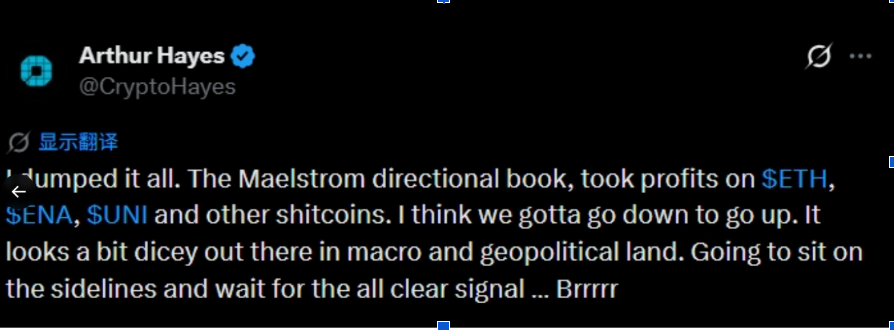
Arthur Hayes, co-founder of crypto exchange BitMEX, has closed the directional book of his fund Maelstrom — the positions that bet on an asset moving in a chosen direction, as distinct from hedged or market-neutral strategies — selling roughly $22.28 million worth of Ethereum and six other tokens amid rising market uncertainty. Hayes confirmed the exit on October 24 and said he would remain on the sidelines conditions improve.
On-chain analytics platform Lookonchain initially tracked $22.28 million in token movements linked to Hayes-associated addresses before raising its estimate to $28.8 million on October 25, a revision that shows how such tallies can shift as more transactions are attributed. Trackers of this kind match publicly recorded blockchain activity to known industry figures, giving observers visibility into large-holder moves.
Ethereum Leads Hayes-Linked Sales at $28.8 Million
Lookonchain identified 6,400 ETH worth approximately $15.2 million among the reported transactions, representing about 68% of the total value. The tracker also recorded 14 million ENA, the token of the Ethena protocol, valued at $2.76 million, and 323,000 UNI, the Uniswap governance token, worth $2.24 million.
Four additional tokens completed the list. According to Lookonchain, Hayes-linked addresses moved 1.89 million ETHFI, the token of Ether.fi, worth $1.23 million, along with 546,609 AERO valued at $398,000, 120,000 PENDLE worth $244,000, and 3 million ZAMA valued at $214,000.
ETH, ENA, and UNI together accounted for roughly $20.2 million of the reported activity, with Lookonchain calculating overall values using prices at the time of tracking.
Some transfers were also linked to trading firms Flowdesk, FalconX, and Wintermute. Transfers to such venues can precede sales, but public wallet records do not show all execution prices, counterparties, or fees for the transactions reported on October 24, 2026.
Hayes Cites Macro and Geopolitical Risk
In an October 24 post on X, Hayes confirmed that he had exited Maelstrom's directional book, naming ETH, ENA, UNI, and other altcoins among the assets he had sold.
“I think we gotta go down to go up,” the BitMEX co-founder wrote.
Hayes pointed to uncertainty in global economic and geopolitical conditions, describing the environment as difficult, and said he plans to wait for an “all clear” signal before returning to directional trading. He did not define what that signal would look like, leaving his public statements and on-chain trackers as the main indicators of when — or whether — the fund redeploys capital into directional positions.
A Reversal From August's Maximum-Risk Stance
The latest sales mark a change from the position Hayes described in August, when he said Maelstrom had taken maximum risk exposure across several cryptocurrencies, including Bitcoin, Ether, Ethena, and Ether.fi. In an August essay, he outlined a bullish view of crypto markets centered on dollar liquidity and United States Treasury operations.
Hayes argued at the time that measures supporting the government bond market could help create favorable conditions for digital assets, while acknowledging that market corrections could occur during a broader advance.
The distance between that stance and October's full exit, covered in a matter of months, underlines how quickly a fund's posture can change when conditions turn. The October announcement did not explain when Maelstrom began reducing those positions, and Hayes did not disclose the fund's remaining portfolio, hedges, or private investments. Neither his statement nor Lookonchain's breakdown identified a Bitcoin sale.
Prior Ethereum Trades Provide Context
Hayes has adjusted his Ethereum exposure during earlier periods of market uncertainty. In June, Lookonchain linked a wallet associated with him to a transfer of 3,000 ETH from Flowdesk valued at approximately $5.42 million. Later that month, the tracker reported that Hayes sold 6,000 ETH for about $10.14 million, and estimated that the sales followed earlier purchases at higher average prices, resulting in an approximate $606,000 loss.
Read together, the June and October episodes show a recurring pattern: Ethereum exposure adjusted through publicly traceable transactions during stretches of macro uncertainty.
This article is for informational purposes only and does not constitute financial advice. Cryptocurrency investments carry substantial volatility and potential financial losses. Readers should conduct independent research before making investment decisions.
Source: The Market Periodical

