Arthur Hayes Predicts Ethereum to Reach $10,000 by End of 2026
Key Takeaways
- •Hayes set a $10,000 year-end 2026 price target for Ethereum, implying a gain of roughly 270% from its price near $2,700.
- •He said Ethereum’s security and large market capitalization support his bullish view, despite attention shifting to other networks such as Solana.
- •Spot Ethereum ETFs have received $13.95 billion in cumulative inflows, while a recent $2.8 million outflow ended a positive daily streak.
- •Ethereum rose almost 70% in the third quarter after declining 29.26% in the first quarter and 25.28% in the second.
- •ETH has remained above $2,500 but struggled to break $2,800 and is still about 46% below its $4,946 all-time high.
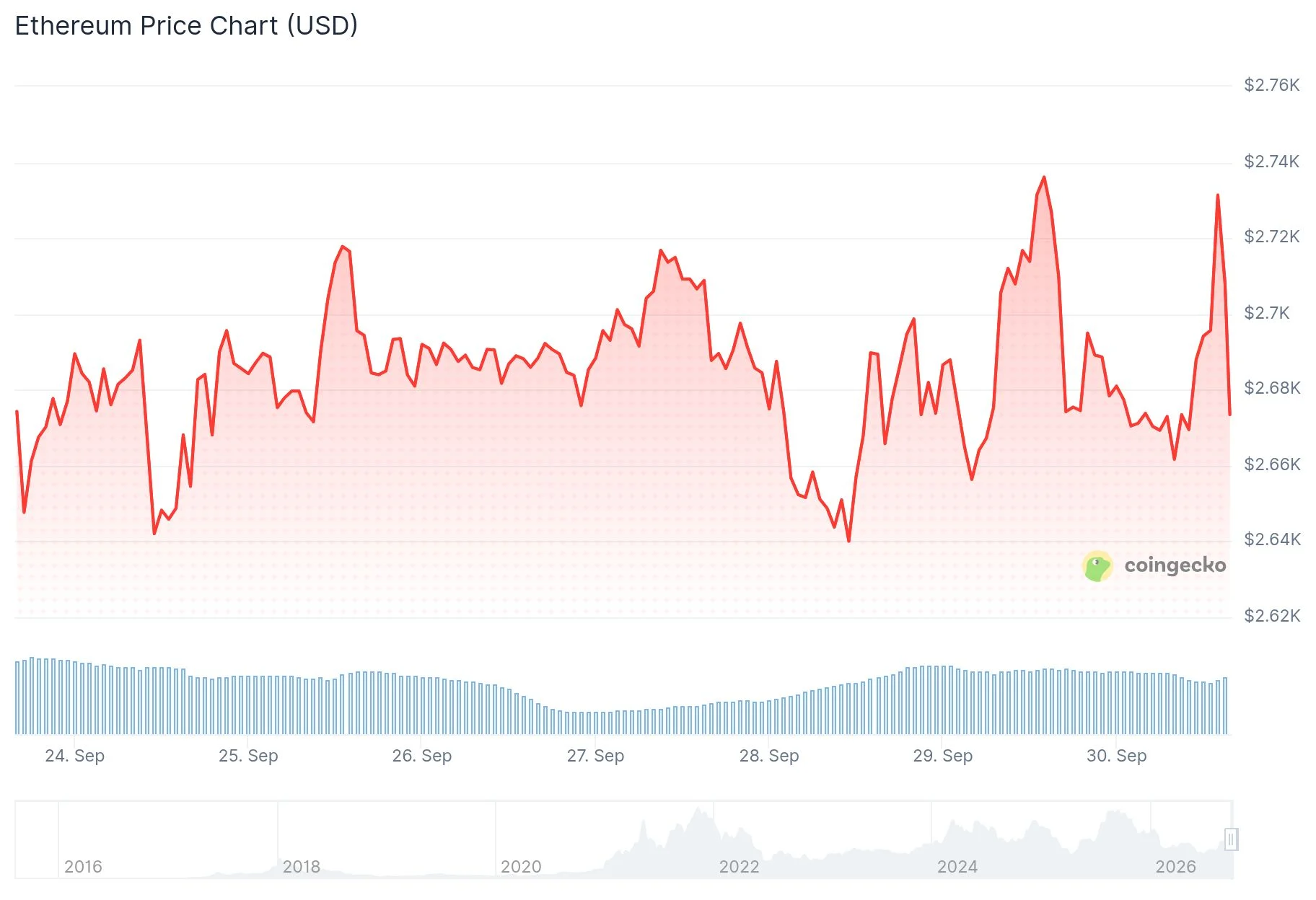
Arthur Hayes, the co-founder and former CEO of BitMEX, has predicted that Ethereum (ETH) will trade at $10,000 by the end of 2026 — a target more than three times the token's current price near $2,700. Reaching that level would represent a gain of roughly 270% from the price at the time of his remarks. Because the call carries a hard deadline, it also works as a public measuring stick: with the remarks delivered at the end of September, roughly three months of trading remain for the market to move toward that level.
Hayes offered the forecast during an on-stage interview at KBW2026 in Seoul, an annual gathering also known as Korea Blockchain Week and one of the industry's major yearly events. Asked for his Ethereum price prediction in a clip posted on X by CoinDesk, he answered directly: "$10,000 by the end of the year."
🚨ARTHUR HAYES JUST CALLED $10,000 ETH BY YEAR-END! BitMEX co-founder @CryptoHayes tells @CoinDesk he sees ethereum:native at $10,000 by the end of the year. He said he can put real size into Ethereum without waking up to a 75% hack, and that it is still the most secure… pic.twitter.com/NvqWCLADgE
— Crypto Banter (@crypto_banter) September 30, 2026
Why Hayes Sees Ethereum as Secure
During the interview, Hayes explained his reasoning. He said he can put large amounts of money into ETH without worrying about a sudden 75% loss from an exploit, framing the network's security as central to his outlook. That consideration carries added weight now that spot ETFs route larger pools of capital into the asset, making the security of the underlying network a first-order question for the funds and their investors.
He also addressed why Ethereum has lagged other networks, saying it comes down to narratives shifting to other chains. Hayes pointed to Solana as an example: the network captured the memecoin narrative and grew quickly while Ethereum slowed down. That rotation pattern — capital and attention migrating to whichever chain owns the prevailing narrative — has been a recurring feature of crypto market cycles.
"Ethereum pioneered this whole decentralized computer thing and then was the victim of its own success," he said. In his account, other blockchains picked up the activity Ethereum lost during that stretch.
Despite that history, Hayes argued that Ethereum remains the most secure layer 1 network. He based this assessment on its market capitalization compared with other altcoins.
Hayes's own ETH trades have not always matched his bullish outlook. In August, he sold 2,365 ETH at about $1,821 each — a loss of $241,000 on a position he had built at an average price of $1,923. In July, he sold 5,900 ETH for close to $10 million, having bought it days earlier for $10.58 million, a loss of more than $600,000. Combined, the two sales amounted to 8,265 ETH. That track record is relevant context for weighing the forecast: it shows the gap that can exist between a prominent figure's stated target and realized results, and it underlines that the $10,000 call is an opinion about the future rather than a settled outcome.
ETF Flows Show a Recent Shift
Spot Ethereum ETFs — funds that hold the token directly and trade on US stock exchanges — recorded positive daily net inflows beginning September 18, attracting more than $850 million across that stretch of sessions, according to daily flow data. The streak ended with a $2.8 million outflow in the most recent 24-hour period, the first daily outflow since the run began. Daily flow figures are watched closely because they offer a running read how much net new money is reaching the asset through regulated investment vehicles.
The prior week alone brought in $689.9 million of net inflows. Cumulative inflows into the funds, which began trading in the United States in July 2024, now stand at $13.95 billion, and September has added $892 million in net inflows, with one trading day left in the month. The upcoming daily prints will show whether the outflow was a one-off or the start of a broader shift — a distinction that will shape the backdrop against which forecasts like Hayes's are judged.
Third Quarter Marked a Turnaround
Ethereum's quarterly performance has been stronger than its recent daily moves suggest. Coinglass data shows ETH gained almost 70% in Q3 2026. That followed a 29.26% drop in Q1 and a 25.28% drop in Q2, making the third quarter a sharp turnaround after two straight losing quarters and its strongest period of 2026 so far.
On the charts, Ethereum has been trading above $2,500 for the past two weeks, but $2,800 has proven a difficult level to clear. The coin is consolidating inside a triangle pattern and remains about 46% below its all-time high of $4,946. That ceiling is the immediate technical marker to watch, and the distance between it and Hayes's $10,000 target illustrates the scale of the move his forecast would require before the year closes.
At the time of writing, ETH was down 1% over 24 hours and nearly 3% over the past week. Over a two-week window, the coin was still up more than 11%, and it stood 9% higher than a month ago. The shorter-term declines stand in contrast to the asset's gains over longer horizons.
Source: CoinCentral

