ARRAY Technologies unveils Atlas foundation systems for solar trackers
Key Takeaways
- •Atlas I is designed for standard soil conditions and connects driven foundations to the tracker through an adjustable rolled steel C-channel and bearing interface.
- •Atlas II is intended for challenging soil conditions and uses helical piles or ground screws with dual-leg support and bearing.
- •ARRAY said Atlas II reduces foundational connection points compared with APA’s A-Frame foundation and offers greater vertical and east-west adjustability.
- •APA Solar CEO Josh Von Deylen said the new system brings the foundation and tracker interface together in a purpose-built solution to help customers install faster and source more efficiently.
Solar tracker manufacturer ARRAY Technologies is launching Atlas, a new suite of foundation-to-tracker solutions designed for ARRAY trackers and APA Solar Racking foundations.
The announcement adds another example of how solar hardware suppliers are increasingly packaging more of the project’s balance-of-system components together, rather than leaving developers to match separate foundation and tracker parts on site. In that context, ARRAY is positioning Atlas as an integrated option for projects that need either standard or more demanding foundation support.
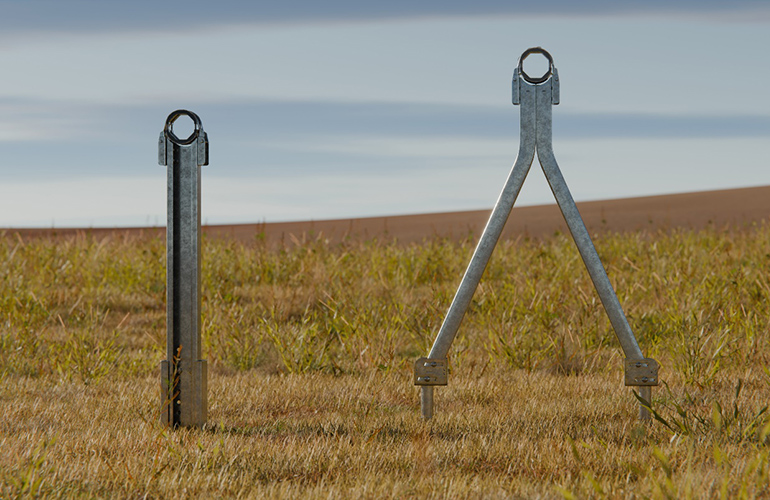
ARRAY Technologies’ Atlas I and II foundations.
Atlas I is designed for standard soil conditions. It connects driven foundations, such as a shortened W-beam or sigma pile, to the tracker through an adjustable rolled steel C-channel and bearing interface. The system can correct minor driving variation in height by adjusting its vertical C-channel. Atlas I also shortens the driven foundation depth and separates the foundation from the tracker interface.
Atlas II is designed for challenging soil conditions. It uses foundations such as helical piles or ground screws with a dual-leg support and bearing. Compared with APA’s A-Frame foundation, this reduces foundational connection points. ARRAY said the design also provides greater vertical and east-west adjustability.
“For decades, developers have relied on commodity steel piles that were never engineered as part of the tracker system,” said Josh Von Deylen, CEO of APA Solar, an ARRAY company. “Atlas changes that by bringing the foundation and tracker interface together in a purpose-built solution that helps customers install faster, source more efficiently and execute projects with greater confidence.”
For project teams, the practical question will be how these systems fit into existing tracker procurement and installation workflows, especially on sites where soil conditions vary across an array. ARRAY is not changing the basic tracker use case here; it is offering a different way to connect the structure to the ground, which is often one of the more site-specific parts of solar construction.
News item from ARRAY Technologies

