ARK's Winton Says Each Starship Launch Could Add $700 Million in Annual Revenue
Key Takeaways
- •ARK Invest's Brett Winton estimated that each Starship launch could generate more than $700 million in incremental annual revenue through the pairing of Starship and Starlink, with the figure expected to grow as SpaceX monetizes AI software.
- •SpaceX shares climbed about 6% to roughly $158.86 on Friday, restoring the company's market capitalization to approximately $2.0 trillion.
- •SpaceX executed three missions in 13 hours, sending a Crew Dragon capsule to the International Space Station, flying its 18ther rideshare mission with 130 payloads, and launching a National Reconnaissance Office satellite on Falcon Heavy.
- •AI agreements with Alphabet and Anthropic bring SpaceX close to $2.2 billion per month in AI services revenue, surpassing what it earns from launching rockets.
- •ARK's open-source valuation model, created with Mach33, estimates SpaceX will be worth about $2.5 trillion by 2030, with bull and bear cases of roughly $3.1 trillion and $1.7 trillion respectively.
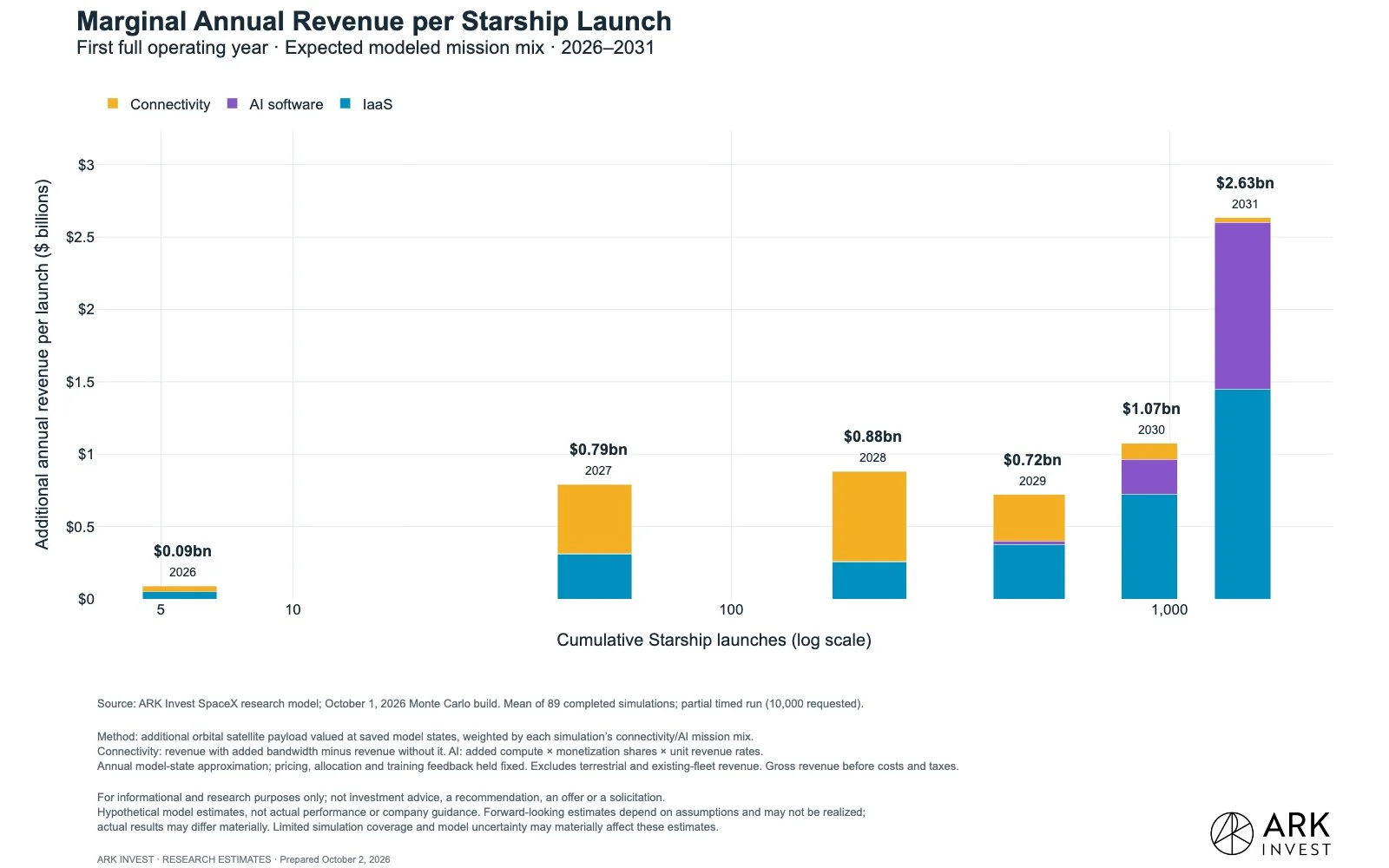
Brett Winton, chief futurist at ARK Invest, argued on Friday that investors are underrating SpaceX's earning power, estimating that every Starship flight could generate more than $700 million in incremental annual revenue.
In a post on X under the handle @wintonARK, Winton wrote that people do not “grok” what the pairing of Starship, SpaceX's heavy-lift rocket, with Starlink, the company's satellite internet constellation, can produce. On ARK's numbers, he said each launch “could drive $700+ million in incremental annual revenue,” adding that he expects the figure to climb as SpaceX begins monetizing AI software through its satellite effort.
SpaceX (NASDAQ: SPCX) shares climbed about 6% to roughly $158.86 by late Friday morning, lifting the company's market capitalization back to approximately $2.0 trillion. The move came the same day Winton published his estimate, and followed a streak of successful launches and expanding AI contracts.
Three missions in 13 hours and a growing AI business
Two factors drove the gain. First, SpaceX executed three missions inside 13 hours: it sent a Crew Dragon capsule to the International Space Station, flew its 18th Transporter rideshare mission — the company's recurring format for carrying payloads from many customers on a single launch — with 130 payloads aboard, and launched a National Reconnaissance Office satellite on a Falcon Heavy before recovering the boosters.
Second, SpaceX's AI-related revenue keeps expanding. Under a June agreement with Alphabet, SpaceX receives $920 million per month across 32 months, or $29.4 billion in total. A separate Anthropic contract adds $1.25 billion per month, allowing the company to pull in close to $2.2 billion a month from AI services — more than it earns from launching rockets.
ARK models $2.5 trillion valuation by 2030
ARK, working with aerospace research firm Mach33, published an open-source valuation model in June 2025, also available on GitHub with its assumptions open to public inspection, estimating that SpaceX will be worth about $2.5 trillion in 2030. The bull case rises to near $3.1 trillion, while the bear case falls to about $1.7 trillion. The base figure represents roughly 38% annual growth from SpaceX's $350 billion December 2024 funding round.
The model runs one million simulations across 17 separate inputs. Its revenue engine is a bandwidth demand model that, on average, sees Starlink capacity leveling off near 130 million gigabits per second — the point beyond which ARK judges extra bandwidth uneconomic. That engine is the same Starship-and-Starlink pairing behind Winton's per-launch figure, and the pace at which Starlink capacity approaches that ceiling is the data point to watch as his estimate and ARK's 2030 range are put to the test.
ARK keeps buying after the IPO
SpaceX listed on Nasdaq in June at $150 a share, an IPO valuation of roughly $1.77 trillion, and the stock subsequently declined. ARK bought about $32.5 million of stock on top of a $444.3 million purchase on the first trading day.
ARK Chief Executive Cathie Wood said in a July interview that SpaceX “could become the most important company in global history,” even as the stock sat well below its $225.64 intraday peak and faced a $116 billion share unlock — a scheduled release of insider-held shares into public trading.
Notably, on September 24, ARK put the tokenized version of its ARK Venture Fund on Ethereum through Securitize, a platform for tokenizing real-world assets, allowing eligible U.S. investors to subscribe with USDC, a dollar-pegged stablecoin. SpaceX is the fund's top position at 7.54%.

