Arc vs Ethereum vs Solana: Which Blockchain Is Best for USDC Finance?
Key Takeaways
- •edgeX is scheduled to launch on the Arc mainnet on September 16, 2026, offering on-chain FX perpetuals starting with JPY and more than 150 perpetual markets, all margined and settled in native USDC.
- •Circle Ventures is an investor in edgeX, and the two companies have previously collaborated on native USDC issuance and CCTP integration for EDGE Chain.
- •Arc is designed as a stablecoin-native Layer 1 with gas paid in USDC, an EVM-compatible environment, and claimed deterministic finality within one second, though its mainnet production performance remains unverified.
- •Ethereum remains the strongest chain for USDC liquidity and DeFi composability, while Solana offers low-fee, high-throughput execution suited to payments and high-frequency trading.
- •Future plans include additional FX pairs, FX spot markets starting with USDC against non-USD stablecoins, and support for non-USD stablecoins as margin.
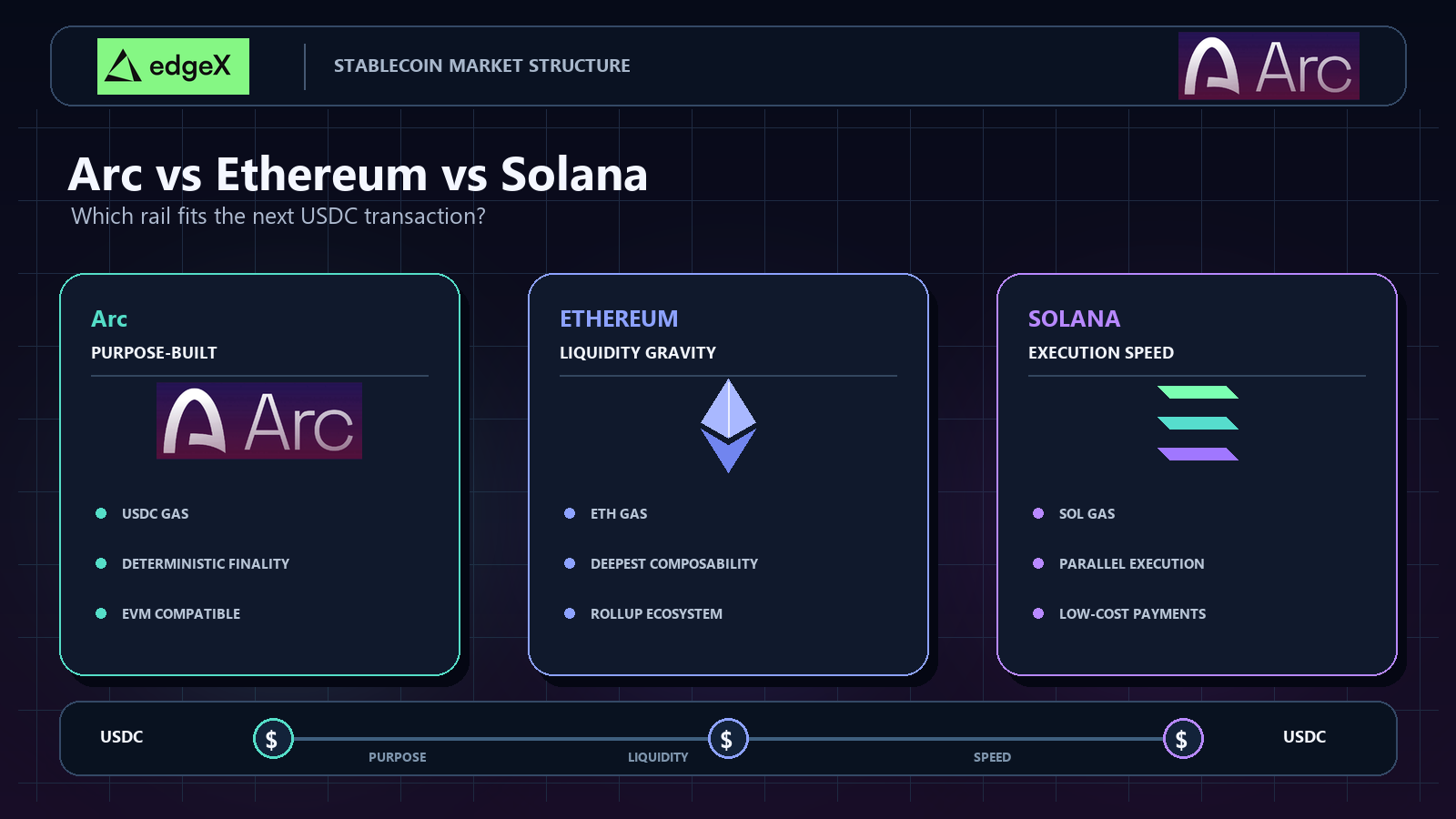
Choosing a blockchain for USDC is not a race between three headline speeds—it is a routing decision. Treasury transfers, collateral positions, consumer payments, and high-frequency trading each impose different requirements on liquidity, fees, finality, tooling, and operational control.
Arc, Ethereum, and Solana each optimize a different part of this decision. Information is as of September 3, 2026. Arc's public mainnet is scheduled to launch on September 16, 2026, so its production performance and availability remain to be verified.
Quick Conclusion
Arc, Ethereum, and Solana serve different USDC use cases. Arc is being designed as a stablecoin-native Layer 1 with fees denominated in USDC and deep integration with Circle infrastructure. Ethereum remains the most significant chain for liquidity, DeFi composability, and institutional settlement confidence. Solana offers low-fee, high-throughput execution that appeals to payments, trading, and consumer applications.
Accordingly, the answer is not that Arc simply "beats" Ethereum or Solana. If adoption follows, Arc may fit regulated, USDC-centric financial products better. Ethereum remains stronger in deep liquidity and mature DeFi. Solana remains attractive for high-frequency, low-cost activity. The market will most likely divide by function rather than crown one universal USDC chain.
Compare the Task Before Comparing Chains
USDC can serve as a payment currency, trading collateral, treasury cash, cross-chain liquidity, or the settlement leg of tokenized assets. "Best chain" means little until the workload is defined.
Start with five questions. How much liquidity is needed at execution? Which fee assets can users or businesses hold? How quickly must results become irreversible to the application? Which contracts and custodians must be connected? What happens when a transaction, bridge, or interface fails?
Circle describes USDC as redeemable 1:1 for US dollars and backed by highly liquid cash and cash-equivalent assets. This issuer-level property travels with USDC wherever it is supported. The network-level experience does not: costs, execution, liquidity, and recovery paths vary by chain.
| Workload | Primary priority | Secondary question |
|---|---|---|
| Treasury settlement | Control and reliable finality | Can counterparties access the same venue? |
| DeFi collateral | Market depth and composability | What are the contract and liquidation risks? |
| Consumer payments | Low cost and simple confirmation | Can fees be hidden from users? |
| Trading | Execution, depth, and latency | How fast can collateral move? |
| Regulated products | Custody, reporting, and compliance fit | Are integrations live in the target jurisdiction? |
Arc Is Optimized for a Dollarized Operating Model
Arc's case begins with specialization. Its official materials describe it as a stablecoin-native Layer 1 with fees denominated in USDC and deterministic finality. For an application whose balances, fees, collateral, and settlements are already dollar-based, this design can remove the extra task of acquiring and accounting for a volatile gas token.
A purpose-built design is not the same as production-proven
Arc combines an EVM-compatible execution environment with a consensus mechanism designed for fast finality. The system overview describes the Malachite consensus layer and a Reth-based execution layer. Familiarity with the EVM can reduce migration work for Solidity teams, but Arc-specific differences, fee behavior, infrastructure, and contracts still need testing.
Its strategic advantage is alignment. Circle services, native USDC, transfer infrastructure, and financial applications may compose more directly than on a general-purpose chain. Its limitation is history. After mainnet launch, Arc must demonstrate stable operations, independent infrastructure, meaningful validator participation, available liquidity, and sustained applications.
Arc fits best when the fee currency and workflow design matter
Payments companies or treasury teams may prefer to forecast all routine network costs in USDC. Financial applications may value fast, deterministic settlement more than access to every existing crypto protocol. These are legitimate reasons to evaluate Arc.
But these reasons do not justify automatic migration. A clean architecture cannot substitute for counterparties, custodians, exchange access, market depth, or recovery procedures. Arc is the strongest candidate when a USDC-centric operating model delivers measurable savings and the required production integrations are live.
Ethereum Is Optimized for Liquidity and Composability
Ethereum's strength is accumulated economic gravity. It has a long production history, mature development and audit tooling, institutional custody support, and broad markets in which USDC can be traded, lent, borrowed, used as collateral, or paired with tokenized assets.
Deep integration can outweigh higher friction
The Ethereum developer documentation presents it as a general-purpose proof-of-stake platform. That generality is useful when a workflow depends on multiple protocols in a single transaction path. Liquidity is not just on-chain balances—it is the ability to execute, hedge, finance, and exit at scale through interconnected venues.
Gas on the Ethereum mainnet is paid in ETH. Its gas documentation explains how base fees and priority fees price computation and block space. For dollar-denominated products, ETH inventory adds treasury and onboarding work. Variable costs also make small transfers less economical when block space is expensive.
Layer 2 networks reduce fees and expand capacity, but the name "Ethereum" then covers multiple execution and settlement paths. Teams must choose a rollup, manage its gas and bridge model, define application finality, and understand withdrawal or sequencing assumptions. That complexity may be worth it, because Ethereum remains the deepest source of composability and settlement credibility.
So Ethereum is the default when existing liquidity, contract relationships, custody, or institutional familiarity outweigh the benefits of a simpler fee model.
Solana Is Optimized for High-Frequency, Low-Cost Execution
Solana's advantages stand out most when an application must execute many small or time-sensitive operations. Payments, order placement, consumer wallets, and interactive products all benefit when transaction costs are negligible.
High performance comes with a different application model
The Solana documentation describes a high-performance network whose programs run on an account model rather than the EVM. Transactions declare the accounts they read and write, allowing non-conflicting work to execute in parallel. Teams migrating from Ethereum need different tooling, security reviews, and operational expertise.
Fees are paid in SOL. Solana's fee reference describes a base fee per signature plus optional priority fees. Costs are generally low, but USDC products still need a way to supply SOL or abstract it away from users.
Solana already has production experience in payments- and trading-style applications. Its trade-off is not simply "speed versus security." Builders must assess validator and infrastructure requirements, application-specific reliability, confirmation settings, custody, and liquidity at the specific venues they plan to use.
Solana is the right fit when high transaction frequency and low per-unit cost determine product viability and the team can support its non-EVM stack.
Settlement and Fees Shape the User Experience
The three networks differ in what users must hold, when the application treats results as final, and where liquidity lives. These differences affect support costs and balance-sheet operations as much as transaction speed.
| Decision factor | Arc | Ethereum | Solana |
|---|---|---|---|
| Network fee asset | USDC, per Arc materials | ETH | SOL |
| Primary design focus | Stablecoin-native financial workflows | General settlement and composability | High-frequency, low-cost execution |
| Contract environment | EVM-compatible, with Arc differences | EVM plus a broader rollup ecosystem | Solana programs and account model |
| Production maturity | New mainnet, performance unverified | Longest and deepest history of the three | Mature high-performance ecosystem |
| Key liquidity question | Will USDC depth and applications persist? | Which mainnet or Layer 2 venue has the required depth? | Do target applications support the required scale? |
| Main operational burden | New network integration and monitoring | ETH gas plus Layer 2 fragmentation | SOL inventory plus non-EVM expertise |
Finality must be defined per workload
Arc claims deterministic finality within one second, a useful property for workflows that need a clear settlement event. Investors and builders still need production evidence under load, plus clear statements on validator resilience.
Ethereum's proof-of-stake finality provides strong settlement guarantees, while applications often act on earlier confirmations. Layer 2 activity can add sequencer, batch, bridge, and withdrawal stages. Solana applications choose confirmation or commitment levels based on their own risk tolerance.
No single latency number captures these paths. Products should state explicitly which event credits the user, when funds become available, and what recovery mechanism applies if later stages stall.
Adopt a Workload-Based Routing Decision
A company can choose more than one venue. It can keep collateral where Ethereum's liquidity is deepest, use Solana for high-frequency customer operations, and settle selected USDC-native workflows on Arc. Circle's Cross-Chain Transfer Protocol can support moving native USDC between integrated networks, but cross-chain routing still introduces fees, timing, liquidity, and operational dependencies.
Match the network to the constraint
Choose Ethereum when the constraint is liquidity, composability, custody coverage, or an established settlement history. Choose Solana when transaction frequency and unit economics determine whether the product works. Evaluate Arc when dollar-denominated fees, Circle-connected infrastructure, and stablecoin-specific settlement would materially simplify a workflow.
| Use case | Likely starting venue | Reasons to reconsider |
|---|---|---|
| Large DeFi positions | Ethereum | Comparable depth emerges elsewhere with lower operational friction |
| Consumer payment flows | Solana | Arc offers simpler USDC distribution and application integration |
| USDC-native treasury workflows | Arc, once verified | Required counterparties or custody remain elsewhere |
| Tokenized asset settlement | Ethereum or Arc | Policy, custody, and liquidity decide the final route |
| Multi-venue trading | More than one chain | Routing costs and collateral fragmentation become excessive |
Architecture should follow measurable constraints, not branding. Estimate total operating costs, including gas inventory, engineering, audits, bridges, liquidity, reconciliation, monitoring, and support. Then test full deposit, trading, and withdrawal paths before committing to production scale.
Pilot with explicit migration thresholds
A pilot should answer a decision question, not merely prove that transactions execute. Before testing, define required uptime, confirmation times, all-in costs, available liquidity, failed-transaction rates, reconciliation workload, and support responsiveness. Run representative transactions during normal and stressed periods, including deposits and withdrawals.
Set thresholds for scaling volume in advance. A new venue should improve things enough to justify integration and concentrated risk; a familiar venue should not remain the default just because migration is inconvenient. Keep fallback paths until custody, liquidity, monitoring, and incident procedures work at expected scale. This turns chain selection into an auditable, revisable operating decision.
What Could Change the Rankings
Arc can improve its standing by converting launch partners into sustained usage. Watch mainnet reliability, validator operations, wallet and custody support, exchange access, USDC depth, and applications that retain users after incentives fade. Circle's validator announcement signals preparation, not a completed network effect.
Ethereum's ranking changes if Layer 2 fragmentation becomes more manageable or if mainnet versus rollup costs shift. Solana's ranking moves with reliability, institutional integrations, developer adoption, and payment distribution. Regulation can change all three by shaping issuance, redemption, custody, sanctions controls, and permitted stablecoin products.
Investors should compare like with like: recurring settlement rather than raw transaction count, durable liquidity rather than temporary deposits, live integrations rather than logo lists. The likely outcome is coexistence, but coexistence does not mean equal economics. Each network must capture enough valuable flow to sustain its infrastructure and applications.
Investor Summary
Arc, Ethereum, and Solana are optimized for different USDC workloads. Arc offers the cleanest dollarized operating model but carries launch and adoption risk. Ethereum remains the strongest venue for liquidity and composability, with higher fees and Layer 2 complexity. Solana offers attractive unit economics for high-frequency execution but requires a different development stack and SOL fee management.
The decision is use-case specific. Identify constraints, price the full operational path, verify production integrations, and re-evaluate as liquidity and reliability change.
Final Verdict
There is no universal USDC winner. Ethereum is the incumbent for capital and interconnected markets. Solana is the proven low-cost execution venue. Arc is a specialized bet that stablecoin finance benefits from USDC-denominated fees and dedicated settlement. The best network is the one that solves the actual workload without introducing larger hidden dependencies.
edgeX Joins Arc as a First-Wave Partner
Markets have always followed money. Today, money is moving on-chain.
edgeX is scheduled to launch on the Arc mainnet on September 16, 2026, bringing new FX perpetual contracts built on Arc's native FX engine, plus more than 150 markets covering equities, commodities, and cryptocurrencies. All markets will be margined and settled in native USDC.
This launch builds on edgeX's long-standing relationship with Circle. Circle Ventures is an investor in edgeX, and the two teams have collaborated on native USDC issuance and CCTP integration for EDGE Chain. Arc is a natural next step for edgeX's global around-the-clock markets to run on a USDC-native settlement layer.
Day-One Lineup
- On-chain FX perpetuals, starting with JPY, built on Arc's native FX engine.
- More than 150 perpetual markets covering US equities, commodities, and cryptocurrencies, all margined and settled in native USDC.
What edgeX Is Exploring Next
- Additional FX pairs, ordered by liquidity and demand.
- FX spot markets, starting with USDC against non-USD stablecoins.
- Non-USD stablecoins as margin, letting traders hold, hedge, and trade without converting back to dollars.
Arc is designed as an around-the-clock economic operating system for internet-native money, with gas paid in USDC, institutional-grade settlement, and a native FX engine. edgeX adds the market layer: an order-book exchange extending its 24/7 equities, commodities, and crypto markets to FX at scale.
Every trade on edgeX supports USDC's broader role as the settlement currency of internet-native finance, while giving USDC holders direct access to global markets.
FAQ
Is Arc better than Ethereum?
Arc may fit USDC-native financial applications better because it is being designed around stablecoin utility and USDC-denominated fees. Ethereum remains stronger today in liquidity, DeFi composability, developer depth, and settlement history.
How does Arc compare with Solana?
Arc is more focused on stablecoin finance. Solana is more proven as a fast, low-cost execution network. Solana may be better suited to high-frequency consumer activity today, while Arc could attract USDC-centric financial products if adoption develops.
Is Arc a USDC chain?
Arc is described by its official website as a stablecoin-native Layer 1 in which USDC plays a central role in fees and financial design. It is more accurate to call it a USDC-centric stablecoin finance chain than to imply it supports only USDC.
Which blockchain is best for USDC payments?
Today, Solana has a strong case for low-cost consumer payments. Arc may become attractive for USDC-native payment and settlement flows after launch. Ethereum remains important for large-value liquidity and institutional settlement, though base-layer fees may be less convenient for small payments.
If Arc is built for stablecoins, does Ethereum still matter?
Yes. Ethereum's liquidity, DeFi infrastructure, institutional familiarity, and developer ecosystem remain hard to replace. Arc's stablecoin focus may create a new dedicated venue, but it does not make Ethereum irrelevant.
Could Solana be a better USDC chain than Arc?
For some use cases, yes. If low fees, speed, and consumer-scale volume are the priority, Solana may remain the better choice. If stablecoin-native financial infrastructure closely tied to the Circle ecosystem is the priority, Arc may become more significant.
What should investors watch before judging Arc?
Watch mainnet execution, validator participation, security history, application launches, exchange support, wallet integrations, USDC liquidity depth, and whether real flows emerge after launch. Arc should be judged by usage, not just design.
