Arc Mainnet, the ARC Token, and the Airdrop: What Investors Should Watch
Key Takeaways
- •Arc's public mainnet, Circle's stablecoin-focused Layer-1 blockchain, is scheduled to go live on September 16, 2026.
- •Neither Arc nor Circle has officially confirmed an ARC token, airdrop, snapshot, or claim process, so all such claims remain unverified.
- •edgeX joins Arc as a day-one partner, launching FX perpetuals starting with JPY and over 150 perpetual markets margined and settled in native USDC.
- •Arc's fee and settlement model centers on USDC rather than a native gas token, making conventional Layer-1 token assumptions risky.
- •Investors should judge Arc by post-launch evidence including operational reliability, sustained USDC liquidity, returning applications, and institutional workflows.
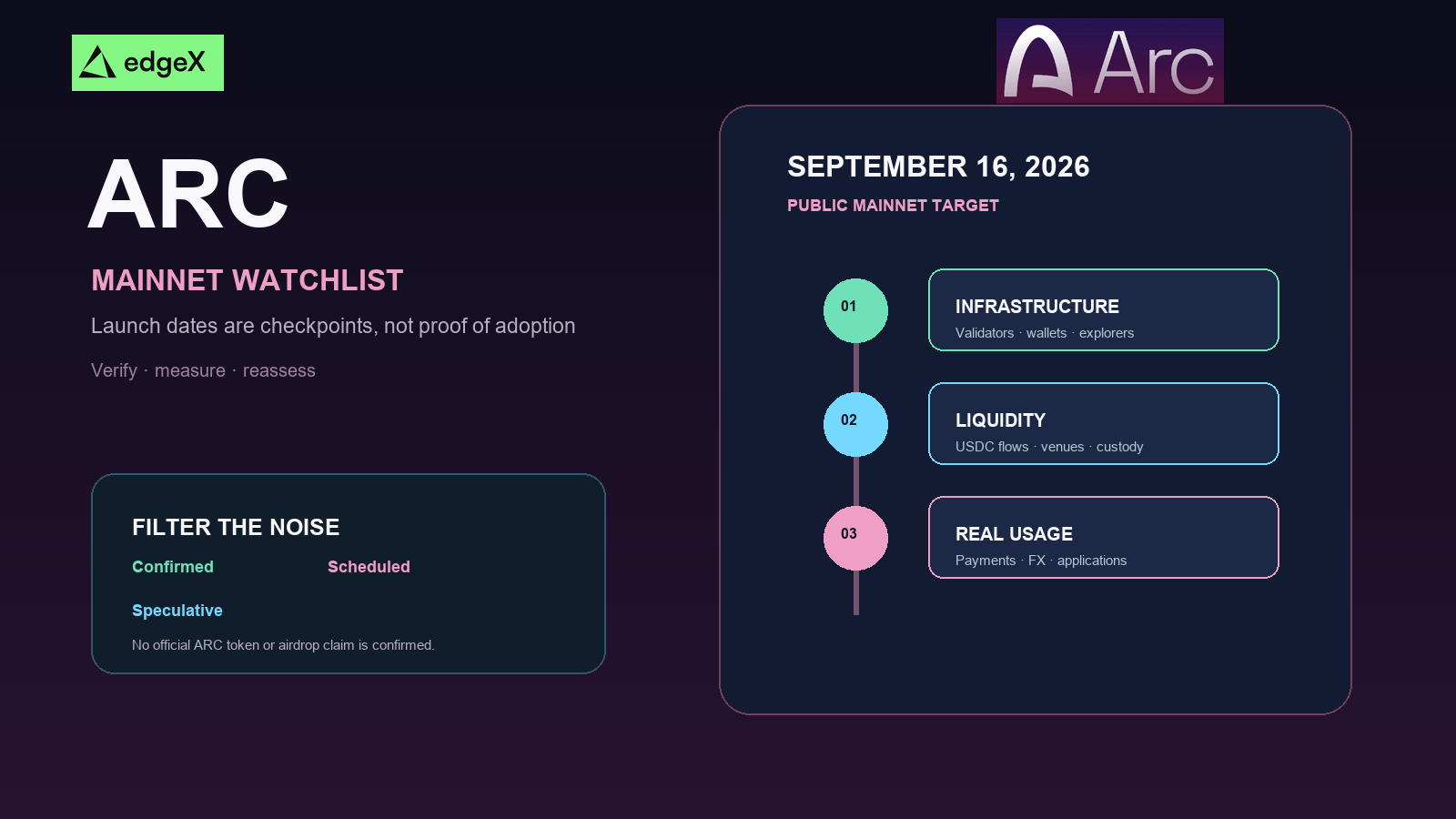
Arc's public mainnet is scheduled to go live on September 16, 2026. This date matters, but it is not an investment conclusion. A network can launch on time and still need months to build reliable infrastructure, durable liquidity, and returning users.
A useful distinction lies between measurable mainnet evidence and speculation around an ARC token or airdrop. Information is current as of September 3, 2026; investors should confirm launch status and product availability through official Arc and Circle channels.
Quick answer
The Arc mainnet is scheduled to launch on September 16, 2026. The investment question is what happens after launch: whether Arc can attract real applications, liquidity, and institutional settlement. Neither Arc nor Circle has officially confirmed an ARC token or airdrop, so eligibility and claim announcements remain unverified until either organization publishes formal terms.
The mainnet is a starting point, not a conclusion
The first test is operational. Arc needs more than block production: users must be able to connect wallets, move USDC, view transactions, use applications, and exit without relying on temporary workarounds. Circle's public testnet announcement established a rehearsal environment, while the official mainnet announcement set the planned production date.
Readiness shows up at the edges
The infrastructure around the chain will show whether launch preparation is real. Investors should look for stable RPC access, a usable block explorer, up-to-date developer documentation, supported wallets, custody options, USDC transfer paths, incident communication, and applications that clearly distinguish testnet from mainnet. A chain that produces blocks but leaves users confused about deposits or transaction status is not fully usable.
Circle's announced founding validator cohort and various integrations are positive signals, because they show institutions and infrastructure providers preparing for the network. But they are evidence of readiness, not evidence of sustained demand. This distinction matters especially during high-profile launches, when announcements can be mistaken for adoption.
The first month matters more than the first hour
Launch-day traffic can be distorted by curiosity, incentives, and speculation. A better test is whether activity repeats. Are the same applications still processing transactions after the first news cycle? Do wallets and bridges remain reliable under load? Are incidents explained quickly? Is liquidity deepening, or does it appear briefly and then leave?
A phased rollout is not automatically negative. Financial infrastructure often opens with restrictions while operators monitor performance. What matters is disclosure: Arc should clearly state which features are live, which are limited, and which are still planned.
| Mainnet checkpoint | Readiness evidence | Warning signs |
|---|---|---|
| Network operations | Stable finality, accessible RPC, reliable block explorer | Repeated outages or inconsistent transaction status |
| Asset access | Documented USDC paths, wallets, custody, withdrawals | Unsupported paths or confusing asset representations |
| Applications | Products aimed at real users with clear terms | Announcements with no usable production interface |
| Liquidity | Two-sided market depth and repeated settlement activity | Fleeting incentivized deposits with little follow-through |
| Communication | Timely status updates and incident explanations | Vague scope, silent delays, or outdated documentation |
Token and airdrop claims require separate evidence
Arc's network launch does not confirm the existence of an ARC token. Neither Arc nor Circle has published official details on token supply, sales, code, allocation, snapshots, eligibility plans, or a claim portal. The name “ARC Chain” has also appeared online, but a familiar name does not prove the existence of a tradable asset.
Why the usual Layer-1 assumptions do not apply here
Many blockchains use a native token to pay for gas, staking, governance, and validator incentives, so users often expect every new Layer 1 to follow that pattern. Arc's disclosed fee model centers on USDC. This makes it especially risky to infer a conventional gas token from the precedents of other chains.
If Arc later introduces token-related mechanics, investors will need official answers on utility, validator economics, governance, distribution, regulatory treatment, and how it relates to USDC-denominated fees. Until then, any token price, presale, exchange listing, or rewards campaign attributed to Arc should be treated as unverified.
Airdrop curiosity creates security problems
Testnets and new ecosystems attract users hoping their activity will count toward future rewards. That expectation can produce useful testing, but it also creates ideal conditions for impersonation scams. Fake eligibility-check tools exploit urgency, code obfuscation, copied branding, and requests for broad wallet approvals.
A legitimate campaign requires verified announcements, written terms, eligibility rules, jurisdictional restrictions, and an official claim path. Arc and Circle have not confirmed any such airdrop. Users should never enter a seed phrase, sign unexplained messages, or approve token spending just to “check eligibility.”
Verify announcements before acting
When a token claim appears, use a simple process. Start from Arc's or Circle's official domains rather than following the post promoting the opportunity. Confirm that official pages link to the same contracts, applications, and social accounts. Then compare networks, contract addresses, dates, eligibility terms, and requested wallet permissions across those pages.
Evidence should form a complete chain. A verified social post without published terms is not enough; a professional-looking website without links from official channels is not enough either. Search results, sponsored ads, screenshots, and forwarded messages can all preserve false information after the original account disappears. If any identifiers conflict, stop rather than attempting a small test transaction.
| Claim encountered online | Current status | Evidence needed |
|---|---|---|
| ARC is Arc's official token | Unverified | Direct token documentation from Arc or Circle |
| Testnet usage guarantees eligibility | Unverified | Published eligibility rules from official channels |
| A snapshot has occurred | Unverified | Dated official announcements and terms |
| A claim portal is open | High risk unless verified | Links from Arc or Circle's official channels |
| An unrelated ARC ticker represents this network | Do not assume | Contract address and issuer confirmation |
Adoption must be measured by quality
The strongest post-launch evidence will come from behavior that requires Arc's design, not activity that could happen on any new chain. Payments, treasury transfers, FX settlement, tokenized assets, and markets using USDC as margin are more informative than raw transaction counts without economic context.
Watch liquidity, not just addresses
Active wallet figures can be inflated by automated activity or one-off marketing campaigns. Investors should read user counts alongside USDC balances, transfer volume, application retention, bridge direction, market depth, and repeat counterparties. A small group of enterprises settling real payments may say more than a large group of users completing identical tasks.
Liquidity also has to be usable. USDC entering Arc only matters if users can deploy, trade, and withdraw through supported paths. Watch spreads, depth, transfer failure rates, custody support, and whether market makers stay after launch incentives normalize.
Competition sets the bar
Arc is not entering an empty market. Ethereum offers deep liquidity and institutional familiarity. Layer 2 networks offer lower-cost EVM environments. Solana supports fast, cheap stablecoin activity, while exchange-affiliated networks bring built-in distribution and fiat on-ramps.
Arc's differentiation is consistency: USDC-denominated fees, Circle's infrastructure, and a stablecoin-first design. Its burden is proving that the frictions these features solve are significant enough for users to undertake yet another integration. If existing networks keep improving stablecoin usability, Arc must win on production results rather than positioning.
| Adoption signal | Strong reading | Weak reading |
|---|---|---|
| USDC supply on Arc | New payments, market, or treasury demand | Liquidity temporarily shifted from another chain |
| Developer activity | Products leveraging Arc's distinctive settlement advantages | Copycat applications launched for incentives |
| Institutional integrations | Live workflows with repeat transactions | Technical support announced but unused |
| Trading activity | Durable depth and balanced participation | Fleeting volume around launch publicity |
| Cross-chain flows | Reliable two-way flows supporting real usage | Deposits can arrive, but withdrawals or applications remain limited |
Circle's strategic upside is limited
Arc could deepen Circle's relationships with developers and institutions by extending USDC from an issuance asset into a broader settlement environment. Applications designed around USDC fees and settlement could bring stronger integrations and higher switching costs.
But that does not mean Arc will automatically become a revenue engine. Its economic contribution will depend on network usage, fee design, services, partnerships, and whether it expands USDC's overall utility or merely shifts existing activity from another chain. Investors should distinguish strategic control from incremental commercial value.
Regulation is part of the same calculation. Circle's compliance posture may help enterprises that require identifiable controls, but stablecoin rules covering reserves, redemption, custody, sanctions, and payments could narrow product design or geographic access. Arc's institutional appeal and its regulatory constraints may grow simultaneously. Investors can follow company disclosures via the SEC EDGAR database and compare policy developments with BIS research on digital currencies and tokenization.
Keep a layered risk map
Arc brings together several categories of risk that should be assessed separately. Technical risk covers consensus, finality, wallets, bridges, smart contracts, and operational incidents. Adoption risk asks whether users and developers will choose Arc over established alternatives. Liquidity risk concerns the depth and availability of USDC. Governance risk involves validator concentration and control. Regulatory risk depends on the network's role in payments and financial markets.
These risks can compound. A bridge incident can impair liquidity; weak liquidity can deter applications; limited applications can make speculative activity look larger than it is. Conversely, a technically clean launch is valuable, but it is not a substitute for demand.
| Risk | Investor question | Evidence to monitor |
|---|---|---|
| Technical | Does Arc remain reliable under production load? | Uptime, finality, audits, incidents, developer reports |
| Adoption | Do users return for real financial workflows? | Retention, payments, active applications, partner usage |
| Liquidity | Can USDC be moved and traded efficiently? | Depth, spreads, transfer paths, exchange support |
| Governance | Is network control clear and resilient? | Validator set, operating rules, governance disclosures |
| Regulatory | Can the product operate in target jurisdictions? | Stablecoin, payments, custody, and sanctions rules |
| Speculative | Do expectations exceed disclosures? | Fake tokens, claim sites, rumor-driven activity |
A post-launch scorecard
Investors should assess Arc in stages. On launch day, confirm scope: mainnet status, validators, wallets, block explorer, USDC paths, applications, and any restrictions. In the first month, watch reliability, returning users, liquidity, and incident handling. In subsequent quarters, ask whether Arc is creating new settlement demand.
Official announcements from Arc and Circle remain the most reliable evidence on token or airdrop questions. Product claims should match live interfaces and documentation, and partner engagement should be judged by actual deployments. The investment thesis should change as the evidence does.
Use scenario analysis rather than a single forecast
An optimistic scenario would combine stable operations, growing two-way liquidity, repeated institutional workflows, and applications that attract activity without permanent subsidies. A neutral scenario would show technically reliable infrastructure but slow migration because existing networks remain good enough. A pessimistic scenario would feature thin liquidity combined with integration delays, recurring incidents, or dominance by speculative activity.
These scenarios should not be labeled permanent on launch day. Investors can revise their views on a fixed cadence using the same metrics. This approach makes disappointment and improvement equally visible and reduces the temptation to reinterpret every data point to fit an initial opinion.
edgeX joins Arc as a day-one partner
Markets follow money. Today, money is moving on-chain.
edgeX is set to launch on the Arc mainnet on September 16, 2026, bringing brand-new FX perpetuals to Arc's native foreign exchange engine, along with 150+ markets spanning equities, commodities, and crypto. All markets will be margined and settled in native USDC.
This launch builds on edgeX's long-standing partnership with Circle. Circle Ventures is an investor in edgeX, and the teams have worked together on native USDC issuance and the CCTP integration for EDGE Chain. Arc is a natural next step for edgeX's global, around-the-clock markets running on a USDC-native settlement layer.
What launches on day one
- On-chain FX perpetuals, starting with JPY, built on Arc's native foreign exchange engine.
- 150+ perpetual markets covering US equities, commodities, and crypto, all margined and settled in native USDC.
What edgeX is exploring
- Additional currency pairs prioritized by liquidity and demand.
- FX spot markets, starting with USDC against non-USD stablecoins.
- Non-USD stablecoins as margin, letting traders hold, hedge, and trade without converting back to dollars.
Arc is designed as a 24/7 economic operating system for internet-native money, with gas paid in USDC, institutional-grade settlement, and a native foreign exchange engine. edgeX adds the market layer: an order-book exchange extending its 24/7 equities, commodities, and crypto markets at scale into foreign exchange.
Every trade on edgeX supports USDC's broader role as the settlement currency of internet-native finance, while giving USDC holders direct access to global markets.
Frequently asked questions
What is the Arc network?
Arc is Circle's stablecoin-focused Layer-1 blockchain. Its announced use cases include payments, capital markets, foreign exchange, and other applications that move real-world value on-chain.
Who is behind Arc?
Circle initiated the Arc project and ties it closely to USDC and Circle infrastructure. Arc is the network's official name, even though it is often informally called Circle's blockchain.
What role does USDC play on Arc?
USDC is central to Arc's settlement model and is used to denominate network fees. The design aims to let users and businesses bear costs in dollar terms without needing another volatile asset for gas.
What does Arc's foreign exchange engine do?
Official materials position the FX engine for currency and stablecoin markets. Features available at mainnet launch should be distinguished from those still planned, experimental, or partner-specific.
When is the Arc mainnet scheduled to launch?
The announced date is September 16, 2026. Because launch scope may change, verify the live network, supported products, and any access restrictions on or after that date through Arc and Circle.
Has Circle announced an official ARC token?
No. Neither Arc nor Circle has published official documentation for an ARC token. A ticker, price page, presale, or exchange listing alone is not sufficient evidence.
Is an Arc airdrop confirmed?
Arc and Circle have not announced any official plans, snapshots, eligibility criteria, or claim processes. Avoid websites that request seed phrases, unexplained signatures, or broad token approvals.
Does “ARC Chain” refer to the same project?
People may use that phrase when searching for Arc, but similar names may also belong to unrelated projects and assets. Verify official domains and any contract addresses rather than relying on names or tickers.
Is Arc meant to move USDC away from Ethereum or Solana?
No. USDC operates across multiple ecosystems. Arc offers an environment tailored to specific stablecoin, payments, FX, and institutional workflows.
What evidence would make Arc significant to investors?
The clearest evidence would be reliable production operations, sustained USDC liquidity, applications that keep returning, institutional workflows, transparent governance, and activity that expands rather than temporarily shifts USDC utility.
Investor summary
Arc is a significant infrastructure test for Circle, but it is not yet proven as a growth engine or token opportunity. The planned launch offers measurable checkpoints: operational reliability, usable USDC paths, repeatedly used applications, liquidity, security, governance, and regulatory clarity. Investors should model these milestones rather than converting the mainnet date directly into adoption assumptions.
Final points
September 16 is the start of Arc's evidence cycle. Judge the network by what remains usable after launch hype fades, and treat every ARC token or airdrop claim as unverified until Arc or Circle publishes verifiable terms.

