Arc Mainnet Goes Live With 190+ Partners as BlackRock, Visa Back New Network
Key Takeaways
- •Arc, a layer-1 blockchain built by Circle, launched its mainnet on September 16, 2026, with more than 190 ecosystem partners spanning finance, payments, DeFi, and artificial intelligence.
- •The EVM-compatible network uses the USDC stablecoin as its native gas asset and delivers sub-second transaction finality, targeting payments and broader financial use cases.
- •Founding validators include major institutions such as BlackRock, Visa, Mastercard, DTCC, Standard Chartered, and Worldpay, making these firms direct operators of the network rather than just application builders.
- •Tokenized assets including BlackRock's BUIDL fund, Circle's USYC, and Janus Henderson offerings are live at launch, along with StableFX, a 24/7 onchain foreign exchange settlement platform supporting USD, EUR, JPY, BRN, and MXN.
- •Arc integrates Circle Agent Stack, agent wallets, and programmable payment tools to support AI-driven machine-to-machine transactions, while major exchanges like Binance, Kraken, and OKX provide access from day one.
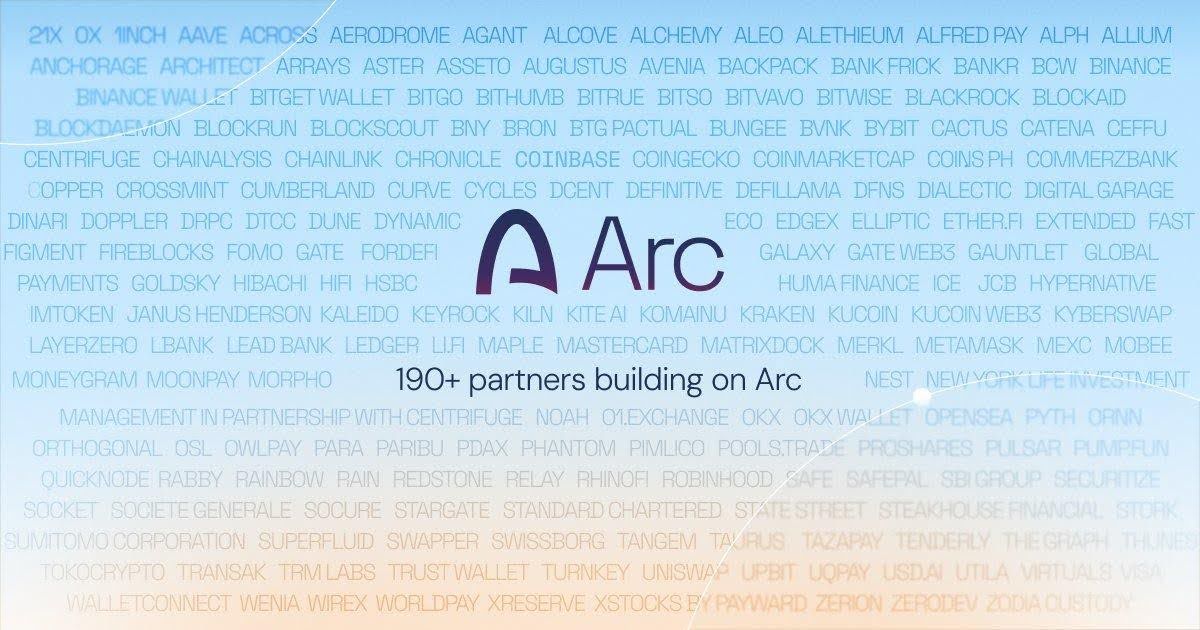
Arc has officially launched its mainnet, unveiling what the project calls the "Economic OS for the Internet" — a blockchain platform designed to bring stablecoins, tokenized assets, payments, and AI-driven economic activity together in a single ecosystem, according to an official announcement. The network went live with more than 190 ecosystem partners spanning finance, payments, decentralized finance (DeFi), and artificial intelligence.
In a post published on X on September 16, 2026, announcing the launch, Arc said the network is more than a blockchain:
Arc Mainnet is live. Arc launches as the Economic OS for the internet: an open platform for global markets, real-time value movement, tokenized assets, and agentic economic activity. Arc is more than a blockchain. It launches as a full-stack financial platform with assets,… pic.twitter.com/SWg0NlUijO
— Arc (@arc) September 16, 2026
Per Arc's official blog post, the platform launched with a full complement of financial partners, wallets, and exchanges already integrated from the outset. That stands in contrast to other liquidity-focused layer-1 chains, which typically require months after going live to build integrations and establish financial partnerships with other DeFi projects. For a network pitched at payments and global markets, having those access points ready at launch determines whether users and institutions can actually move funds on and off the chain from day one.
Arc Starts With a Full Financial Stack
Arc, a layer-1 blockchain developed by stablecoin issuer Circle — the company behind USDC — runs on an EVM-compatible network, meaning applications and developer tools built for Ethereum can be deployed on it with minimal changes. Unusually for a layer-1, it uses the USDC stablecoin as its native gas asset, so transaction fees are paid in a dollar-pegged currency rather than a dedicated network token. The network also delivers sub-second finality, which means transactions are settled within a second of being submitted — a threshold that matters for payments, where counterparties need certainty that funds have cleared before goods or services change hands.
The network is built for financial use cases rather than serving only crypto-native users, according to Arc. From day one, users can access lending, borrowing, trading, payments, foreign exchange settlement, tokenized assets, and a suite of stablecoin-based financial services.
The project begins with Arc Portal, an entry point where users can make deposits, exchange assets, monitor portfolio movements, and find ways to earn within the ecosystem.
Major crypto exchanges supporting Arc include Binance, Bybit, Kraken, OKX, KuCoin, Gate, MEXC, and Upbit. Supported wallets for interacting with the network include MetaMask, SafePal, Phantom, Rabby, Ledger, and OKX.
BlackRock Visa, and Major Institutions Join as Founding Validators
One of the most notable elements of the launch is the involvement of traditional financial giants. Arc's founding validators include BlackRock, Visa, Mastercard, DTCC, Galaxy, MoneyGram, Standard Chartered, SBI Group, Sumitomo Corporation, and Worldpay. Validators are the entities responsible for processing transactions and maintaining the network's ledger, meaning these firms are not simply building applications on top of Arc but are directly involved in operating it. The participation of these companies reflects the network's focus on institutional-grade blockchain infrastructure.
Tokenized Assets and StableFX Go Live
Several tokenized assets are available on the network from day one, including BlackRock's tokenized BUIDL fund, Circle's USYC, and related offerings from Janus Henderson. Tokenized funds like these represent ownership of traditional investment products on a blockchain, allowing them to move and settle at the speed of the underlying network.
The protocol also introduces StableFX, a new onchain foreign exchange platform that enables currency conversion and settlement around the clock, 24 hours a day and seven days a week, using fully reserved stablecoins. That continuous operation is a break from traditional foreign exchange, which trades during set business hours and relies on banking infrastructure that does not process settlement on weekends. Supported currencies include USD, EUR, JPY, BRN, MXN, and a selection of regional stablecoins.
Bitcoin liquidity is also accessible on Arc through cirBTC, a programmable Bitcoin asset offered by Circle.
Arc Targets the AI Agent Economy
Beyond its financial stack, Arc is also positioning itself as autonomous infrastructure for AI-enabled economic activity. The platform integrates Circle Agent Stack, agent wallets, and programmable payment tools designed to support machine-to-machine transactions and payments, where autonomous software pays for services, data, and APIs without human intervention.
Developers can build their own applications using Arc Studio and Arc App Kits, and a number of AI-focused projects are already plugged into the network.
At launch, Arc arrives with more than 190 partners, institutional validators, tokenized assets, stablecoin-native payments, and infrastructure built for AI. With this lineup, the project is positioning its mainnet as a full-stack financial platform rather than a conventional blockchain. How that positioning holds up in practice is the next thing to watch: transaction activity across lending, trading, and StableFX settlement, along with any additional partners integrating after launch, will show whether day-one breadth converts into sustained use.
Source: Crypto Ninjas

