Arbitrum's 92.65 Million ARB Unlock Arrives as Token Trades Near Record Lows
Key Takeaways
- •About 92.65 million ARB is scheduled to unlock on August 16 under Arbitrum's pre-announced vesting plan.
- •The tranche represents just under 1% of ARB's original 10 billion supply and is part of releases that continue through 2027.
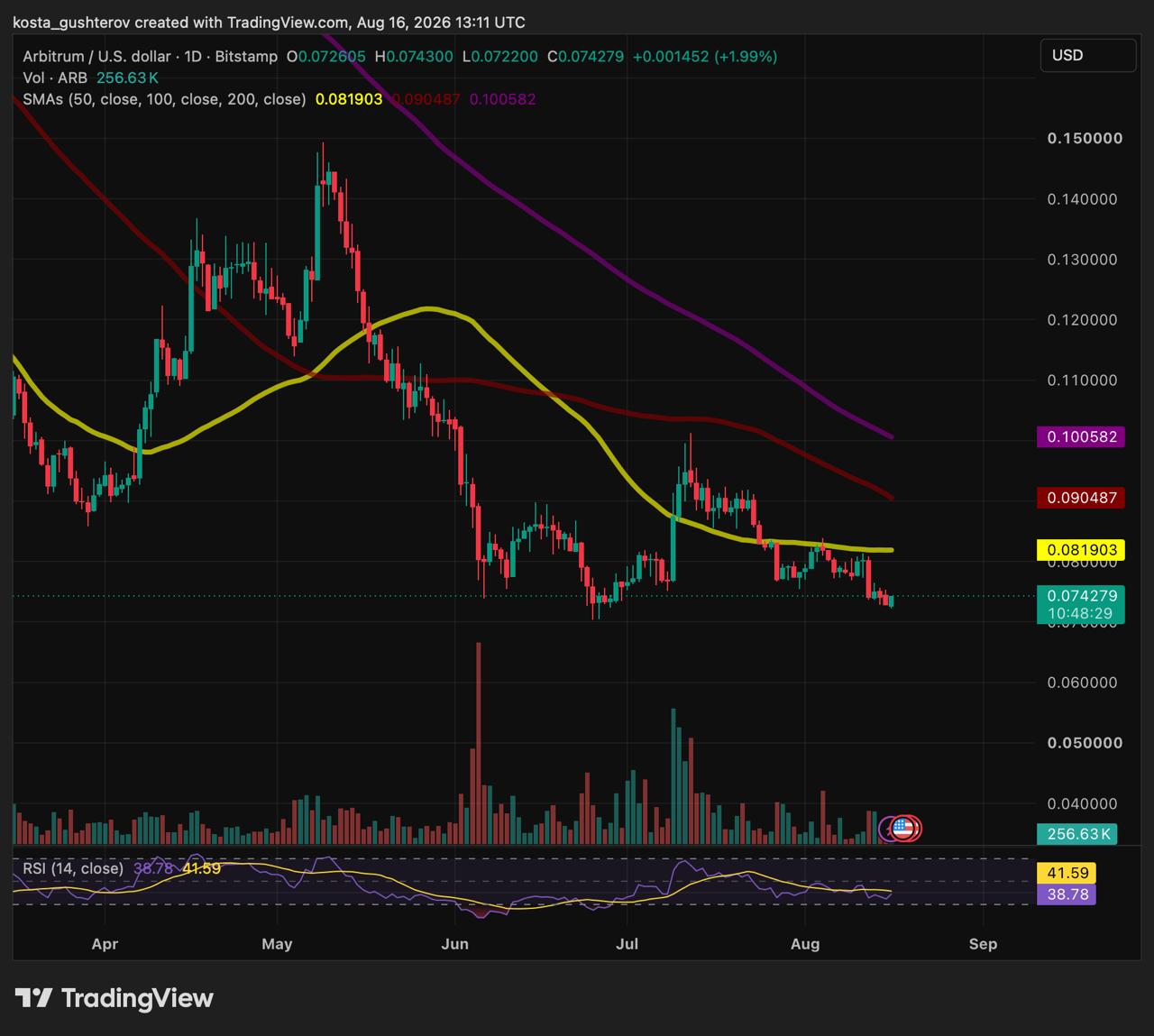
- •ARB was trading near $0.074, below its 50-day, 100-day, and 200-day moving averages, while daily RSI stood at 38.7.
- •At the referenced price, the unlock was valued at about $6.88 million, or roughly 27% of the prior day's reported ARB trading volume.
- •The article said Arbitrum's network growth does not automatically create ARB buying demand because Arbitrum One transactions use ETH for gas fees.
What makes Arbitrum's latest token release worth examining is not its predictability. It is the position of the market when the tokens become available.
The event therefore poses a direct test: can the market absorb another scheduled tranche without sending ARB into price discovery?
A Routine Unlock in an Unusual Chart Position
Arbitrum's official distribution documents state that tokens allocated to the team and investors follow four-year vesting arrangements. The first release occurred one year after the March 2023 token-generation event, followed by monthly releases across the remaining three years.
According to Tokenomist's schedule, approximately 92.65 million ARB is due for release on August 16. The published schedule establishes the date but does not provide a confirmed execution hour.
Measured against ARB's initial total supply of 10 billion tokens, the tranche amounts to just under 1%, and the vesting window that opened with the March 2023 token-generation event runs into 2027. August's release is one instalment in a long, pre-announced sequence rather than an isolated event.
The tokens are not newly minted. They already form part of ARB's initial allocation and are becoming transferable under the vesting schedule. Their release also does not require recipients to sell them.
A 2% Bounce Does Not Repair the Daily Chart
Bitstamp's chart showed ARB trading near $0.074 after gaining approximately 2% during the session at the time of writing. The move followed an intraday test of $0.072, showing that buyers were still defending the lower end of the range.
The bounce has not broken the downtrend. ARB remains below its 50-day SMA near $0.082, its 100-day SMA around $0.09, and its 200-day SMA close to $0.10. All three averages are falling, with the shorter averages positioned beneath the longer ones.
Recovery attempts have also continued to produce lower highs. ARB approached $0.10 in July, failed to hold the move, and later stalled around $0.082 in August. Buyers have slowed the decline without taking control of it.
Daily RSI stood at 38.7. Momentum is weak, but the indicator remains above the conventional oversold threshold of 30. ARB can therefore fall further without producing an unusually stretched RSI reading.
A brief wick below $0.07 followed by a quick recovery could become a false breakdown. Continued daily trading beneath that level would be more serious, because no established historical support exists below the all-time low.
The Real Unknown Is How Much Becomes Sell-Side Supply
At $0.074, the scheduled release had a gross market value of approximately $6.88 million. For comparison, CoinGecko showed around $25.6 million in ARB trading volume over the previous 24 hours.
The unlock was therefore worth roughly 27% of one day's reported turnover. That ratio should not be interpreted as the market having $25.6 million of available buying demand.
Trading volume counts completed transactions on both sides of the market and can include the same tokens changing hands repeatedly. It does not reveal how many buyers are willing to absorb additional sales near the current price.
If recipients hold the tokens or distribute sales over time, the immediate effect could be limited. Concentrated transfers to exchanges would create a more difficult test. Tracking those flows is standard practice around scheduled unlocks: market watchers monitor block explorers and analytics dashboards for movements from vesting contracts to exchange wallets, the clearest on-chain sign that recipients intend to sell. Without evidence of such transfers, it would be inaccurate to describe the entire 92.65 million ARB as incoming sell pressure.
The first useful evidence will come from the market reaction. Holding $0.07 would show that available demand was sufficient to prevent a new low. Reclaiming $0.082 would go further by showing that buyers were willing to pursue ARB above immediate resistance rather than merely defend the bottom.
Arbitrum's Network Growth Has an ARB Demand Gap
The continuing weakness in ARB also exposes a wider issue: growth in the Arbitrum ecosystem does not automatically require users to buy its governance token.
ARB gives holders voting power over the DAO and the technologies it controls, according to the project's official token documentation. Arbitrum One transactions, however, use ETH for gas fees.
More applications and transactions can increase the importance of the network without creating a corresponding stream of ARB purchases. Ecosystem expansion may strengthen the DAO treasury, attract developers, and make governance more valuable, but the route from network activity to token demand remains indirect. A substantial share of the initial supply was also reserved for the Arbitrum DAO treasury at launch, and those tokens move only when governance approves their use.
Robinhood Chain demonstrates that distinction. The network directs part of its protocol revenue to the Arbitrum ecosystem, but our earlier examination of Robinhood Chain's activity found that the mechanism does not require continuous purchases of ARB.
That leaves the market balancing two different forces. Arbitrum can continue attracting applications and economic activity, while scheduled vesting makes more ARB available each month through 2027. Until stronger token demand connects those two sides, every monthly release will remain another test of the market's ability to absorb supply.
Cryptocurrency prices are highly volatile. Technical levels are based on the supplied daily chart and may change as new market data becomes available. A scheduled token release does not guarantee that recipients will sell. This article is for informational purposes only and does not constitute investment advice.

