ARB Arrives on Solana via Sunrise as Executives Clash Over Trading Fees
Key Takeaways
- •ARB, the Arbitrum governance token, is now available on Solana through Sunrise, a venue designed to list tokens originating from other networks.
- •Solana claims the listing offers tighter spreads and roughly tenfold lower fees, while Offchain Labs cofounder Steven Goldfeder calls the comparison misleading because it ignores MEV and frontrunning protections on Arbitrum.
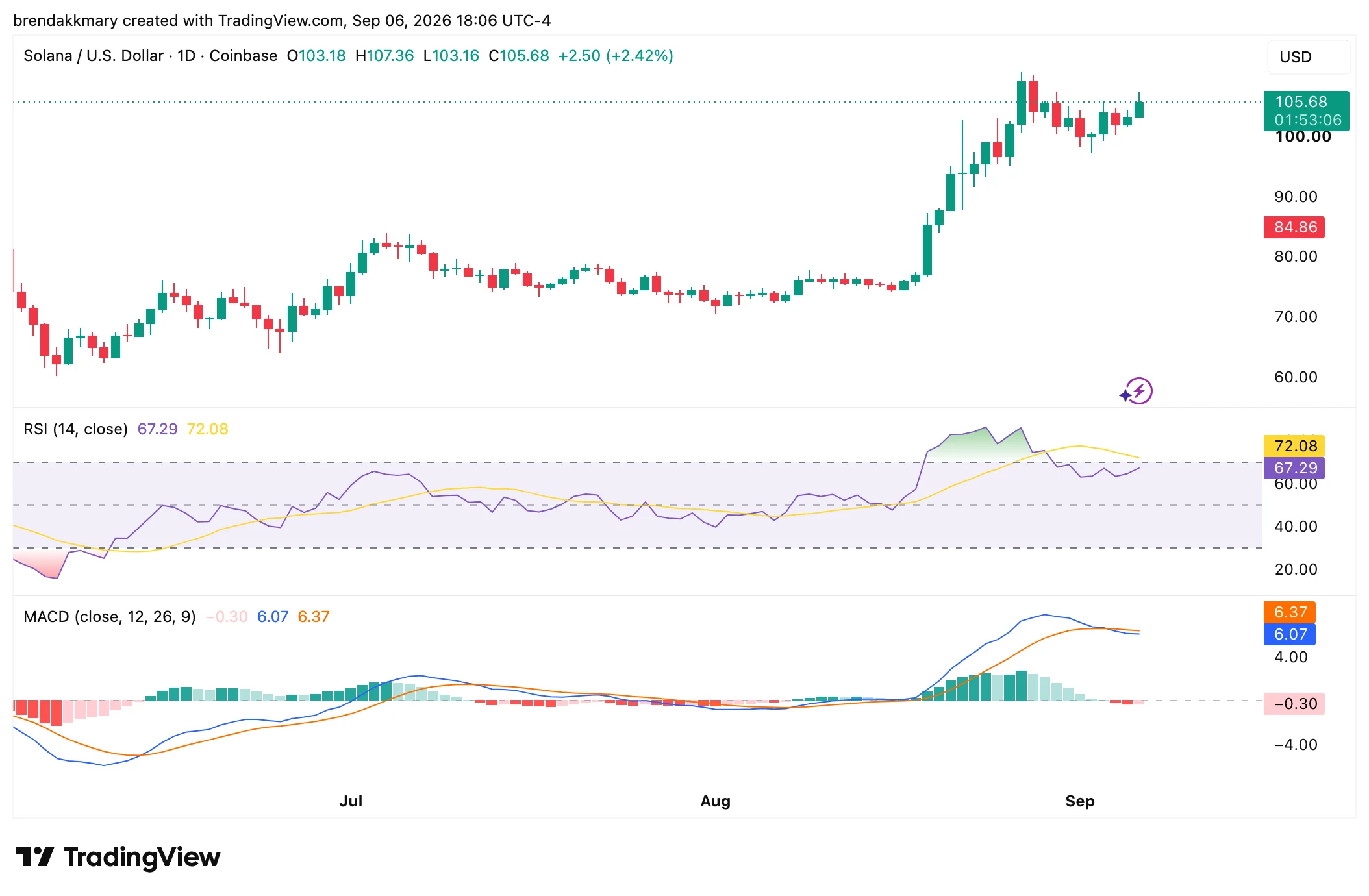
- •SOL traded at $106.02, up 2.5% over 24 hours, while its trading volume climbed 63.8% to $3.49 billion, though this does not prove the ARB listing caused either move.
- •Network fees alone do not capture total trading costs, which also include liquidity provider fees and slippage, so the fee dispute requires comparison of equivalent order sizes and execution outcomes.
- •Key technical levels for SOL include the $105 support area, nearby resistance at $107.37, and $104.94, below which the immediate recovery setup would weaken.
ARB Listing Through Sunrise Puts Fees and Execution in Focus
Solana's latest development centers on ARB, the governance token of the Arbitrum ecosystem, becoming available on its network through Sunrise, with SOL trading at $106.02, up 2.5% over 24 hours. Sunrise is a Solana-based trading venue built to list tokens from other networks, so the move extends a broader pattern in which Solana hosts trading of assets that originated on other chains. The listing gives traders another venue for the asset while bringing trading costs into sharper focus. Solana promotes better spreads and lower fees, while rival executives publicly disagree over how those costs should be measured.
According to Coingecko data, SOL trading volume climbed 63.8% to $3.49 billion during the same period. That increase accompanied the price recovery, although it does not establish that the ARB launch caused either move. Attention now turns to execution quality, available liquidity, and support near the closely watched $105 level.
Solana Announces ARB on Sunrise as Fee Debate Intensifies
Solana announced that ARB is available on its network through Sunrise, presenting the expansion as access to the same asset. Its message emphasizes tighter spreads and lower fees. The development concerns a new trading venue for ARB rather than the creation of a new Solana token.
The story also intersects with a public disagreement between Steven Goldfeder, cofounder of Offchain Labs, the development firm behind Arbitrum, and Solana cofounder Anatoly Yakovenko. Goldfeder argues that simple fee comparisons overlook protection against frontrunning and harmful maximal extractable value (MEV) — the value that validators or other actors can extract by reordering, inserting, or censoring transactions.
BREAKING: $ARB is now on Solana via $ARB
Same asset, better spread and lower fees. By 10x. pic.twitter.com/S5tlwlz8Ov
— Solana (@solana) September 6, 2026
In his comments, Goldfeder described the comparison as "apples and oranges." He says Arbitrum protects users against trading practices that can create hidden execution costs. His argument focuses on the total cost experienced by traders, beyond the visible charge. Arbitrum has previously promoted its sequencer design as a mechanism intended to reduce such extraction risks.
Yakovenko disputes that assessment, saying Arbitrum has worse spreads and higher fees, citing a difference of roughly tenfold in his comparison. That statement represents his assessment rather than an independently verified guarantee covering every ARB transaction.
For this development, the distinction matters because network fees and trading costs measure different things. A swap can involve a network charge, a liquidity provider fee, and price slippage. Available liquidity also affects execution, particularly for larger orders. How quickly liquidity deepens on the new venue will shape whether the claimed fee advantage holds in practice for typical order sizes.
Solana documentation describes a base transaction fee alongside optional priority fees. Those charges alone do not establish the complete cost of buying ARB. Comparing equivalent order sizes and execution outcomes would provide a stronger basis for evaluating the competing claims.
The launch announcement does not specify a universal fee schedule. Making comparisons therefore requires examining actual trading costs across different venues and individual order sizes.
SOL Price Tests Support After Trading Volume Jumps Higher
The SOL price increase places the token above $105, with the recent $107.37 swing high marking nearby resistance. A move from $106.02 to that level would represent approximately 1.3% upside. Holding support would keep that resistance test in view.
Meanwhile, a decline below $104.94 would weaken the immediate recovery setup. That threshold sits just beneath the broader $105 support area. These levels describe conditional trading scenarios; they do not establish that a breakout or deeper decline will occur.
The news arrives alongside stronger turnover, but the $3.49 billion figure requires careful interpretation. SOL trading volume measures activity in the token itself. It should not automatically be described as Solana network trading volume or ARB turnover.
Similarly, higher volume does not measure net capital inflows. Every completed trade involves both a buyer and a seller. The increase shows greater trading activity, while separate flow measurements would be necessary to establish whether fresh capital is entering the ecosystem.
For the ARB token, adoption would be better assessed through actual trading activity and available market depth. Social engagement can show attention, but likes and reposts do not demonstrate lasting demand. The announcement alone provides no basis for estimating future user growth.
As the discussion shifts toward execution, the immediate technical markers remain close together. SOL trades $1.02 above $105 support and $1.35 below the recent $107.37 high. A price break below $104.94 would place the token beneath both nearby support references.
