Apollo Economist Torsten Slok Says the AI Bull Case Has a 'Core Economic Flaw' as Stock and Bond Trades Unravel
Key Takeaways
- •Torsten Slok argued that the marginal cost of producing compute exceeds the marginal benefit it delivers to users, casting doubt on claims of unlimited demand for centers.
- •He found that 80% of the top 1% of AI spenders are venture-backed, suggesting startups are paying their compute bills with venture capital rather than organic earnings.
- •According to Slok, profit margins and revenue per worker are rising at the Magnificent Seven while the rest of the S&P 500 has seen no AI-driven financial improvement.
- •Meta's five-year credit default swaps widened 7.6 basis points to a record 114.79 basis points, while CoreWeave's stock dropped more than 30% this month and its swaps reached 1,145 basis points.
- •S&P Global's Mark Habib warned that interconnected financing structures between hyperscalers and data center projects mean there may be more AI-linked debt than current disclosures reveal.
Apollo chief economist Torsten Slok spent the past week on a warpath, issuing a string of warnings about the AI boom just as Wall Street retreated from the sector.
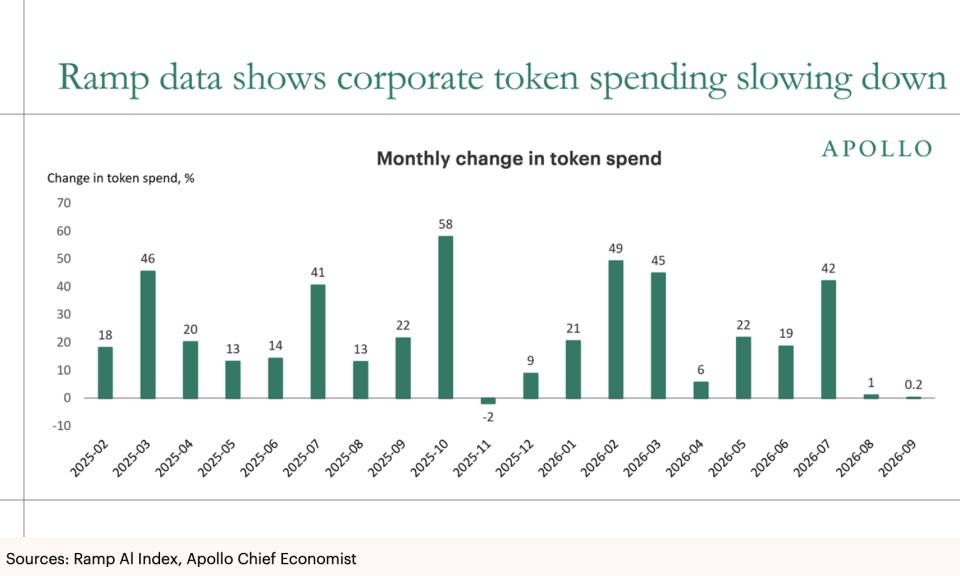
On Tuesday, Slok pointed to the recent slowdown in token spending growth—the usage-based charges for running AI models—arguing in a note on slowing token spend that the demand curve for compute is flat and highly sensitive to price changes. Most companies investing in the technology, he added, have yet to see significant productivity returns, making AI look more like a cost center than a growth driver.
"The core economic flaw in the AI bull case is that the marginal cost of producing compute exceeds the marginal benefit it delivers to users, raising questions about claims of unlimited demand for data centers," he explained. "How much compute and how many data centers are needed depends on the returns firms are able to generate with that compute. So far, the AI payoff for firms has been slow to materialize, implying a growing reluctance to pay for AI services."
The main determinant in data-center construction models, he argued, is not physical capacity or power availability, but the actual price users are willing to pay for compute. Companies will only pay a high price if it translates into higher revenue growth, bigger profits, or substantial savings—and Slok wrote that there is little sign any of those exist at scale. "Maybe that will come in the future. Maybe not," he warned.
On Thursday, he sounded the alarm on "circularity" in token spending in a follow-up note. AI companies have already come under scrutiny for financing deals in which they provide money or guarantee debt for other companies that are also among their top customers, raising doubts about how sustainable their growth is. Slok suggested a similar dynamic exists between AI startups and the venture capital firms that invest in them, noting that 80% of the top 1% of AI spenders are VC-backed. In his view, that means startups are paying their compute bills with venture capital rather than organic earnings.
By Saturday, he declared that AI has "delivered zero financial payoff" to U.S. companies outside the big hyperscalers, writing that while profit margins and revenue per worker are rising at the so-called Magnificent Seven—the mega-cap tech stocks that dominate the S&P 500—the rest of the S&P 500 has seen no such improvement. Echoing his earlier notes, Slok said Corporate America overall doesn't need the latest AI models—and doesn't want to pay for them. Even as AI becomes cheaper and increasingly commoditized, mainstream companies may struggle to use the technology to lift financial results.
"AI may be a great calculator, but in business, intelligence is mostly judgment," he wrote. "Judgment depends on context, and the answer varies with which human or which model you ask. Perhaps most importantly, AI does not understand accountability, trust, culture, unwritten rules, ethical trade-offs or fairness, all of which shape reputational risk and ultimately drive revenue growth and profit margins."
His series of notes landed as AI-related stocks tumbled—chip names in particular—with traders doubting how much longer the capital expenditure spree can continue. A handful of hyperscalers plan to spend an estimated $800 billion this year, with capex next year seen topping $1 trillion.
Raising all that capital may not be easy, however. Meta has already issued a lot of debt, and this week announced the issuance of a new class of shares, in part to help CEO Mark Zuckerberg pay for a possible wealth tax in California. With the social media giant planning to spend $135 billion to $145 billion this year, the cost of insuring Meta's debt against default touched a record on Thursday: five-year credit default swaps widened 7.6 basis points to an all-time high of 114.79 basis points. Because these swaps work like insurance on corporate bonds, a rising price for that protection reflects markets assigning a higher probability of default.
Smaller AI companies such as "neoclouds"—specialist providers that rent out GPU computing capacity to AI developers—have come under pressure as well. CoreWeave's stock has crashed more than 30% this month, and its five-year credit default swaps have shot up to 1,145 basis points, roughly ten times Meta's level.
The worries don't end there. Mark Habib, S&P Global's head of digital infrastructure, flagged "interconnected financing structures" between hyperscalers and data center projects or smaller AI companies.
"It is safe to assume that there is more (debt) out there that we are not seeing," he said during a roundtable in London, according to Reuters. "If it's not reported, then it's not part of the disclosure by the hyperscalers. Also, if we are not rating the transactions where this liability may accrue, then the fact of the matter is that we might not have the visibility."\nThis story was originally featured on Fortune.com.

