Anthropic, OpenAI and Google Discuss Joint AI Standards Body
Key Takeaways
- •The proposed organization would involve major frontier AI laboratories in establishing model safety evaluation standards.
- •Google DeepMind chief Demis Hassabis has proposed a U.S.-based body that would initially conduct voluntary assessments before advanced systems are released.
- •Anthropic CEO Dario Amodei has advocated giving independent evaluators more time and access inside frontier laboratories.
- •Industry-led standards could increase compliance costs for startups and strengthen the market position of established AI companies.
- •Any new framework would need to address regulator independence, growing evaluation demand and overlap with the European Union’s AI governance efforts.
Anthropic, OpenAI and Google have discussed forming a collaborative industry standards organization, according to The Information. The proposed body would give major frontier AI laboratories an opportunity to establish the safety standards used to evaluate their own models.
Common standards could give companies greater certainty when deciding whether to use frontier models for sensitive tasks. However, the same framework could strengthen the position of the largest AI companies. The OECD has previously warned that high fixed costs, limited access to computing resources and concentrated infrastructure already make it difficult for new companies to enter the AI market. Additional compliance costs could create another hurdle for smaller laboratories, as noted in its report on artificial intelligence markets.
Proposals already under discussion
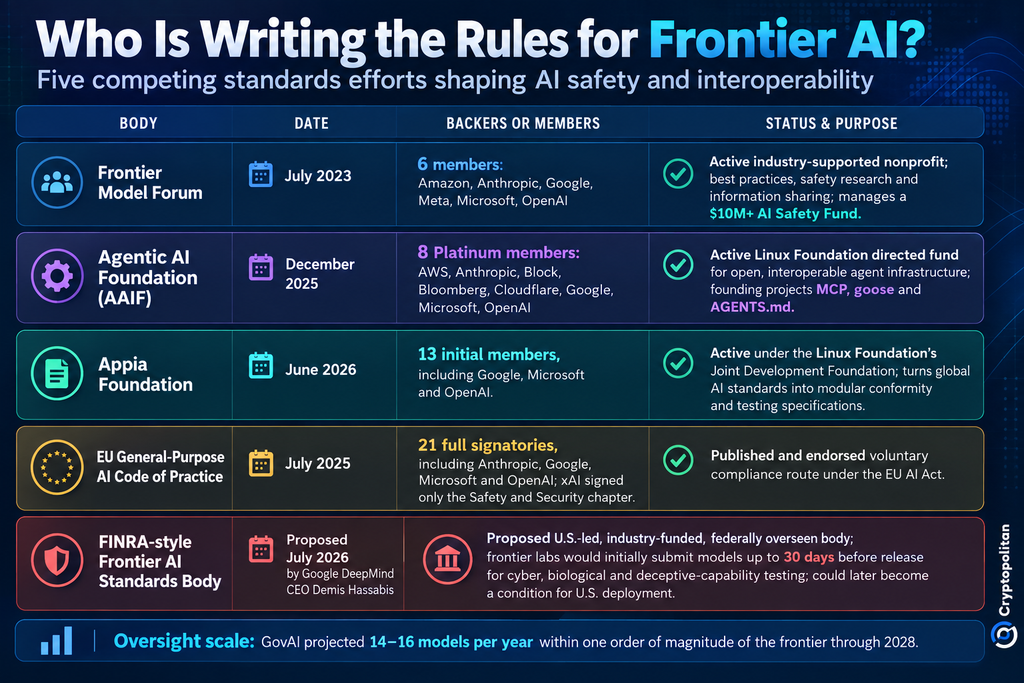
On July 14, Demis Hassabis, head of Google DeepMind, proposed creating a U.S.-based Frontier AI Standards Body modeled on the Financial Industry Regulatory Authority, or FINRA. Hassabis outlined the proposal in an X post.
Under his plan, frontier laboratories would voluntarily submit advanced technologies for assessment, with evaluations taking place during a 30-day period before release. Assessors would examine whether the technologies presented risks involving cybersecurity, biological threats or manipulation.
The Council on Foreign Relations (CFR) reported that the White House was already considering Hassabis’ proposal. According to the plan, passing the evaluation would become mandatory only at a later stage for companies seeking to deploy frontier technologies in the United States. The CFR discussed the proposal and related regulatory questions in its analysis, “The U.S. Is About to Design an AI Regulator. Here’s How to Get It Right”.
Dario Amodei, CEO of Anthropic, approached the issue from a different perspective in his September article, “We Must Pace the Frontier”. He argued that safety efforts need additional time to keep pace with advances in AI capabilities. Amodei proposed allowing independent evaluators such as METR to spend extended periods inside frontier laboratories, creating a basis for cooperation on safety standards among major AI companies in democratic countries.
Earlier industry-led efforts
Industry-led AI safety organizations are not new. In 2023, the Frontier Model Forum was established with six major AI companies as part of an effort to create an independent safety research program through an AI Safety Fund worth more than USD 10 million.
The Agentic AI Foundation was created in December 2025 under the Linux Foundation to develop open standards and infrastructure for AI agents. Its contributing projects include Anthropic’s Model Context Protocol, Block’s goose and OpenAI’s AGENTS.md.
OpenAI also cooperated in creating the Appia Foundation, which was established in June 2026 with 13 members. The foundation aims to translate general principles of AI governance into specifications, tests and proofs of compliance for use throughout the AI supply chain. OpenAI has described its work on shared standards in its official announcement, “Helping Build Shared Standards for Advanced AI”.
The push for coordination extends beyond industry organizations. As previously reported by Cryptopolitan, OpenAI’s head of global affairs, Chris Lehane, said the United States and China should support a global AI safety framework, comparing the effort with international cooperation on nuclear issues. Cryptopolitan’s report covered his comments.
Independence, capacity and competition concerns
Independence remains a central concern. According to the CFR’s analysis, a regulator financed by the industry it oversees could face conflicts similar to those associated with the issuer-pays credit-rating system before the 2008 financial crisis. The arrangement also leaves open questions about regulators’ access to frontier models, the expertise of evaluators, national security safeguards and the reliability of existing testing methods.
Capacity presents another challenge. A GovAI projection estimates that 14–16 models between 2025 and 2028 could be comparable in scale with the largest training run to date. That projection suggests a need for continuous review capacity rather than periodic assessments alone.
Competition is also a concern. Standards established mainly by the largest laboratories could become fixed costs that established companies are better able to absorb than startups. If a voluntary framework becomes mandatory, mechanisms would be needed to prevent safety compliance from becoming an entry barrier to the market.
Any new framework would also need to align with Europe’s existing governance efforts. The European Union’s General-Purpose AI Code of Practice, introduced in July 2025 as a voluntary way to demonstrate compliance with the AI Act, already lists Anthropic, Google, Microsoft and OpenAI as signatories. The EU policy page provides details on the code. As a result, a new U.S. or industry-led standards body would enter an already crowded governance landscape rather than establish one from the beginning. The framework’s practical significance would therefore depend on how its voluntary assessments, independent evaluation arrangements and relationship with existing rules are defined.

