Anthropic Debuts as Gold Drops: Five Major Market Moves in 24 Hours
Key Takeaways
- •Anthropic raised $81.3 billion at an $83 offering price and closed its first Nasdaq session at $97.17, up 17.1%, with a private placement bringing total proceeds above $107 billion in the largest IPO on record.
- •Anthropic carries close to $900 billion in computing commitments with Amazon and Google, underscoring the capital required to build and run frontier AI systems before they generate returns.
- •US equities sold off despite the debut, with the Nasdaq falling 2.25%, the Dow closing below 50,000 for the first time since June, and AMD dropping 7.7% after a short-seller report it rejected.
- •Gold fell roughly 8.9% for the week to about $3,552 an ounce, its lowest level since September 2025, as the dollar traded near a 19-month high and traders priced in about a 95% chance of a December Fed rate hike.
- •Japan's Nikkei 225 and South Korea's Kospi each fell 4.5% on Friday while Hong Kong's Hang Seng dropped nearly 2%, extending the global selloff to semiconductor-heavy Asian markets.
Anthropic’s record IPO rises 17% as broader markets sell off
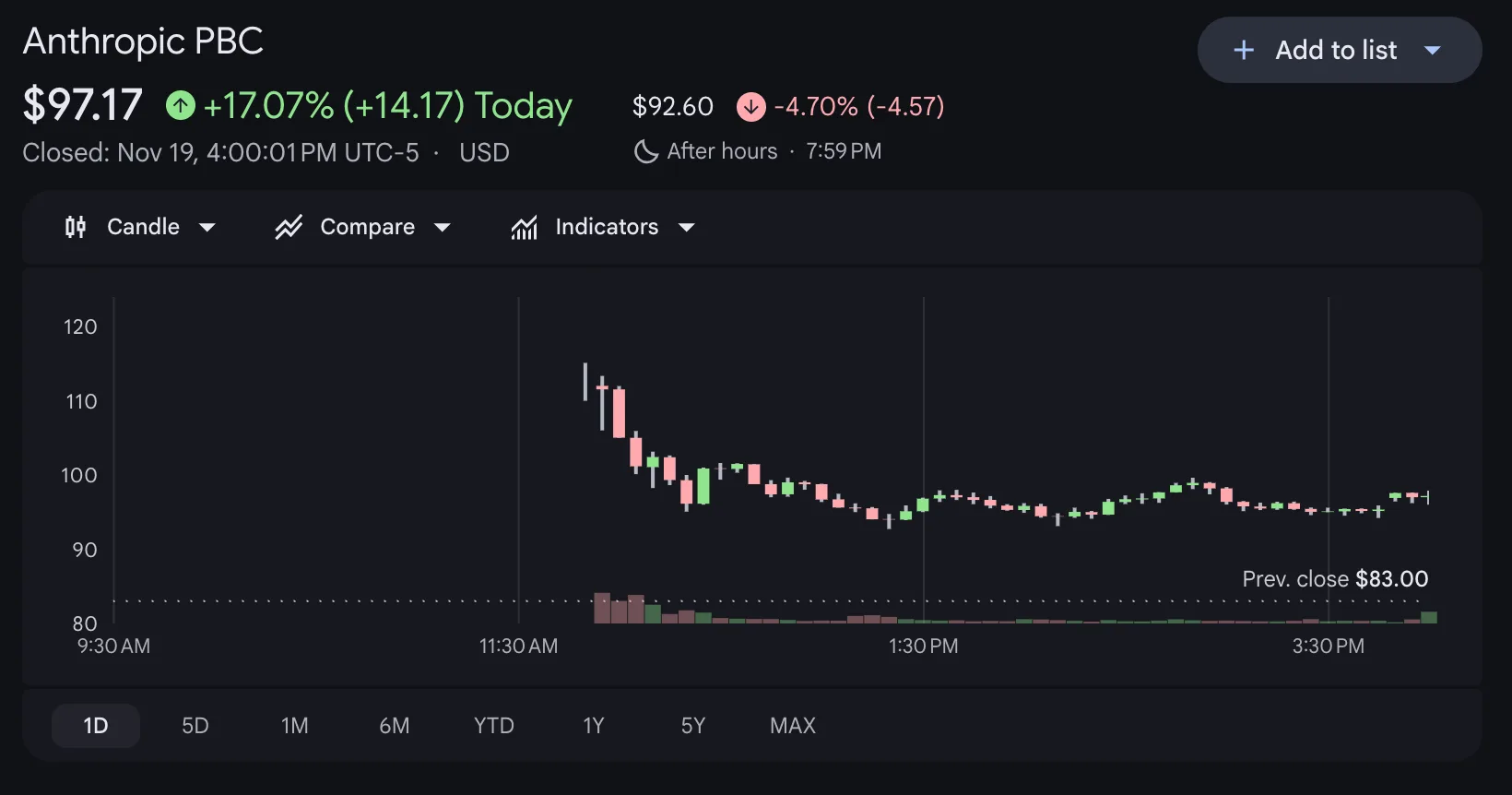
Anthropic priced its Nasdaq initial public offering at $83 per share, raised $81.3 billion and closed its first trading session at $97.17, up 17.1%, making it the largest IPO on record. A private placement brought total proceeds above $107 billion.
The artificial intelligence company’s public debut began strongly on Thursday, with shares opening at $111.50, approximately 34% above the offering price. The stock briefly reached about $115, lifting its implied valuation above $2 trillion. Gains faded during the afternoon, however, and the shares ended the session at $97.17. That closing price valued Anthropic at nearly $1.5 trillion, placing it among the world’s largest listed companies. Under standard IPO mechanics, the issuing company receives only the offering price from the listing itself, so the aftermarket jump above $83 increased the value held by existing shareholders rather than the proceeds Anthropic collected.
Anthropic listed on the Nasdaq under the ticker ANT. The decline from the intraday high indicated that some shareholders sold within hours of the debut. The listing also highlighted the company’s spending requirements. Reports show that Anthropic has close to $900 billion in computing commitments with Amazon and Google, underscoring the capital required to develop and operate frontier AI systems before they generate returns. Such commitments are typically structured as multi-year cloud capacity agreements, tying AI developers’ cost bases to the infrastructure plans of their cloud providers.
The strong IPO performance did not lift the wider technology market. Instead, the Nasdaq, Dow Jones Industrial Average and S&P 500 each lost more than 2% as chip stocks led a broad selloff.
AI and semiconductor stocks fall despite Anthropic’s debut
The Nasdaq moved from a 2% gain to a 2.25% loss, shedding about 551 points. The Dow fell more than 1,100 points and closed below 50,000 for the first time since June. More than 90% of S&P 500 companies ended the session lower.
Semiconductor companies recorded some of the sharpest declines. AMD dropped 7.7% after Hunterbrook published a report alleging ties to China and disclosed a short position in the company’s stock. AMD rejected the claims. Nvidia fell 3.3% after new US chip rules targeted China, while the Philadelphia Semiconductor Index declined 2.4%. Broadcom and Micron each lost about 2.1%. China has been among the largest end markets for semiconductors, which is why export rule changes tend to feed quickly into chip share prices.
The weakness extended beyond individual companies. Market participants were focused on the amount the AI industry may still need to spend on data centers, the time required for those investments to produce profits and whether valuations have moved ahead of underlying results.
Cybersecurity stocks provided a notable exception. Palo Alto Networks gained 6.4% after reporting better-than-expected earnings and raising its outlook, showing that earnings results could still produce gains when more than 90% of the S&P 500 fell.
Gold falls 2.7% as the dollar and rate expectations rise
Gold also came under heavy pressure, despite typically holding up when equities decline. Bullion fell about 2.7% on Thursday, while silver dropped 4.9% to $42.83.
Selling continued on Friday, when spot gold declined another 1.9% to approximately $3,552 an ounce, its lowest level since September 2025. Gold was down roughly 8.9% for the week and was on track for its worst weekly performance in eight months.
Several factors were weighing on the precious-metal market. The dollar was trading near a 19-month high, making gold more expensive for buyers using other currencies. Inflation data also remained elevated, with the Philadelphia Federal Reserve’s prices paid index reaching 58.2, its highest level since April. The index measures the input costs regional manufacturers report paying, so its rise points to continued cost pressure.
Traders assigned approximately a 95% probability to a December Federal Reserve rate hike. Higher interest rates increase the relative appeal of yield-bearing assets, placing additional pressure on gold. That makes the December Federal Reserve meeting the next scheduled test of the rate expectations now weighing on the metal.
Bitcoin declines as oil and Treasury yields remain elevated
Bitcoin traded near $61,500 on Friday, down approximately 3.4% over 24 hours. The cryptocurrency had already fallen below $65,000 earlier in the week and was facing pressure from the broader market environment. It also fell to $61,000 during the period, while the key-insights account put the level at about $61,600.
The 10-year US Treasury yield held near 5.05% after reaching about 5.15% earlier in November. When government bonds offer yields at those levels with comparatively low risk, speculative assets such as cryptocurrencies and growth stocks can become less attractive relative to fixed-income investments. The 10-year yield also serves as a benchmark for borrowing costs across the economy, which is why its level matters beyond the bond market.
Oil prices added to inflation concerns. West Texas Intermediate settled at $83.21, while Brent crude traded near $90 as shipping disruptions in the Strait of Hormuz kept supply tight. Higher energy costs contribute to inflation, potentially limiting the Federal Reserve’s room to ease policy and helping keep bond yields elevated. The strait is one of the world’s busiest transit routes for seaborne oil, so disruptions there can tighten global supply even without any change in production.
Asian markets extend the global selloff
The fifth major move came overnight in Asia. Japan’s Nikkei 225 and South Korea’s Kospi each declined 4.5% on Friday, while Hong Kong’s Hang Seng Index fell nearly 2%. Japan and South Korea both host large export-driven semiconductor and technology sectors, so their benchmarks tend to amplify shifts in global chip sentiment.
In the United States, the S&P 500 ended 2.02% lower for its sixth consecutive losing session. The Dow dropped 2.19%, and the Nasdaq fell 2.25%.
The market moves over the 24-hour period showed a contrast between strong demand for a leading AI company and widespread pressure across other asset classes. Anthropic’s debut attracted substantial buying, but the listing did not offset concerns about interest rates, inflation, a strong dollar and the cost of expanding AI infrastructure. From here, the December Federal Reserve meeting, the path of the 10-year yield and Anthropic’s first sessions as a public company are the most direct reference points.
This article provides financial information and market analysis, not investment advice. Stock, commodity and cryptocurrency prices remain volatile.
Source: The Market Periodical

