Anthropic Stock Jumps After $81.3 Billion IPO, Putting AI Tokens VVV, NEAR and WLD in Focus
Key Takeaways
- •Anthropic's IPO raised $81.3 billion, with shares priced at $83 on Nov. 18 and the stock opening about 34% higher at $111.50 on the Nasdaq the next day.
- •AI-focused cryptocurrencies such as Venice Token, NEAR Protocol and Worldcoin attracted attention after the listing, but none provides ownership in Anthropic and the offering itself does not prove rising demand for the tokens.
- •Venice Token is tied directly to platform performance through a revenue-funded buyback-and-burn program, expanded in July to include subscription and API credit purchases, with cumulative burns reported near 33.97 million VVV.
- •A potential OpenAI IPO, which could arrive as soon as the first quarter of next year and rival Anthropic's in size, positions Worldcoin as a leading beneficiary given its ties to Sam Altman and the possible adoption of World ID.
- •NEAR Protocol has fallen more than 45% from its yearly high amid a broader crypto sell-off, but its Near AI agent marketplace and inference cloud offer operational signals for assessing its AI positioning.
Anthropic raised $81.3 billion in its initial public offering after the artificial intelligence company priced its shares at $83 on Nov. 18. The stock opened at $111.50 on the Nasdaq the following day, roughly 34% above the offer price, reflecting strong initial investor demand.
The listing has brought renewed attention to artificial intelligence (AI) cryptocurrencies such as Venice Token (VVV), NEAR Protocol (NEAR) and Worldcoin (WLD). That attention is indirect, however: none of these tokens gives investors ownership in Anthropic, and the company's successful offering does not by itself establish higher demand for their underlying assets.
Venice Token's Value Is Tied to Platform Revenue
Venice Token operates within Venice AI, a platform that offers access to multiple artificial intelligence models, supporting use cases such as text generation, reasoning and other applications.
The VVV token has a more direct connection to platform operations through a buyback-and-burn mechanism. According to Venice's tokenomics announcement, the company uses part of its revenue to purchase and burn VVV, a process that reduces the number of tokens in circulation by permanently removing the purchased supply.
In July, Venice expanded the mechanism to cover certain subscription and application programming interface (API) credit purchases, providing an additional source of demand for VVV that depends on actual platform spending. The token also carries ongoing staking emissions, however, so cumulative token burns do not establish that the circulating supply declines every month.
Earlier company disclosures from Venice reported burning more than 33.7 million VVV, and third-party monitoring subsequently placed cumulative burns near 33.97 million tokens. The precise percentage of supply removed depends on the denominator used, since ongoing emissions alter the effective supply.
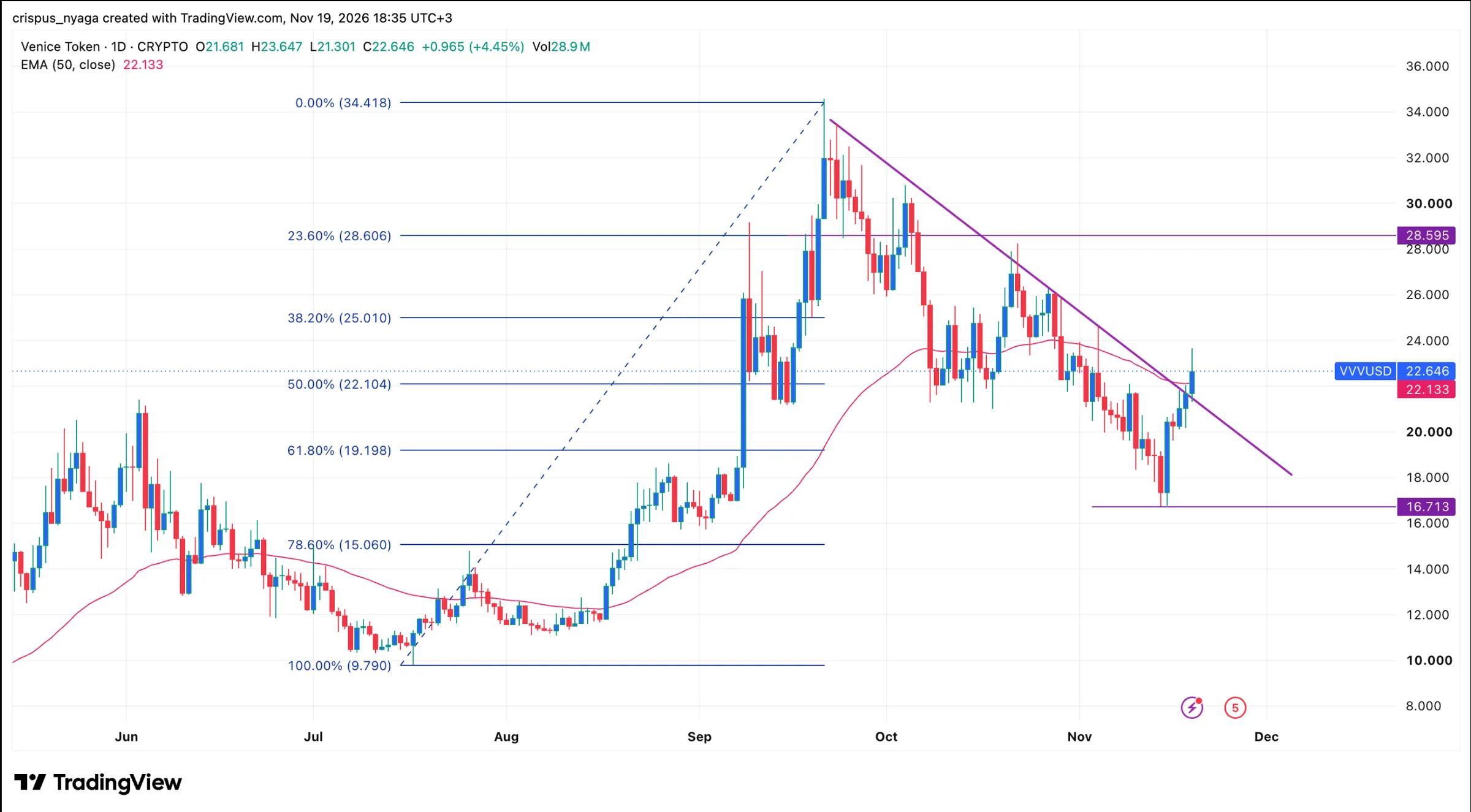
The market snapshot at the time of writing placed VVV around $22.70 following a rebound from $16.71, roughly 35.8% above the cited low. Those values require confirmation against the original chart's dates and trading venue, and a proposed $28.60 resistance level depends on the Fibonacci retracement anchor points used. For investors assessing Venice, platform revenue and net token issuance provide stronger evidence than unrelated stock-market movements.
Worldcoin in Focus Ahead of a Potential OpenAI IPO
The successful Anthropic IPO may open the door for OpenAI to go public, a listing that could arrive as soon as the first quarter of next year and may be as big as the one Anthropic has just completed.
Worldcoin is identified as one of the top potential beneficiaries of such a listing because of its association with Sam Altman, its creator. One key aspect is that OpenAI may ultimately decide to use World ID, which would place it alongside companies such as Tinder and DocuSign that already use the identity system. Any such decision would be verifiable through OpenAI's official adoption of the identity system, independent of token price movements.
Unlike Venice Token, WLD's price has been under pressure over the past few months and is now trading at its lowest level since May. On that basis, the analysis points to signs of a possible rebound as investors buy the dip ahead of a potential OpenAI listing.
NEAR Protocol's Position in AI Infrastructure
The NEAR Protocol token price has dropped sharply over the past few months, falling by more than 45% from its highest point this year, a decline that has coincided with the ongoing sell-off in Bitcoin and altcoins.
The token is cited as a potential beneficiary of the Anthropic IPO because NEAR is considered a major player in the AI space. The network runs Near AI, which offers an AI agent marketplace, and also operates Near AI Cloud, which provides AI inference and other solutions. As with Venice, NEAR's AI positioning can be assessed through operational signals — activity in its agent marketplace and demand for its inference services — rather than through Anthropic's share performance alone.
Other AI-related tokens that may benefit from Anthropic's IPO and the potential listings of other companies include Bittensor (TAO), a protocol for decentralized machine learning; Akash Network (AKT), a decentralized marketplace for cloud computing capacity; and the Artificial Superintelligence Alliance (FET), an alliance of AI-focused crypto projects.
This article provides general cryptocurrency market analysis, not investment advice. AI-related digital assets carry volatility, liquidity and project-specific risks. An equity IPO does not guarantee returns for unrelated cryptocurrencies.

