Anchorage Digital Reportedly Cuts 17% of Staff Despite $4.2 Billion Valuation
Key Takeaways
- •Anchorage Digital is laying off 17% of its workforce, an estimated 68 employees based on the roughly 400 staff figure CEO Nathan McCauley disclosed in February 2025 congressional testimony, though no official count has been provided.
- •The cuts arrive eight months after Tether's $100 million investment valued Anchorage at $4.2 billion and enabled the company's first-ever employee tender offer.
- •McCauley told employees the layoffs stem from the general downturn in the crypto market rather than a lack of available capital.
- •Industry data show at least 7,411 crypto job cuts across 60 companies in 2026, while new job listings on major crypto job portals declined roughly 80% year over year.
- •Institutional demand remains resilient, with an EY survey finding 73% of companies plan to expand digital asset investments and Binance adding Anchorage to its triparty banking network in June.
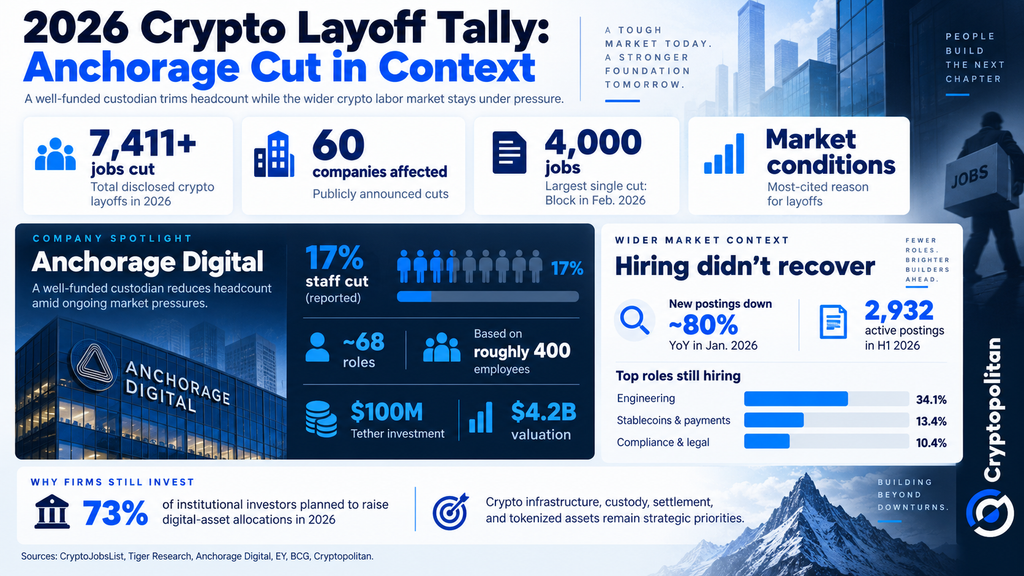
Anchorage Digital, one of the more well-funded regulated firms in the crypto industry, is laying off 17% of its workforce as crypto winter — the industry's shorthand for a prolonged market downturn — continues to grip the sector, according to a report from The Information. If headcount still stands near the 400 employees that CEO Nathan McCauley reported to Congress in February 2025, the reduction would entail approximately 68 layoffs. The move comes eight months after Tether invested $100 million in the company at a $4.2 billion valuation — capital that also funded Anchorage's first-ever employee tender offer, a buyback that lets employees sell their shares back to the company for cash.
Cost-cutting sits alongside capital strength
According to the report, McCauley told employees the job cuts were driven by the general downturn in the current crypto market. The figure of roughly 68 is an estimate rather than an official number; it is derived from the 17% reduction reported by The Information and the employee count McCauley disclosed earlier in congressional testimony. The company has not provided an official figure for the number of employees affected.
The timing stands out. Tether's February investment valued Anchorage at $4.2 billion and made the payouts to employees through the first employee tender offer possible. Against that backdrop, the layoffs do not appear to reflect a desperate need for cash, but rather a deliberate effort to reduce expenses in response to worsening market conditions.
A crypto labor market kept shrinking through 2026
Anchorage is not alone in trimming headcount; the reductions span an industry that has been cutting roles throughout the year. Data compiled by CryptoJobsList show at least 7,411 job cuts across 60 crypto companies in 2026, the largest being Block's elimination of 4,000 roles in February.
Hiring has contracted as well. Tiger Research reported in January that the number of new job listings on leading crypto job portals declined by roughly 80% year over year, continuing a decline that began after 2022 — a contraction that leaves comparatively fewer openings for anyone displaced by this year's cuts.
The hiring that remains points toward infrastructure
The vacancies that do surface are becoming increasingly specialized. Of the 2,932 openings monitored by Tiger Research in the first half of 2026, engineering accounted for 34.1%, followed by compliance and legal roles at 10.4%. Stablecoins and payments made up 13.4% of the total.
That mix is consistent with Anchorage's own approach. The company describes itself as a service provider to institutions across custody — the safekeeping of clients' digital assets — trading, settlement, and other digital asset activities, and it has pushed further into institutional market infrastructure with products that link regulated custody to crypto trading.
Institutions keep buying even as firms get leaner
Institutional interest has not faded. A 2026 survey published by EY found that 73% of companies surveyed intended to expand their investments in digital assets over the following year. BCG's analysis likewise concluded that infrastructure — custody, settlement, and tokenized assets — is becoming more important as digital assets become increasingly integrated with traditional finance.
Anchorage fits into that shifting picture. In June,inance added Anchorage to its triparty banking network, an arrangement that allows institutions to keep collateral in regulated custody while trading.
Read together, the layoffs indicate a crypto industry that is becoming more selective about where its funds go. Capital remains available, but companies are limiting their spending. For Anchorage, the question now is whether it can thrive with a smaller workforce while keeping infrastructure projects as its principal avenue of growth. Any official confirmation of the number of employees affected would fix the true scale of the cuts.

