AMD Q2 2026 Earnings: Record $11.5 Billion Revenue Meets a Higher AI Bar
Key Takeaways
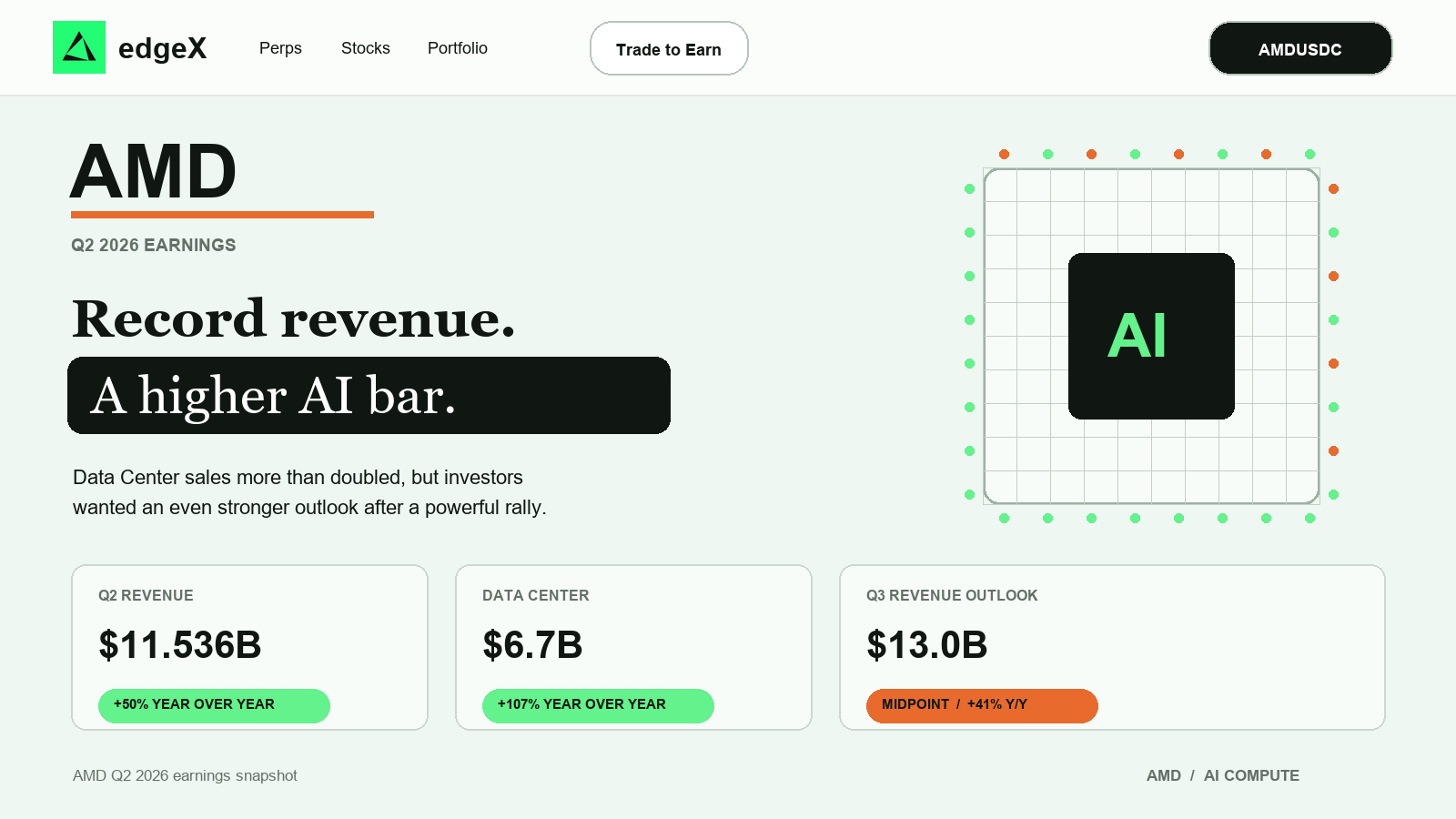
- •AMD achieved record Q2 2026 revenue of $11.536 billion, representing 50% year-over-year growth and exceeding the $11.28 billion analyst consensus estimate.
- •Data Center segment revenue more than doubled to approximately $6.7 billion, accounting for 58% of total company revenue and reflecting strong demand for both EPYC CPUs and Instinct GPUs.
- •Despite beating earnings and revenue estimates and guiding above consensus for Q3, AMD shares declined roughly 9% in after-hours trading after the stock had more than doubled in 2026.
- •AMD guided third-quarter revenue to approximately $13 billion at the midpoint, implying about 41% year-over-year growth, and expects Data Center sales to more than double in 2027.
- •GAAP gross margin improved to 54% from 40% a year earlier, while free cash flow of $1.558 billion declined from $2.566 billion in Q1 due to increased capital expenditures.
Why AMD’s Record Quarter Was Not Enough for the Stock
AMD entered its August 4 earnings release carrying one of the market's most demanding expectations packages. The stock had more than doubled in 2026, according to Reuters, as investors positioned for a broader AI accelerator market, rising server-CPU share and a stronger alternative to Nvidia's tightly integrated systems. That rally changed the standard by which the quarter would be judged.
The reported numbers cleared the conventional hurdle. Revenue of $11.536 billion was above the $11.28 billion analyst estimate cited by Reuters. Non-GAAP diluted earnings of $1.66 per share exceeded the $1.62 estimate. Management's $13 billion third-quarter revenue midpoint was also above the $12.52 billion consensus. Yet AMD shares fell nearly 9% in extended trading.
That reaction captured the real post-earnings debate. The market was no longer asking whether AMD could grow. It was asking whether growth could accelerate fast enough to justify the expectations embedded in the stock. For an AI beneficiary whose valuation had already expanded, a beat was necessary but not sufficient.
The Numbers Behind AMD’s Q2 2026 Earnings
AMD's quarter ended June 27, 2026. The company reported both GAAP and non-GAAP results, and the distinction matters because acquisition-related amortization, stock-based compensation and investment gains created a meaningful gap between the two presentations.
| Metric | Q2 2026 Result | Investor Read |
|---|---|---|
| Revenue | $11.536 billion | Record level; up 50% year over year and 13% sequentially |
| Data Center revenue | $6.7 billion | Up 107%; 58% of total company revenue |
| GAAP gross margin | 54% | Up from 40% a year earlier and 53% in Q1 2026 |
| GAAP operating income | $1.990 billion | Reversed a $134 million operating loss in Q2 2025 |
| GAAP net income | $2.297 billion | Up 163% year over year |
| Non-GAAP diluted EPS | $1.66 | Up 246% year over year and above consensus |
| Operating cash flow | $2.366 billion | Strong cash generation, though below Q1 2026 |
| Free cash flow | $1.558 billion | 14% free-cash-flow margin |
| Q3 2026 revenue outlook | About $13.0 billion, plus or minus $300 million | Roughly 41% growth at the midpoint |
The year-over-year comparisons require context. AMD's Q2 2025 results included $800 million of inventory and related charges tied to U.S. export controls on MI308 data-center GPUs. That depressed the prior-year gross margin and operating result, making some growth rates look unusually large. Even after allowing for that base effect, however, the sequential gains and record revenue show that the business moved materially forward.
Data Center Has Become the Core AMD Business
The most consequential figure was not total revenue. It was the 58% contribution from Data Center. Segment revenue reached approximately $6.7 billion, up 107% from a year earlier, as demand strengthened for both EPYC server processors and Instinct GPUs.
EPYC and Instinct are reinforcing each other
AMD's AI opportunity is broader than accelerator sales. AI clusters require host CPUs, GPUs, networking, memory and software, while inference growth can increase demand for general-purpose server compute as well as specialized accelerators. That gives AMD two routes into the same infrastructure budget: EPYC CPUs and Instinct GPUs.
Reuters reported that Data Center revenue rose 16.3% sequentially from $5.78 billion and exceeded the $6.48 billion analyst estimate. The sequential comparison is important because it avoids much of the export-control distortion in the prior-year base. It suggests that demand accelerated within 2026 rather than merely recovering from an impaired comparison.
The market wants proof at rack scale
AMD is moving beyond individual components toward integrated systems. The company has introduced the Helios rack-scale platform, the MI400 accelerator family, sixth-generation EPYC processors and an expanded ROCm software environment. Management said Instinct deployments are scaling and Helios is beginning to ramp.
That systems strategy is essential if AMD wants to narrow Nvidia's platform advantage. Customers building large AI clusters increasingly evaluate performance per dollar, power efficiency, networking, deployment time and software maturity at the system level. A competitive GPU is necessary, but it is no longer enough. AMD must show that its hardware and software can be deployed reliably across large fleets.
The upside is significant. A credible rack-scale offering could increase AMD's revenue per deployment and make customer relationships harder to displace. The risk is equally clear: systems execution requires more coordination, working capital and software support than selling discrete chips.
The Rest of AMD Still Matters
Data Center now drives the narrative, but the other segments reveal whether AMD's growth is broad or overly concentrated.
Client demand remained healthy
Client revenue rose 23% year over year to $3.1 billion, supported by demand for Ryzen processors. The result suggests that AMD maintained momentum in PCs even as investor attention shifted toward AI infrastructure. AI-PC marketing may help product mix, but the more durable issue is whether AMD can keep gaining share and defend average selling prices through product cycles.
Gaming remained the weak spot
Gaming revenue fell 31% to $779 million because of lower semi-custom sales. Console-related revenue is cyclical and depends on product generations, so weakness here does not overturn the Data Center story. It does, however, limit diversification and shows why the aggregate Client and Gaming segment grew only 6% despite a much stronger client business.
Embedded returned to growth
Embedded revenue increased 19% to $977 million as demand improved across several end markets. The recovery matters because embedded chips tend to have long product lives and can provide a steadier counterweight to consumer and data-center cycles. Investors should watch whether this rebound persists as industrial and communications customers normalize inventories.
Margins Improved, but Cash Conversion Deserves Attention
GAAP gross margin reached 54%, one percentage point above Q1 and 14 points above the export-control-affected prior-year quarter. Non-GAAP gross margin was 56%. Operating leverage was also visible: GAAP operating margin rose to 17%, while non-GAAP operating margin reached 27%.
Those figures support the view that scale is improving AMD's earnings profile. Still, profitability should not be reduced to a single adjusted EPS number. GAAP net income included a $483 million net gain on long-term investments, while stock-based compensation and acquisition-related amortization remained meaningful reconciliation items. Investors should use both presentations rather than treating either one as the complete picture.
Cash flow provides another checkpoint. Operating cash flow was $2.366 billion and free cash flow was $1.558 billion after $808 million of property and equipment purchases. Free cash flow rose from $1.180 billion a year earlier, but fell from $2.566 billion in Q1 as capital spending increased and operating cash flow moderated. If AMD moves deeper into rack-scale systems, working-capital requirements and deployment timing could make cash conversion less smooth from quarter to quarter.
Guidance Raised the Stakes for the Second Half
AMD expects third-quarter revenue of approximately $13 billion, plus or minus $300 million. The midpoint implies about 41% year-over-year growth and a 13% sequential increase. Non-GAAP gross margin is expected to remain near 56%.
A beat that still left investors wanting more
The guide exceeded the $12.52 billion analyst estimate cited by Reuters, but the after-hours decline showed that consensus was not the market's only benchmark. Investors had been looking for evidence that AI infrastructure demand would produce accelerating returns after a powerful stock rally.
Management added a longer-term signal on the earnings call. Reuters reported that AMD expects Data Center sales to more than double in 2027 and sees total revenue growth above the longer-term target of more than 35%, with annual earnings above the $20-per-share goal presented at its 2025 analyst day. Those statements strengthen the growth case, but they also create new milestones against which execution will be judged.
Customer concentration and delivery risk move closer to center stage
Large AI infrastructure agreements can support years of demand, but they also make quarterly timing more sensitive to customer deployments, supply availability and project milestones. AMD's expanding relationships with cloud providers and AI developers improve visibility, yet a delay at a major customer could shift revenue between quarters.
Export controls remain another material variable. The MI308 charge in the prior-year quarter showed how quickly policy can affect inventory, product configurations and access to important markets. Investors should treat regulatory exposure as part of the operating model, not as a footnote.
The Bull Case, Bear Case and Middle Path for AMD Stock
The bull case is that the AI accelerator market becomes large enough to support multiple scaled platforms, while AMD pairs Instinct growth with continued EPYC share gains. In that scenario, Helios and ROCm improve deployment economics, Data Center remains the majority of revenue, and operating leverage turns rapid sales growth into stronger earnings and free cash flow.
The bear case is not that AMD lacks competitive products. It is that expectations run ahead of delivery. Nvidia's software ecosystem and rack-scale integration remain formidable, AI customers can concentrate spending among a few suppliers, and large deployments can be delayed by power, networking or construction constraints. If growth merely meets guidance after a sharp stock rally, valuation pressure can persist even while the business expands.
The middle path may be the most realistic. AMD can establish itself as a durable second platform in AI compute, gain server-CPU share and produce substantial earnings growth without matching every expectation attached to the stock. That outcome would still create a stronger company, but returns for shareholders would depend on the price paid and the pace at which results catch up with the market's assumptions.
What AMD Investors Should Watch Next
The next earnings cycle should be judged through a small set of connected signals: Data Center growth versus the $13 billion company revenue guide, non-GAAP gross margin near 56%, Helios deployment timing, Instinct customer expansion, EPYC share gains and free-cash-flow conversion.
Investors should also track the mix between GPUs and CPUs, because both contribute to AMD's AI economics in different ways. Product announcements matter less than recognized revenue, stable margins and repeat orders. The strongest confirmation would be rising Data Center sales alongside improving cash generation and a broader customer base.
AMD's Q2 report proved that the company has reached a new scale. The stock reaction proved that scale alone no longer settles the debate. From here, execution must outrun expectations, not merely match them.
Trade AMD Perpetual Futures on edgeX
AMD earnings and AI infrastructure news can move the market outside regular U.S. trading hours. edgeX gives eligible traders self-custodial access to stock, commodity and crypto perpetual markets through an on-chain platform built for active execution.
Access the AMDUSDC market
The AMDUSDC perpetual market provides a dedicated AMD-linked contract for expressing long or short market views. Traders should verify current leverage, funding, fees, liquidity, order availability and market status directly on the product page before entering a position.
Trade to Earn without giving up custody
edgeX's current Trade to Earn program returns trading activity to users through EDGE-denominated rewards, subject to campaign rules and eligibility requirements. The platform is designed around self-custody, with users retaining control through their private keys and authorizing fund movements themselves.
Perpetual futures are derivatives, not AMD common stock. They do not provide ownership, voting rights, dividends or other shareholder rights. Leverage magnifies gains and losses and can lead to liquidation. Product access may vary by jurisdiction, and traders should review current specifications and terms before participating.
Frequently Asked Questions
When did AMD release its Q2 2026 earnings?
AMD released its second-quarter results on August 4, 2026. The fiscal quarter ended June 27, 2026.
What was AMD's Q2 2026 revenue?
AMD reported record revenue of $11.536 billion, up 50% year over year and 13% from Q1 2026.
How fast did AMD’s Data Center business grow?
Data Center revenue reached approximately $6.7 billion, up 107% year over year. The segment represented 58% of total company revenue.
Why did AMD stock fall after strong earnings?
Reuters reported that AMD shares fell nearly 9% in extended trading. The results and guidance exceeded consensus estimates, but investors had expected an even stronger AI outlook after the stock more than doubled during 2026.
What should investors watch in AMD’s next report?
The main checkpoints are third-quarter revenue against the $13 billion midpoint, Data Center acceleration, Instinct and Helios deployments, EPYC demand, non-GAAP gross margin near 56% and free-cash-flow conversion.
Is the AMD share price in this article live?
No. This article does not state a live AMD share price. Verify the latest quote through Nasdaq, a broker or a real-time market-data page before making a trading decision.

