AMD Set to Launch Next-Generation Helios AI Servers, Escalating Rivalry with Nvidia
Key Takeaways
- •AMD is launching next-generation AI hardware including the Helios server platform and Venice data center CPU to compete directly with Nvidia's integrated AI systems.
- •Microsoft has committed as anchor customer for AMD's Helios platform, with Oracle, Meta Platforms, and OpenAI also signing on to the platform.
- •AMD disclosed a $5 billion investment in Anthropic, under which Anthropic will purchase up to 2 gigawatts of AI server capacity equipped with AMD's Instinct MI450 chips.
- •Nvidia shares have gained approximately 11% year-to-date, underperforming the Nasdaq 100 Index's 14% rise despite the company reporting robust revenue growth.
- •Alphabet raised its projected capital expenditures to approximately $205 billion for the year, up from a prior estimate of $195 billion, reflecting ongoing AI infrastructure buildout across the technology sector.
Nvidia shares traded in a narrow range as the stock's recent rally lost momentum, with Advanced Micro Devices (AMD) preparing to unveil its next wave of AI infrastructure products at an event in San Francisco later today. The launch marks one of the most consequential moments in the AI hardware market this year, as AMD looks to translate design wins and strategic partnerships into meaningful share gains against the dominant GPU supplier.
Nvidia stock has gained approximately 11% year-to-date, underperforming the Nasdaq 100 Index, which has risen about 14% over the same period. The lag comes despite the company reporting robust revenue growth and strong forward estimates. Rising competition in the AI chip sector has been cited as a contributing factor, and AMD's upcoming product launches may intensify that pressure.
AMD to Launch Next-Generation AI Infrastructure Products
AMD, led by Lisa Su — a cousin of Nvidia CEO Jensen Huang — has emerged as one of the most formidable competitors to Nvidia in the AI hardware space. The company has already captured roughly 8% of the AI inference market, a segment focused on running trained AI models in production rather than training them, where demand is growing as enterprises move from pilot projects to large-scale deployments.
According to Reuters, AMD is preparing to launch a suite of AI hardware designed to rival Nvidia's offerings. The centerpiece is the second generation of its server platform, known as Helios. The company will also introduce its Venice central processing unit (CPU) for data centers. Together, the products represent AMD's push to offer full-rack AI computing solutions — encompassing both GPUs and CPUs — that can compete with Nvidia's integrated systems on performance and total cost of ownership.
AMD has secured several major partners ahead of the launch. Microsoft, Nvidia's largest customer, has signed on as the anchor customer for Helios. Oracle, Meta Platforms, and OpenAI have also committed to the platform. The breadth of these commitments signals that major cloud and AI operators are actively diversifying their hardware suppliers, both to manage costs and to reduce dependency on a single vendor amid surging demand for compute capacity.
In a significant announcement on Wednesday, AMD disclosed a $5 billion investment in Anthropic, the company behind the Claude AI assistant. Under the agreement, Anthropic will purchase up to 2 gigawatts of AI server capacity equipped with AMD's latest Instinct MI450 chips. The move mirrors a strategy Nvidia has employed for years — investing in companies that subsequently use those funds to procure its hardware. Two gigawatts of capacity represents a substantial deployment, underscoring the scale of compute resources that leading AI developers now require.
AMD is not the only company seeking to challenge Nvidia's dominance. Major Nvidia clients including Microsoft, Google, Meta Platforms, and Amazon are all developing their own inference chips, aiming to lower per-query costs for high-volume workloads. OpenAI has already unveiled custom chips manufactured by Broadcom. A growing field of startups — including Cerebras, SambaNova, Etched, and d-Matrics — is also entering the market, targeting specialized workloads and architectural alternatives to traditional GPU designs.
At the same time, Nvidia is pushing back. The company is developing additional products, including a CPU, which could disrupt AMD's core business.
Alphabet Earnings Signal Continued Nvidia Chip Demand
On a positive note for Nvidia, Alphabet reported strong financial results, with revenue and earnings per share exceeding analyst expectations. The company also announced an increase in capital expenditures, projecting approximately $205 billion for the year, up from a prior estimate of $195 billion. The upward revision reflects the ongoing buildout of AI infrastructure across the technology sector, where leading operators are accelerating investment in data centers.
While Google's proprietary Tensor Processing Unit (TPU) continues to gain market share, the company is also spending heavily on Nvidia chips. Looking ahead, other major technology firms — including Meta Platforms, Amazon, and Microsoft — are scheduled to report earnings next week. Any indication of increased spending by these companies would be favorable for Nvidia.
Nvidia may also react to Intel's earnings report, expected later today. Results are anticipated to reflect strong demand driven by a booming CPU business. Nvidia acquired a large stake in Intel last year.
Nvidia Stock Price Technical Overview
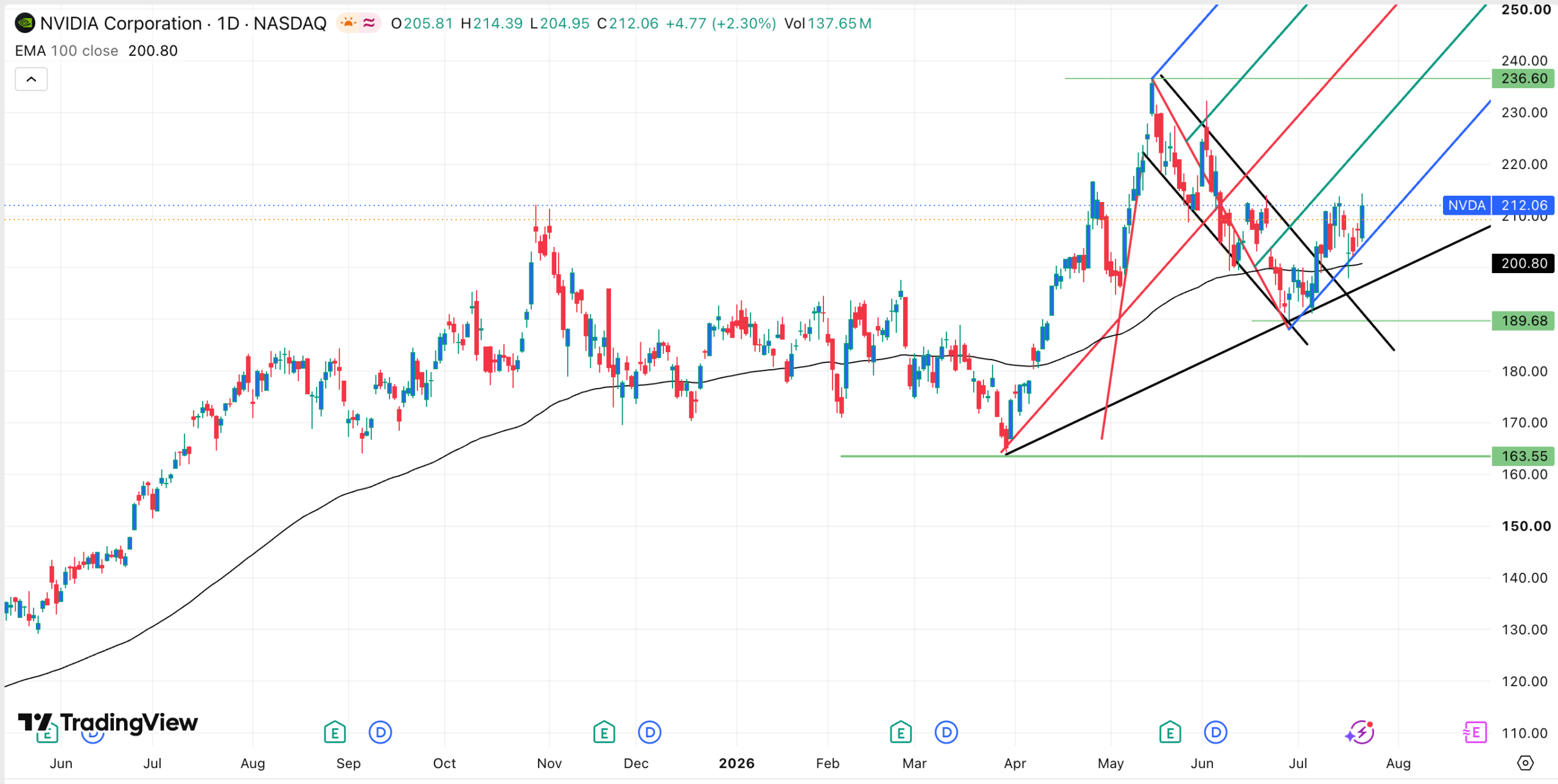
NVDA shares have staged a cautious rebound over the past several days, rising from a low of $189.68 on June 29 to approximately $212. The rebound followed the formation of a large falling wedge pattern, widely regarded as a bullish reversal signal.
The stock has moved above the upper boundary of the falling wedge and reclaimed its 50-day Exponential Moving Average (EMA). It currently remains between the first and second support levels of Andrew's Pitchfork technical indicator. The year-to-date high stands at $236.
