AMD to Acquire Fei-Fei Li's World Labs in $8.2 Billion Deal to Expand Beyond GPUs
Key Takeaways
- •AMD is acquiring Dr. Fei-Fei Li's spatial intelligence company World Labs for approximately $8.2 billion, ranking as the chipmaker's second-largest deal behind the nearly $50 billion Xilinx acquisition.
- •Fei-Fei Li will join AMD as executive vice president and chief scientist, reporting directly to CEO Lisa Su, with the transaction expected to close by the end of 2026 pending regulatory approvals.
- •World Labs core model, Atlas, launched on September 1 and processes text, images, video, and 3D within a single spatial framework for applications such as video generation, 3D scene reconstruction, and robotics simulation.
- •AMD and World Labs already had an established relationship, with AMD participating in the startup's $1 billion funding round and World Labs using AMD GPUs for model training and optimization.
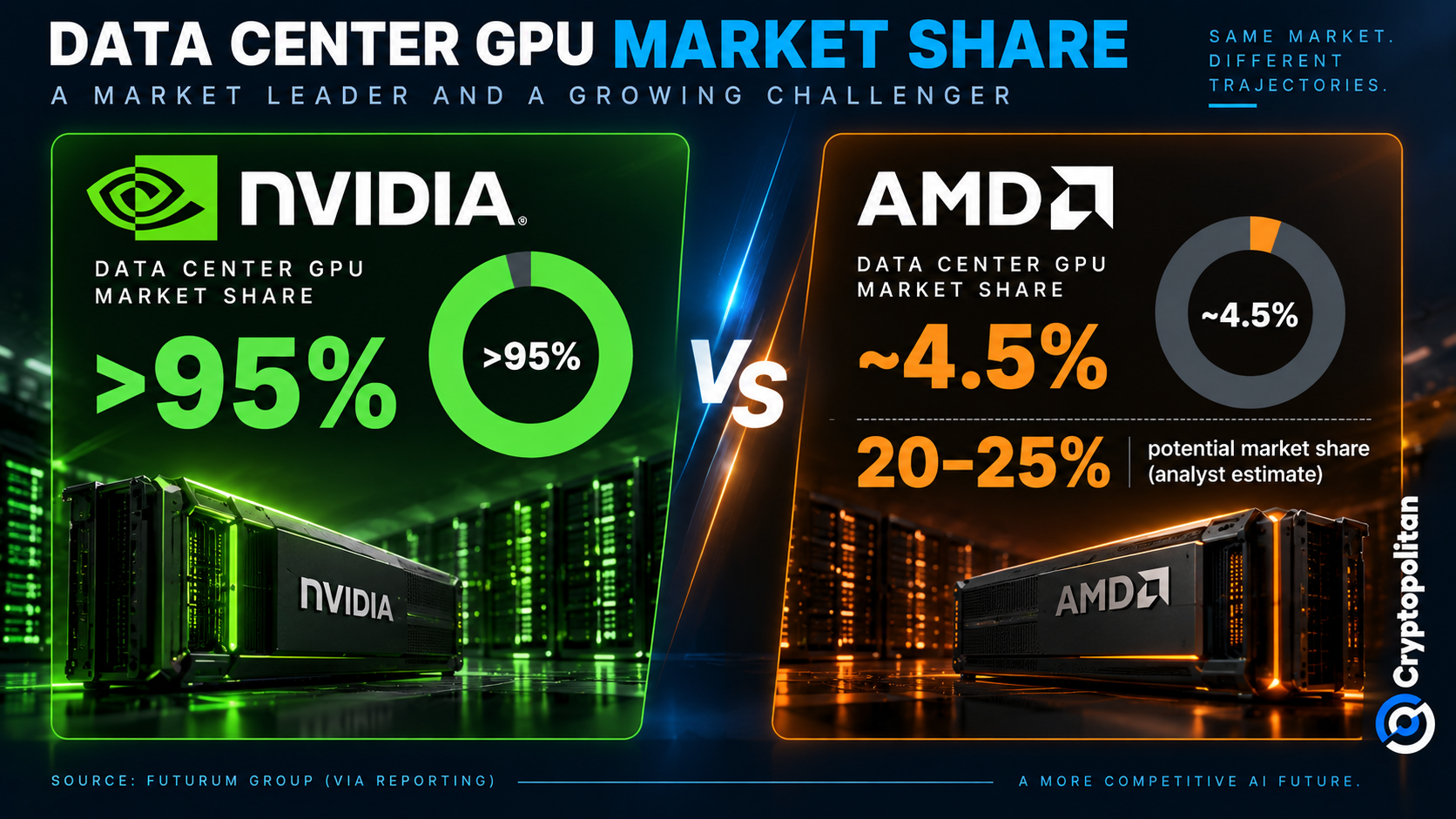
- •The acquisition supports AMD's broader effort to compete across the AI infrastructure stack, where Nvidia holds more than 95% of the data-center GPU market versus AMD's 4.5%, as Gartner forecasts global AI spending to reach $2.7 trillion in 2026.
AMD has agreed to acquire World Labs, the spatial intelligence company founded by AI researcher Dr. Fei-Fei Li, in a transaction valued at approximately $8.2 billion. The deal gives the chipmaker its own research team working on frontier models and signals a deeper push into artificial intelligence, beyond its traditional role as a supplier of processors. At roughly $8.2 billion, the purchase would rank as the second-largest acquisition in AMD's history, ahead of its approximately $4.9 billion purchase of server maker ZT Systems completed in 2025 and behind only the nearly $50 billion Xilinx deal that closed in 2023.
Buying the research, not just the customers
World Labs builds spatial intelligence models that generate, reconstruct, and simulate interactive 3D environments from text, images, and video. Li, who co-directs Stanford University's Human-Centered AI Institute, is best known for leading the creation of ImageNet, the dataset widely credited with catalyzing the modern deep-learning era, and she founded World Labs in 2024. Under the terms of the deal, Li will join AMD as executive vice president and chief scientist once the acquisition closes, reporting directly to CEO Lisa Su. The transaction is expected to be finalized by the end of 2026, pending the receipt of all required regulatory approvals — a review process that stands as the key milestone to watch before Li's team formally joins the chipmaker.
The two companies are already closely familiar with one another's operations. According to Reuters, World Labs raised $1 billion earlier this year through a funding round that included AMD. Li has also noted that the startup has been using AMD GPUs in its model training and optimization processes, a working relationship that predates the acquisition.
"Fei-Fei and the World Labs team bring exceptional research leadership and model expertise," Su said in AMD's announcement.
What spatial intelligence gives AMD
At the center of World Labs' current work is Atlas, a model the company launched on September 1. World Labs describes Atlas as an omni-world model built entirely from scratch to understand text, images, video, and 3D within a single shared spatial framework.
The company positions the model for camera-controlled video generation, reconstruction of 3D scenes, and simulation work for robotics. Those workloads place far heavier demands on computing systems than a typical chatbot does, giving AMD direct insight into how its next generation of chips, software, and AI systems should be designed.
An answer to Nvidia that spans the whole stack
The acquisition underscores how far AMD intends to reach across the AI infrastructure market, well beyond semiconductor products alone. It was previously reported that Microsoft intends to deploy AMD's Helios rack-scale AI system, and a few days later, AMD announced that it was ready to inject about $5 billion into the Anthropic project, allowing for the supply of up to 2 GW of Instinct MI450 GPUs.
Nvidia still commands the lion's share of the data-center GPU market. According to Futurum Group, Nvidia accounts for more than 95% of the market, compared with just 4.5% for AMD. Analyst Daniel Newman has suggested AMD could eventually capture 20-25% of the market, though that figure is an external estimate rather than a forecast from AMD itself.
Why the timing works in AMD's favor
The deal lands at a moment when AI spending continues to climb. Gartner forecasts that worldwide AI spending will hit $2.7 trillion in 2026, an increase of 49.5% year over year. IDC reports that AI infrastructure spending reached $89.7 billion in the first quarter and could total $497 billion for the full year. According to PwC, cumulative global investment in AI infrastructure is expected to reach $31.6 trillion by 2050, while TrendForce expects the combined 2026 capital expenditure of the world's nine leading cloud vendors to reach $886.7 billion.
By acquiring World Labs, AMD is aiming to secure more than another AI-related asset. It is bringing in a research team that will develop the kinds of models its future hardware will need to run, tying the company's silicon roadmap directly to frontier model development.

