Amazon Commits $1 Billion to US Communities Hosting Its Data Centers Amid Rising Local Opposition
Key Takeaways
- •Amazon will invest a total of $1 billion over five years in US communities that host its data centers, focusing on education, workforce development, resource conservation, and community relations.
- •A September University of Massachusetts Amherst poll found that 65% of Americans do not support an AI data center being constructed in their area, while only 11% would back one.
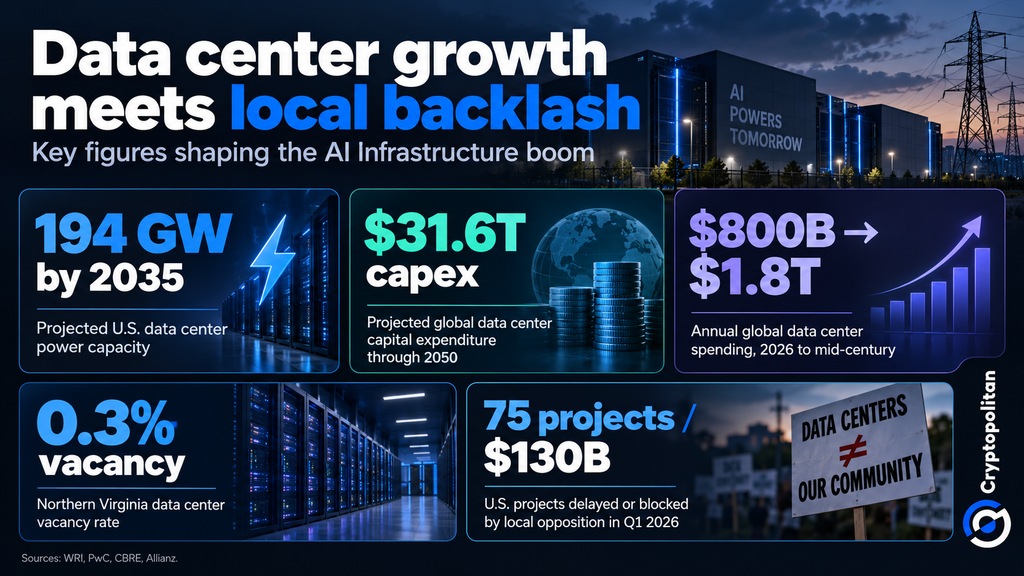
- •According to Allianz, local resistance prevented or delayed more than 75 US data center projects worth a combined $130 billion in the first quarter of 2026.
- •The World Resources Institute projects US data-center power capacity could reach 194 GW by 2035, more than triple today's level, potentially consuming up to 20% of US electricity compared with 5.9% currently.
- •PwC estimates global data center construction spending will total $31.6 trillion by 2050, with annual expenditure rising from roughly $800 billion in 2026 to $1.8 trillion by mid-century.
Amazon will invest a total of $1 billion over five years in US communities that host its data centers, directing the funds toward education, workforce development, resource conservation, and community relations. The commitment, reported by the Associated Press, comes as public opposition to AI infrastructure intensifies over concerns about energy costs, water consumption, and environmental impact.
Data centers are the physical backbone of the AI boom — buildings packed with servers that cloud platforms and AI models run on. For an industry investing trillions of dollars in additional computing capacity, winning the support of local communities has become just as vital as acquiring chips, funding, and energy. Amazon's pledge is more than charitable giving: it is also intended to build the local backing the company needs to keep growing.
Two in three Americans do not want one next door
The resistance is difficult to ignore. A September poll by the University of Massachusetts Amherst found that 65% of Americans do not support an AI data center being constructed in their area, while only 11% said they would back one. Respondents cited environmental issues, resource consumption, land disruption, a lack of trust in AI, and rising utility costs — concerns that track the physical profile of the facilities, which operate continuously and, depending on their cooling design, can consume substantial volumes of water alongside electricity.
The opposition is already costing the industry. According to Allianz, local resistance prevented or delayed more than 75 US projects in the first quarter of 2026, worth a combined $130 billion. Community pushback now stands alongside grid limitations, permitting delays, and supply chain problems as one of the many obstacles developers face.
Why a check alone will not buy acceptance
The World Resources Institute (WRI) points to community benefits agreements (CBAs) as one way to ease some of the tension. These agreements allow developers to make concrete commitments to the communities where they build.
One example comes from Lancaster, Pennsylvania, which WRI describes as the first public CBA for a data center. Three developers have pledged $20 million to support sustainability and economic programs, in addition to commitments to use 100% clean energy, limit water consumption, and meet noise restrictions.
WRI cautions, however, that such agreements are not a cure-all. They cannot replace broader regulation, and some communities may still conclude that a data center is simply not worth it.
The pressure behind those concerns is substantial. WRI says US data-center power capacity could reach 194 GW by 2035, more than three times today's level, at which point data centers could consume as much as 20% of US electricity, up from 5.9% today.
Power, permits, and politics now shape the map
The issue extends well beyond Amazon. PwC estimates that total global spending on data center construction will reach $31.6 trillion by 2050, with annual expenditure rising from about $800 billion in 2026 to $1.8 trillion by mid-century. PwC emphasizes that the availability of electrical power will determine where those investments are made.
Meanwhile, CBRE reported that the vacancy rate for data centers in Northern Virginia — one of the world's largest data center markets — stood at just 0.3% in the first quarter, as power supply shortages, zoning issues, and local resistance policies continued to hamper growth.
The policy environment is hardening as well. The Global Electronics Council reports that governments are raising transparency and sustainability requirements as data center growth puts pressure on electricity grids, water resources, and communities. The International Energy Agency (IEA), meanwhile, warns that the development of AI workloads threatens existing grids and energy.
Even so, the expansion of data centers and AI technologies is providing a boost to the US construction and manufacturing sectors, despite growing problems with electricity supply, raw materials, and infrastructure.
Amazon's $1 billion commitment underscores how important community acceptance has become for an industry whose expansion now depends as much on public support as it does on chips, power, and capital. With WRI projecting US data-center power capacity to more than triple by 2035 and governments raising sustainability and transparency requirements, how pledges like Amazon's interact with formal CBAs and broader regulation will be a thread to watch as the buildout proceeds.

