Altseason Nears as Traders Turn More Discerning This Time
Key Takeaways
- •CoinMarketCap's Altcoin Season Index stands at 64 out of 100, up from 48 the previous week but still below the 75 level that officially marks an altseason.
- •Over the past 30 days, PONS climbed more than 350%, ARB rose over 150%, NEAR gained around 180%, and UNI added more than 110%, while Zcash set a record high above $1,600.
- •Talos data shows the top 10 altcoins now account for roughly 80% of total altcoin market capitalization, up from about 70% at the end of 2024, indicating capital is clustering in a smaller group of assets.
- •Dealer participation in altcoin trading dropped from around 65% at the end of 2024 to about 32% in September, suggesting liquidity providers and market makers have played a smaller role in the current rally.
- •Figures including David Hoffman and Michael Egorov point to rising interest in revenue-generating protocols and stablecoin use in real-world financial applications, even as 1inch co-founder Sergej Kunz notes memecoins showed the strongest buyer growth over the past 30 days.
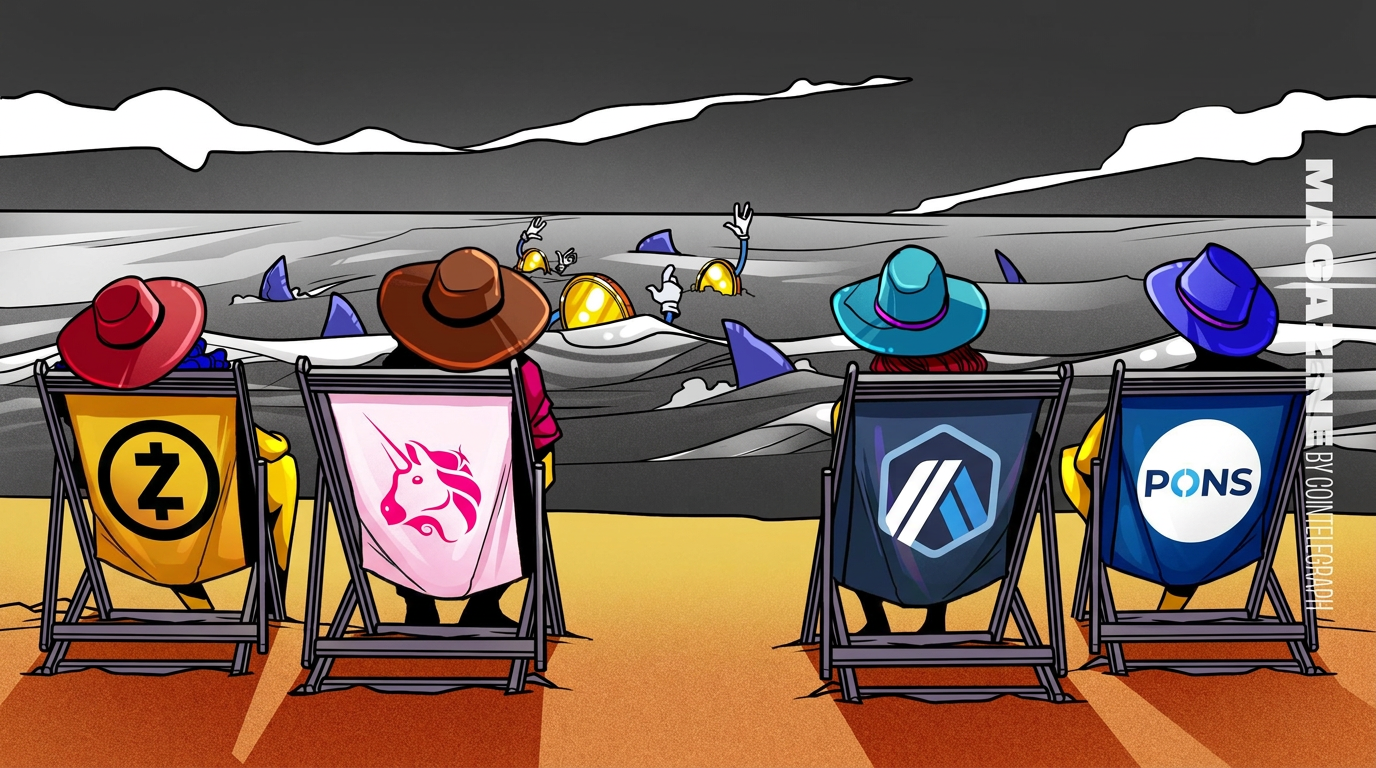
Altseason may not have officially arrived, but traders are already starting their rotations — and the numbers are becoming harder to ignore.
Over the past 30 days, memecoin launchpad token PONS soared more than 350% in price, while in decentralized finance (DeFi), Uniswap's UNI gained more than 110%, Arbitrum's ARB jumped over 150% and AI-focused NEAR shot up around 180%.
Privacy token Zcash hit a record high above $1,600 last week, while Bitcoin Layer-2 token LIT and memecoin launchpad token PUMP were also among the biggest gainers over the period, according to CoinMarketCap.
Spanning very different sectors, those gains do not point to one obvious trade, but they do suggest that many traders are looking at coins with a solid business case behind them this time around.
Revenue-driven rally?
Looking at the massive gains in tokens such as ARB, UNI, Jupiter's JUP and Ondo's ONDO, Bankless podcast host David Hoffman said Friday that what they had in common is, "They make money, they all print revenue," suggesting that this rally could be driven by utility rather than speculation. (Source: Bankless)
Among the top 20 biggest gainers last week, there were only two memecoins, and in the most recent week, only Pudgy Penguins made the list.
But it is not all about fundamentals, according to 1inch co-founder Sergej Kunz, who noted that over the last 30 days, memecoins have shown the strongest growth among buyers. Even so, he said, DeFi protocols, privacy tokens, AI projects and tokenized assets are also attracting attention.
"The pattern so far is breadth before depth," he told Cointelegraph Magazine, describing a market in which more wallets are buying a broader range of tokens, but generally in smaller amounts. "The caution in the data fits the broader pattern of selective participation," he said, with users participating "selectively rather than going all-in."
Related: The 100x obsession: Fundamentals grow in importance as crypto matures
So what will make this altseason different?
Is the market finally becoming more discerning and allocating into assets with actual utility, as Hoffman suggests, or will it once again end up driven by memecoins featuring dogs in hats and sexual innuendos?
It is too early to say, with CoinMarketCap's official Altcoin Season Index yet to break into Altcoin Season. The gauge is currently sitting at 64 out of 100, up from 48 last week but still a little way below the 75 threshold that marks an official new season.
A small number of coins account for most of the market. Data from trading firm Talos shows the top 10 altcoins currently account for roughly 80% of total altcoin market capitalization, up from around 70% at the end of 2024.
Samar Sen, head of international markets at Talos, said the data is "pointing to a market where capital is clustering around a smaller number of assets rather than rotating broadly into the long tail."
He added that Talos' September flow data also shows a "notably strong buying tilt," with buying dominating on almost every day. That contrasts with late 2024, he said, when buyers and sellers were more evenly matched, and the post-election rally produced broader outperformance across tokens including DOGE, ADA and HBAR.
What people are actually buying
According to Sen, the strongest performance is around specific themes, like revenue-generating protocols, onchain perpetuals and DeFi projects, including HYPE, LIT, UNI and MORPHO.
Privacy-related assets such as ZEC, NEAR and XMR are also performing strongly, alongside AI-adjacent tokens including VVV and TAO.
Talos is also seeing a flurry of activity around memecoin launchpads, including PUMP and PONS, while the Robinhood ecosystem and the USELESS memecoin are performing well. PONS is the biggest gainer of the past 30 days, according to CoinMarketCap data.
Like Kunz, Sen said the market is becoming "much more selective."
"Investors are concentrating around specific narratives and ecosystems rather treating altcoins as a single broad trade," he said.
Tokenized gold and tokenized stocks are also seeing more buyers, and AI tokens are up as well, "albeit from a small base."
Overall, however, it may be less of a wholesale shift from speculation to utility and more of a jumble of competing narratives. The explosion of unconventional trading pairs on Robinhood earlier this month offered a glimpse of how the categories are beginning to overlap: tokenized stocks are suddenly being traded against memecoins via market pairings like BONER/HIMS and SPACEHOOD/SPCX.
One such pairing generated more than $425 million in 24-hour trading volume in early September.
Related: Crypto's next altseason may have fewer winners: Wintermute
The case for a more fundamental altseason
Michael Egorov, founder of Curve Finance and Yield Basis, said he is seeing more attention around actual use cases and institutional demand than in previous cycles.
"All in all, I'd say there's now more interest in protocols that actually do something useful, can connect crypto with real financial activity, and prove it in action," he said.
Stablecoins are one example, he noted, particularly their use in onchain foreign exchange and fintech applications. He believes the "biggest driver" will be the growing integration of crypto infrastructure with the real economy.
If that demand keeps growing, it could give this altseason a new source of buying, as crypto infrastructure becomes more useful outside of crypto trading itself — but that remains a big if.
Who is actually driving the rally?
Talos data shows dealer participation in altcoin trading has fallen from around 65% at the end of 2024 to about 32% in September, even while flows maintained a strong buying trend.
"That is a significant difference from the last altcoin rally," Sen said, "and suggests liquidity providers and market makers have so far played a smaller role in the current move."
He added that, at the same time, access has become easier, and exposure that once required traders to interact directly with decentralized venues like Raydium or Orca is now available through mainstream platforms. That "lowers barriers to entry and broadens retail participation," he said.
Professional traders also have more tools for following the money this cycle, from wallet tracking to copy trading, which can provide signals about where capital is moving across wallets, protocols and chains.
According to Sen, that creates a combination of broader retail access alongside more sophisticated ways for professional traders to identify where activity is building. The next test for the rally is whether participation broadens beyond the leading themes and whether more altcoins join the move, rather than capital remaining concentrated in a relatively small group of assets.
Related: Exchanges reporting crypto gains to IRS becomes tax nightmare
Source: Cointelegraph

