Alternet columnist: After historic midterm rout, Republicans’ one remaining choice is to ‘cut and run’ from Trump
Key Takeaways
- •D. Earl Stephens contends in an Alternet column that the midterm results served as a referendum on President Trump, delivering his party what he characterizes as the most overwhelming defeat for a party in midterm history.
- •Stephens points to Democrats' 12-seat Senate advantage and 85-seat House advantage, along with flipped states such as Texas, North Carolina, and Georgia, as evidence of an electoral sweep he labels a 'Bluenami.'
- •The column links recent developments—including the United States losing its measles elimination status from the Pan American Health Organization and an aviation meltdown that grounded thousands of flights—to what Stephens describes as cabinet-level incompetence.
- •Stephens asserts that roughly 75 percent of Americans are tired of the president and predicts Trump will not complete his second term, citing visible health decline and unexplained multi-day absences from public view.
- •He forecasts that a Republican break from Trump could trigger impeachment over misuse of public funds, with removal requiring only a handful of GOP senators to join Democrats, and notes signs that Rupert Murdoch may be preparing to withdraw his support.
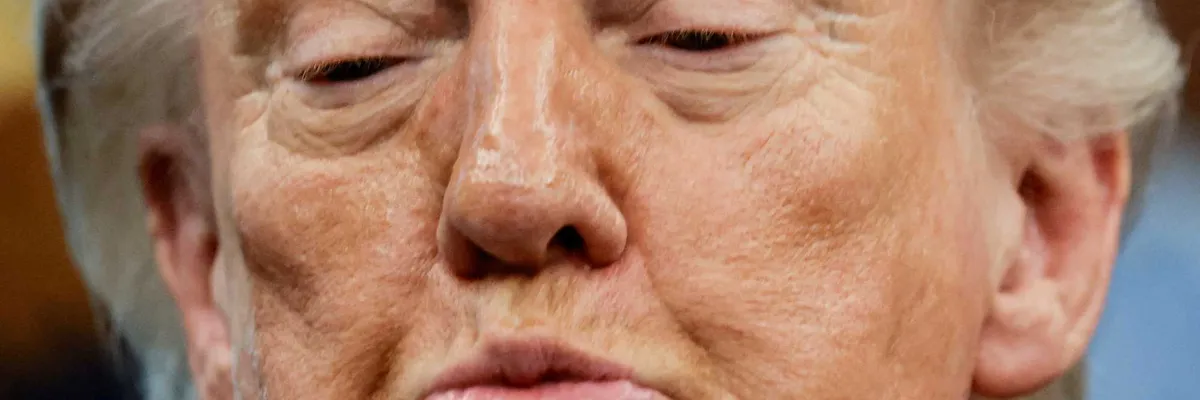
In a column for Alternet, the progressive online news outlet, D. Earl Stephens argues that Republicans have been left with a single choice after this month's midterm elections: sever themselves from President Donald Trump, or go down with him. Writing days after results he describes as the most overwhelming defeat for a party in midterm history, Stephens contends the vote was, above all, a referendum on Trump himself — and that the president is unlikely to finish his second term.
A June 2025 warning
The column builds on an argument Stephens first laid out in June 2025, in a piece published on his Substack, 147 days into Trump's second term. At the time, he suggested the question dominating political conversation was pointed in the wrong direction. "Maybe, instead of wondering if our country will survive the next three-plus years of Donald Trump, this question should be asked: Will the grotesque and failing Donald Trump survive the next three years?" he wrote.
By then, Stephens argued, Trump was "overplaying a weak hand, touting a mandate he never had, and over-serving himself, instead of the American public." He took aim at the cabinet as well, writing that Trump had "surrounded himself with a cabinet that is right out of the bowels of Rupert Murdoch," and naming Hegseth, Noem, Kennedy, Loeffler, Bondi, McMahon, Gabbard and Duffy. Each, in his telling, owed the job not to "stellar qualifications, or abiding allegiance to our country," but to "their appalling capacity to bow over and over again to their huffing and puffing ringmaster."
Stephens accused that cabinet of "bringing back measles," turning air travel into "a literal, death-defying, high-flying act," "texting top-secret information to our enemies," and "defending the indefensible in court," while the president backed himself "into a corner."
Measles status lost, flights grounded
In the new column, Stephens presents recent developments as confirmation of that warning. On Tuesday — the 666th day of Trump's second term, as he notes — the United States historically lost its measles elimination status from the Pan American Health Organization, a development the New York Times reported that Stephens calls "really impossible for any sane person to properly process." Elimination status — which the United States has held since 2000 — is the designation the Pan American Health Organization, the World Health Organization's regional office for the Americas, gives to countries that have interrupted endemic measles transmission. He pairs the development with the aftermath of an aviation fiasco that grounded thousands of planes, which he reads as cabinet incompetence elevated "to sky-high levels." The cumulative effect, he writes, is that America has become "the laughingstock of the world, and the butt of all its jokes" — an emperor, in his phrase, with "no place to go but down and out."
A 'Bluenami' at the ballot box
Those failures culminated at the ballot box, in Stephens' account. In the run-up to the midterms, he writes, Trump — "doing his best Mussolini impression" — relentlessly told America to pretend he was on the ballot. Voters by the millions did just that, delivering Trump's party "the most overwhelming defeat in midterm history." Midterm elections fall halfway through a president's term, fill all 435 House seats and roughly a third of the Senate, and the party holding the White House has historically lost ground in nearly every one of them.
The numbers he cites are stark. Democrats hold a 12-seat advantage in the Senate and an 85-seat advantage in the House. Races were not merely flipped, he writes; they were "turned upside down and shook." Texas — "TEXAS," as he emphasizes — went blue by +12, North Carolina by +20 and Georgia by +18, margins he calls "breathtaking," and even Mississippi now has a Black senator-elect. Stephens labels the sweep a "Bluenami," summing up the mood with one word: "r-e-l-i-e-f."
Having pored over "hundreds and hundreds of column inches" of post-election analysis in search of the wipeout's causes, Stephens says one through line runs through the after-action reports: the election was "a mandate against the convicted felon, Donald John Trump." Roughly 75 percent of Americans, in his assessment, are "sick and tired" of the president, and "there will be no coming back from it." He notes he reached a version of that conclusion more than a year earlier, quoting his own line from June 2025: "Stick a fork in him. He's done."
Health questions and vanishing acts
So, he asks, "now what?" Stephens writes that he continues to find it "impossible to believe" Trump will finish his presidency, quipping that "there is not enough room in this country for 340 million Americans" and the president. Central to that judgment is Trump's condition. Describing the president as "an old 80," Stephens catalogs what he presents as visible decline — bulging ankles, scabbed hands, slurred speech, heavy makeup — and calls Trump "a dying mess."
He also highlights a pattern of unannounced, multi-day absences from public view, several of which he says have occurred during the second term. The most recent came last week, when the president was, by Stephens' account, neither seen nor heard from for four days while thousands of Americans were trapped in airports by the aviation meltdown. Stephens faults what he calls the "broken corporate media" for no longer asking where the president goes, and invites readers to imagine the reaction had Barack Obama or Joe Biden vanished for days at a time without notice. How long, he asks, will the president keep doing this — and, "more importantly," want to? He calls the 80-year-old "the absolute picture of pain," doing his best to "drag everybody down to his miserable level."
Trump's response: blame and escalation
Trump's answer to the midterm wreckage, Stephens writes, was to "blame others, and double-down on his hate, bigotry and vitriol" — most notably by placing Stephen Miller, whom Stephens denounces as "a Nazi," in the chief of staff chair. Trump, he observes, has "the singular talent of going lower," but the operative question for Republicans is concrete: how much longer will they allow themselves to be "dragged under" with him? Stephens concedes the party has stuck by Trump for a decade, but insists that "there are realities, and then there are political realities."
The case for 'cut and run'
The political reality, as Stephens frames it, is that "Trump is actively killing the Republican Party." If the GOP has any hope of "stabilizing their descent, and cutting their historic losses," he writes, it must "cut and run" from the president. He urges Democrats, "if … smart," to press the advantage and keep tying Trump around Republicans' necks until — and if — the party makes its break.
Impeachment and the Murdoch factor
At that point, Stephens predicts, impeachment would follow "for one of any number of 100 offenses." He believes Democrats would settle on Trump's "gross misuse (stealing) of public funds," a case he calls "compelling and easy to make." An electorate he describes as overwhelmingly sick of corruption in the White House, he argues, would want the president "run out of town on a rail" once the full scale of the self-dealing is exposed. Removal, he notes, would require only "a handful of Republicans" joining Democrats in the Senate. Under the Constitution, removal from office requires a two-thirds supermajority in the Senate — 67 of 100 votes — after a simple-majority impeachment vote in the House, which is why even a small number of Republican defections would be decisive in his scenario.
With a presidential race then roughly a year away, Stephens asks how many Republicans would willingly "lash themselves to a two-ton anchor" dragging them to the bottom of the Potomac River. He extends the calculus to the president's media patrons, asking how long what he calls "Trump TV" will refrain from dropping him "like a sack of dirt" and redirecting its coverage toward another Republican hopeful as the presidential election swings into full gear. Stephens writes that there are already signs Rupert Murdoch is "ready to bail on the toxic Trump," a rupture he suggests the president would handle badly.
A bleak closing portrait
The column ends with a withering assessment. Stephens calls Trump "a failing, flailing old man" but, "worse than that," "old news" — "the most polarizing figure in American history" reduced to "a played out, scratched record." In his words, the president is "hated by most of the planet" and must now spend what little time he has left "trapped in a tiny, miserable world of his making."
Stephens expects Trump to keep lashing out and blaming everyone for his demise, with his most ardent supporters holding their noses and rushing to his side in hopes of pardons, while the rest of the country tunes him out and turns toward a future without him. Trump, he concludes, has so thoroughly overstayed his welcome that only the man most responsible for saddling America with him will miss him when he is gone. His parting line is a farewell of sorts: "He's all yours now, Vlad."
D. Earl Stephens is the author of "Toxic Tales: A Caustic Collection of Donald J. Trump's Very Important Letters" and an award-winning journalist who capped his newspaper career as managing editor of Stars and Stripes.

