Altcoins Rally Broadly, but Altseason Is Not Here Yet
Key Takeaways
- •The CoinMarketCap Altcoin Season Index registered 45 on September 19, below the 75% level the platform requires before classifying the market as altcoin season.
- •On September 18, 31 of 45 eligible assets among the 60 largest cryptocurrencies rose more than 5% in 24 hours, with 14 posting double-digit gains across sectors including DeFi, Ethereum scaling networks, layer-one blockchains, privacy coins, meme tokens, and real-world-asset projects.
- •Glassnode data published on September 18 show altcoins' futures open interest share trailing Bitcoin's by roughly 12 percentage points, leaving derivatives positioning below the firm's risk threshold, which sits about five points below parity.
- •Uniswap gained 27% on September 18 while its tracked futures turnover exceeded five times spot volume and short positions drove most liquidations, showing how a single token can attract aggressive derivatives activity before market-wide indicators signal a trend.
- •Because the CMC index uses a rolling 90-day window, sustained altcoin outperformance and spot demand after the rally, rather than single-day strength, are needed before altseason conditions could be reached.
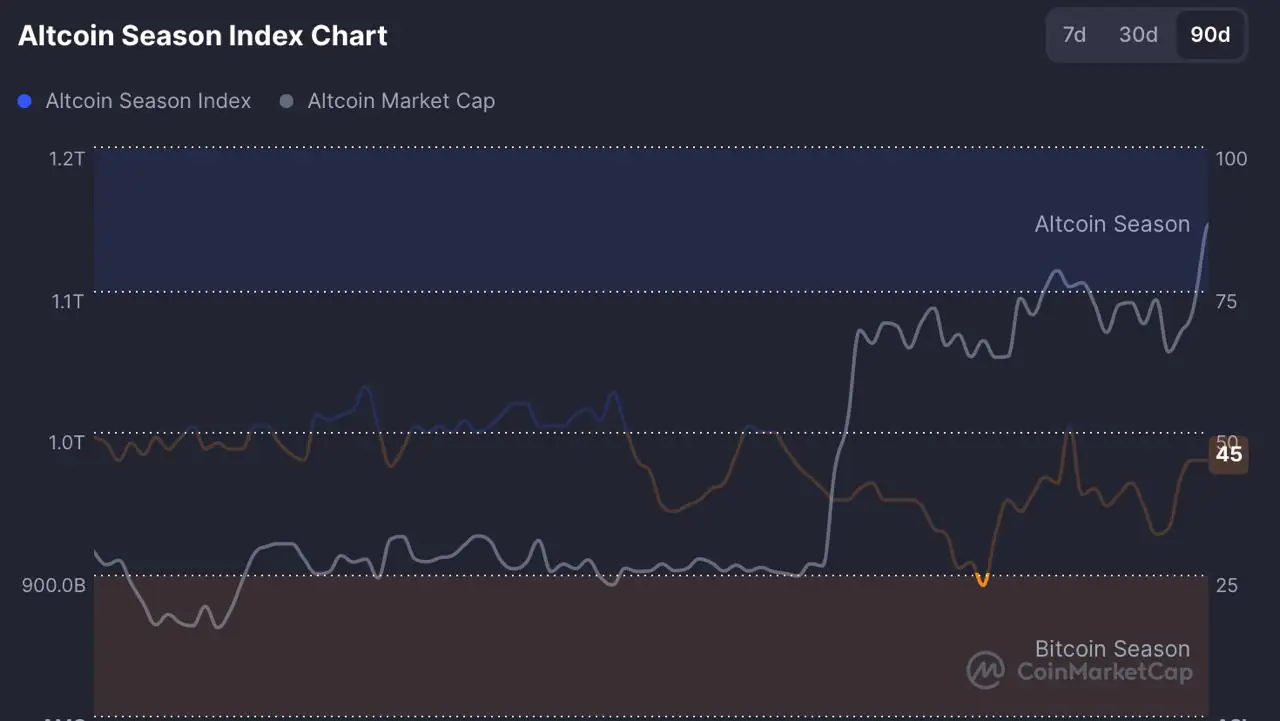
The rally was broad enough to stand out, but it has not lasted long enough to qualify as altseason. CoinMarketCap's index remains well below its threshold, while Glassnode data show that futures positioning has not yet entered its historical risk zone.
Why a Reading of 45 Falls Short of Altseason
The CoinMarketCap Altcoin Season Index stood at 45 when checked on September 19. The index measures how many eligible cryptocurrencies among the top 100 have outperformed Bitcoin during the previous 90 days.
Stablecoins such as USDT and DAI are excluded, as are asset-backed tokens including WBTC and stETH. A reading of 45 means that 45% of the remaining group beat Bitcoin during the measured period. CoinMarketCap does not classify the market as being in altcoin season until that share reaches 75%.
Altseason itself is an informal trading term rather than an official designation, and CMC's index is one of the most widely cited benchmarks for it. Because the gauge looks back on a rolling 90-day window, its reading shifts only as newer sessions extend, or replace, the current count.
This is why a strong day is not enough to change the label. Daily market data can show where money is moving now; the CMC index asks whether altcoins have maintained that advantage for three months.
The September 18 Rally Was Broad, but Still One Day
A review of the September 18 altcoin-led rally found that 31 of 45 eligible assets among the largest 60 cryptocurrencies gained more than 5% over 24 hours. Fourteen posted double-digit increases.
The leaders included decentralized finance tokens, Ethereum scaling networks, layer-one blockchains, privacy coins, meme tokens, and real-world-asset projects. The gains were not confined to one project or one corner of the market. Breadth across those categories is relevant to the altseason question, because it separates a market-wide move from a rally concentrated in a single narrative.
That breadth helps establish that capital was moving beyond Bitcoin, but it cannot establish a 90-day trend. Many of those assets would need to retain their advantage through subsequent sessions before the CMC index could approach 75.
Futures Positioning Has Not Reached Glassnode's Warning Line
A Glassnode chart published on September 18 adds a different view of the rally. It compares altcoins' share of futures open interest with Bitcoin's share, showing where derivatives positions are concentrated.
Open interest — the total value of futures contracts that remain open — is watched as a gauge of how much capital is committed to derivatives, a different question from how much trading volume changes hands. The orange line measures the percentage-point difference between the two shares. A deeply negative reading means Bitcoin still accounts for considerably more open interest. As the line approaches zero, altcoins are taking a larger portion of the futures market.
Glassnode places its risk threshold approximately five percentage points below parity. The latest point appears to be around 12 points below Bitcoin's share, leaving it some distance from the area associated with several earlier periods of market stress.
This does not mean leverage is low or that the rally is safe. The indicator measures relative concentration across the tracked market, not the leverage used by individual traders. It also cannot show whether the new futures positions are long or short, or whether spot buying is keeping pace.
Its message is narrower: altcoins have not captured enough of the futures market to recreate this particular historical warning. That leaves positioning below the risk line, but it does not predict whether prices will continue rising.
Uniswap Shows How One Token Can Heat Up Earlier
A market-wide indicator can remain below its threshold while trading becomes crowded around individual assets. Uniswap analysis published on September 18 recorded a 27% daily gain as tracked futures turnover reached more than five times spot volume. Short positions also accounted for most of the reported liquidations.
Ratios above one indicate that derivatives turnover outweighed spot trading; a reading above five points to a session dominated by futures activity. Those figures describe the September 18 snapshot and are not live September 19 readings. Their value here is as a case study: UNI attracted aggressive derivatives activity even though the combined altcoin market remained below Glassnode's warning line.
Forced short closures can amplify a breakout because traders must buy back their positions as price rises. Once those liquidations fade, continued gains depend more heavily on new demand absorbing sales from investors taking profits.
Would Move the Market Closer to Altseason?
- Broader 90-day outperformance: The CMC index would need to rise from 45 toward its 75 threshold.
- Support after the rally: Recent leaders would need to hold above their former ranges during a pullback.
- Demand beyond derivatives: Spot activity would need to keep pace as futures open interest grows.
What Would Weaken the Case?
- Recent leaders quickly surrender their breakouts.
- Open interest grows while spot participation fades.
- Liquidations provide much of the upward momentum.
- Altcoins lose ground to Bitcoin during subsequent sessions.
The Next Pullback Will Say More Than Another Rally Day
Another surge would increase the short-term performance figures without proving that buyers will defend the new prices. The clearer test will come when forced short covering slows and traders begin taking profits.
If leading altcoins hold their breakouts and the CMC index continues climbing, the September rally may be developing into a longer rotation away from Bitcoin. If those gains disappear while futures positions remain elevated, the move will look more like a burst of leveraged speculation than the beginning of altseason.
This article is provided for informational purposes only and does not constitute financial or investment advice. Cryptocurrency prices, derivatives positioning, and market indicators can change rapidly.
Source: Coindoo

