Alan Dershowitz Defends Trump and Argues for Broad Free-Speech Protections
Key Takeaways
- •Dershowitz argued that the First Amendment applies only to Americans, contending that Mahmoud Khalil's three-month ICE detention stemmed from his immigration status rather than his criticism of Israel.
- •He denied that his argument at Trump's 2020 impeachment trial—that a lawful act motivated partly by reelection is not impeachable—emboldened the president during his second term.
- •Dershowitz rejected the characterization of January 6 as a coup attempt, asserting that Trump left office after the 2020 election despite challenging the result.
- •He supported the administration's defunding of NPR and public television and its limits on Smithsonian exhibits, while opposing the cancellation of university research grants.
- •Dershowitz claimed open debate has largely disappeared, faulting Democrats and independent bookstores, and said professors should teach critical thinking rather than advocate personal views, including on climate change.
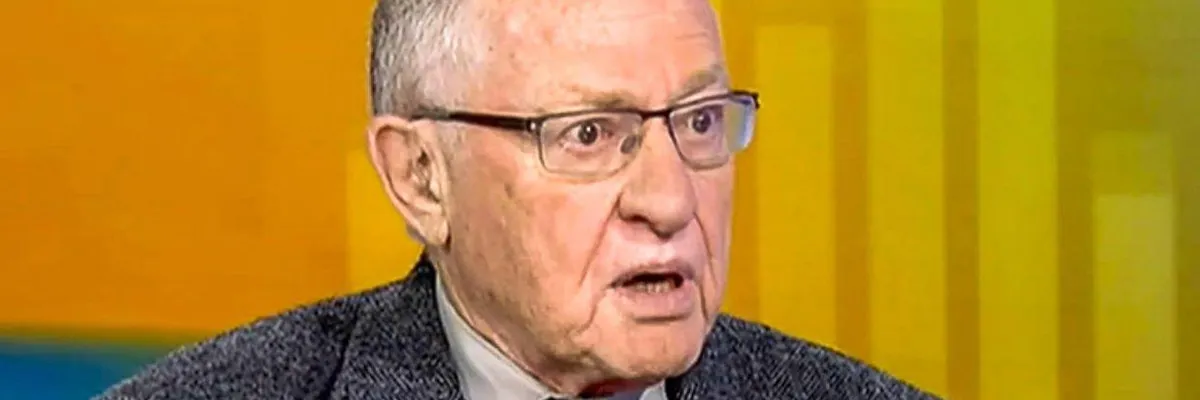
Attorney Alan Dershowitz, one of the most prominent and controversial lawyers in the United States, discussed President Donald Trump, free speech, antisemitism and academic debate in an AlterNet exclusive interview.
Dershowitz played key roles in the successful legal cases of accused criminals including Harry Reems, Claus von Bülow and O.J. Simpson during the late 20th century. He also became one of the world’s most distinguished law professors, teaching at Harvard University and writing influential works on subjects ranging from criminal defense to Jewish rights.
He has also drawn controversy. In 2020, Dershowitz defended Trump during his first impeachment trial, which concerned Trump’s effort to withhold military aid from Ukraine unless Ukrainian officials helped him smear Democratic presidential candidate Joe Biden. The House impeached Trump over the Ukraine affair in December 2019, and the Senate acquitted him in February 2020. Dershowitz was also accused by Virginia Giuffre, one of Jeffrey Epstein’s sex-trafficking victims, of abusing her, including when she was underage. After legal proceedings, Giuffre recanted her claim.
The interview, conducted by Rozsa, was lightly edited for clarity, context and length.
The First Amendment and antisemitism
Rozsa: When I was 12, I was nearly murdered in an antisemitic hate crime, so I know that antisemitism is real and dangerous. At the same time, I am concerned that the Trump administration may have gone too far in fighting it, including in the case of Mahmoud Khalil, a green-card holder who was detained by ICE for three months over speech criticizing Israel. As a Jew who has fought antisemitism and advocated for civil liberties, where do you draw the line between opposing antisemitism and respecting free-speech rights?
Dershowitz: I have no respect for the free-speech rights of non-American people. The First Amendment applies in America to Americans, and there has been no restriction of anybody’s free-speech rights. They can use Zoom and speak freely outside the country.
I do not see any contradiction between enforcing immigration laws and making sure that people do not come into the country. If they entered through fraud, even if they were elected to Congress, like Ilhan Omar, or became a Columbia student, they can still exercise their free speech. In fact, their speech has received a new megaphone because of the controversy surrounding them. They can do podcasts, video conferences and anything else they want. Their free speech has not been restricted.
On the other hand, my free speech has been severely restricted by Harvard, which has essentially banned me from speaking there; by the 92nd Street Y, which has banned me; and by Temple Emanu-El, which has banned me from speaking. There have been significant restrictions on my free speech. I can still speak to you, but many audience members who would like to hear me cannot hear me at those venues.
I care deeply about free speech, but you have to examine it functionally. If you can speak through Zoom or other media, and you are not entitled to be in America, that does not sound to me like a violation of the First Amendment.
That framing matters for readers: under long-standing U.S. constitutional doctrine, the First Amendment limits government action, while private institutions such as universities, cultural venues and bookstores are generally free to set their own rules about who may speak on their platforms. Where immigration enforcement ends and free-speech principles begin for noncitizens remains one of the open legal questions of Trump’s second term.
Rozsa: I want to make clear that I personally do not think Khalil is antisemitic. I was speaking broadly about where the line should be drawn. I disagree with you about Khalil’s ideas, and I also think that being detained by ICE for three months over one’s opinions violates the principle of free speech, even if it does not technically violate the First Amendment. Do you at least see that point?
Dershowitz: That did not happen. He was not detained because of his speech. He was detained because of his status. If he were an American and said exactly what he said, nobody would try to prevent him from speaking.
He was detained because of his status. He is a vicious antisemite. Let’s be clear about that. Anyone who focuses solely on Israel and Israel’s right to exist, without caring about the Kurds, the Uyghurs or any other group, and focuses only on the nation-state of the Jewish people, qualifies to me as an antisemite. So I disagree with you on both points.
Did Dershowitz embolden Trump?
Rozsa: In February 2020, during Trump’s first impeachment trial, you argued that a lawful act does not become impeachable because of a reelection motive. You added, “If a president does anything unlawful, that’s completely different.” I later called this the “Dershowitz precedent” because I argued that it essentially emboldened Trump to view himself as above the law. Do you believe that, during his second term, he has felt emboldened to do illegal things?
Dershowitz: Not by my defense. My defense was constitutional. I think President Lincoln, President Jefferson and President Roosevelt all did things that would come under the impeachment clauses directed against President Trump. You can ask whether they were emboldened. They did things that pressed the limits of executive authority.
My answer is no. I do not think President Trump was emboldened by my defense or by others who argue that a lawful act cannot be turned into an impeachable offense merely because it may have been motivated in part by political or electoral considerations. That would open the door to virtually every president being impeached.
The boundary between lawful executive authority and impeachable conduct has followed Trump into his second term, resurfacing in disputes over university research funding, museum exhibits and public media discussed later in this conversation.
Rozsa: That is an interesting perspective. I had not thought of it that way. You have a long history of making comments that cause people to pause and reflect. I would argue that was part of how you assisted O.J. Simpson when you advised him. You gave his legal team ideas that helped reorient them. This actually—
Dershowitz: That is what I tried to do in all my legal representation. I try to push the envelope. As a professor, I try to do the same thing. I try to stretch people’s minds and make them reconsider issues they may have thought were settled.
Rozsa: In a 2019 interview, I expressed concern that if Trump lost the 2020 election, he would refuse to accept the result. You told me that no president would refuse to step down if an opponent were elected and that the American public would never tolerate it.
Dershowitz: Right.
Rozsa: Looking back, do you think you were incorrect—that Trump did refuse to step down and that the public tolerated it?
Dershowitz: Of course not. Neither statement is true. First, Trump did not refuse to step down. He stepped down. He accepted the election, although he challenged it.
I wish Al Gore had challenged the election in 2000. He did not. Challenging an election is a good thing. Some people wish Richard Nixon had challenged the 1960 election. He challenged it, criticized it and continues to criticize it, but he stepped down. He left the White House.
So no, I do not think what I said was wrong. Trump has criticized many elections. Sometimes he has been right and sometimes he has been wrong. But he has never refused to accept the results of an election by refusing to leave the White House.
Rozsa: I would argue that the January 6 coup attempt constituted an effort not to step down from power.
Dershowitz: That is simply false. He made a speech. I have read the speech. He asked people to protest lawfully. He did not urge them to do anything illegal. What they did, they did on their own, and it was not a coup attempt. He did not try to prevent a succession by physical force. I do not agree with that characterization.
The events under dispute took place on January 6, 2021, when rioters breached the U.S. Capitol as Congress met to certify the 2020 election results; Trump left office on January 20, 2021.
The value of civil debate
Rozsa: We have been able to have this conversation civilly even though we strongly disagree. Is that unusual in your experience?
Dershowitz: In the last 10 years, you cannot have a debate. For example, Harvard professor Michael Sandel wrote a book against meritocracy. I think meritocracy is the key to democracy and to American success, so I challenged him to a debate. Harvard would not hold such a debate.
I used to debate William Buckley and many other conservatives. Debate is dead. There are no more debates. That is largely a function of the Democratic Party. They have refused to debate. They are in the process of trying to rid themselves of John Fetterman, a centrist Democrat, so he probably will not be a Democrat in the next election.
I think it is good that we are having a debate and discussion. There is too little of it.
I have a book called Why I Quit the Dems: and So Should You! You cannot buy it in an independent bookstore. If you walk into a local independent bookstore, they will not sell it or carry it.
Independent local bookstores have become enemies of free speech and the First Amendment. They carry only radical, liberal or progressive books. You cannot buy a conservative or Republican book in many of these so-called independent bookstores. I urge your viewers and listeners not to patronize independent bookstores. They used to protect free speech, but no longer do.
If a bookstore will not sell books from both sides of the political spectrum, you should not patronize it. If you want to buy my book, you should buy it on amazon.com or another website that sells all kinds of books, rather than websites that censor and close down the marketplace of ideas.
Rozsa: You said that Democrats are responsible for harming free speech in this country, but Project 2025, as implemented by Trump, has rigorously purged ideas that the administration objects to, describing them as “woke” or “DEI.”
Dershowitz: Give me an example of something that was actually censored by Republicans.
Rozsa: What about Smithsonian exhibits from which material critical of American history has been removed?
Dershowitz: The Smithsonian Institution has become a very polemical and political institution. I completely agree that public institutions—including the Smithsonian, museums paid for with state or city funds, and National Public Radio, which used to be publicly supported—should not be ideological.
They should not push a narrative that America was created by slavery and that America is a terrible country. I think the Smithsonian should present history objectively and—
Rozsa: When the government decides what is objective or polemical, does that violate the fundamental idea behind the First Amendment—that the state should not dictate how individuals perceive events or express their opinions?
Dershowitz: Some part of the state has to prevent other parts of the state from doing things. Remember, the Smithsonian Institution is the state. What the Trump administration did was not tell the Smithsonian what it should do, but tell it what it cannot do. I completely agree with that. I agree with them—
Rozsa: What about canceling millions of dollars in research grants to universities because—
Dershowitz: That is wrong. That is wrong, and I have opposed it from the very beginning.
Rozsa: What about trying to remove Jimmy Kimmel from the air?
Dershowitz: Wait a minute. Let me finish my statement.
Rozsa: I apologize.
Dershowitz: I have strongly opposed any attempt to restrict pure science. But when scientists use their position as scientists to indoctrinate students rather than teaching them how to think, I believe the government has a role to play in perhaps defunding propagandistic institutions, as it ultimately defunded National Public Radio and National Public Television. That was the right thing to do.
Trump and science
Rozsa: Sometimes what the government calls propagandistic is not. For example, officials refer to climate change as an ideology, even though human-caused climate change is an established fact verified by tens of thousands of scientists across dozens of disciplines.
When a West Point professor is fired or funding is withdrawn because the professor tells the truth about humans overheating the planet, and Trump says he is merely stopping an ideology with which he disagrees, he is in fact violating the free-speech rights of scientists.
Dershowitz: Who is being interviewed here, you or me?
Rozsa: I am responding to your ideas.
Dershowitz: Take someone like Thunberg, who uses environmentalism and climate control to promote what I consider racist, antisemitic, anti-American and anti-Israel propaganda. We know that climate control has been misused to promote ideologies and propaganda.
I support climate control. I support environmentalism. But I think it is an issue that can be debated. The whole world can be wrong. You could say that every scientist in the 1900s said the Jews poisoned wells and were responsible for one war or another. They were all wrong.
I have a new book coming out called It Ain’t Necessarily So, in which I challenge everything. I challenge science and religion. I think everything in a democracy that is subject to freedom of speech should be open to challenge, including things I agree with, such as climate control.
Challenging something is fine. I think firing people because they teach certain subjects is wrong. I would need to know what was being taught. I would fire a professor who stood up and said, “Climate control? You cannot argue with that. You cannot disagree with that. If you do disagree with it, you cannot be in my class.” I would fire a professor for doing that.
The same applies to professors at Columbia who have said that Zionism is racism and that anyone who disagrees cannot be in their class.
Rozsa: If a science professor tells students they can jump off a roof, flap their wings and fly away, the professor should be fired for teaching bad science.
Dershowitz: Of course.
Rozsa: I would argue that the same principle applies to denying climate change.
Dershowitz: That would be wrong. Climate change, to the degree that it is advocated, is somewhat controversial. The degree to which human beings have influenced the climate is an issue that should be debated and discussed inside and outside the classroom.
Teachers should not tell students to jump off a roof or to join demonstrations in favor of climate control. That is not the teacher’s role. The teacher’s role is to help students think for themselves and reach their own conclusions. Teachers who violate that rule do not belong in universities.
Teachers who use their platform to preach their own gospels, whether about climate control or anything else, are violating an almost sacred role. They have a bully pulpit not to persuade students that their own viewpoint is correct, but to teach critical thinking so students can reach their own conclusions.
I am a strong opponent of capital punishment. If one of my students left my class and said, “You taught me how to think, and I am now doubling down on my commitment to capital punishment. I want to see more people executed,” I would consider that a great success, even though the student’s conclusion was completely contrary to mine. If I taught the student to think independently, that was my goal.
Rozsa: If a science student says greenhouse gases do not trap heat and cause the planet to become excessively warm, that is as incorrect as saying two plus two equals five.
Dershowitz: Let them try to prove it. Some years ago, my close friend Stephen Jay Gould, the greatest paleontologist in the world, came to me with a problem.
Rozsa: I loved his writing. I am a huge fan.
Dershowitz: Gould told me he was on a committee deciding which applicants would receive Ph.D.s. There was an application from a brilliant student at a Christian college with an outstanding record, but the student believed in creationism—that God created the world in six days and rested on the seventh. Gould asked whether he should admit the student.
I said, “Absolutely, of course. Let him make his arguments. Let him try to persuade you. You will probably persuade him that he is wrong, but even if you do not, as long as you give him the opportunity, I think he would be good.”
I loved having students who fundamentally disagreed with everything I believed. In 50 years of active teaching at Harvard, I tried my best never to express a personal view in a classroom. Never.
Source: AlterNet

