Alabama's 'Gulf of America' Mandate Takes Effect as Hurricane Isaias Threatens Gulf Coast
Key Takeaways
- •Hurricane Isaias was rapidly intensifying and expected to reach the Gulf shore today or overnight, putting Alabama's coastline on alert.
- •Alabama's House Bill 2, which took effect last week, requires all state and local entities and their employees to refer to the Gulf of Mexico as the 'Gulf of America,' following a Trump executive order.
- •The law extends to the state university system, and the University of Alabama at Birmingham has ordered journalists at NPR affiliate WBHM to comply even though the Associated Press and NPR do not accept the name change.
- •Public employees must make reasonable efforts to update pre-existing maps, educational materials, and communications, with an exception where doing so would impose an operational or financial burden.
- •Faculty have raised academic freedom and free speech concerns, while a spokesperson for Governor Kay Ivey defended the mandate, stating that Alabama refers to the Gulf as the Gulf of America.
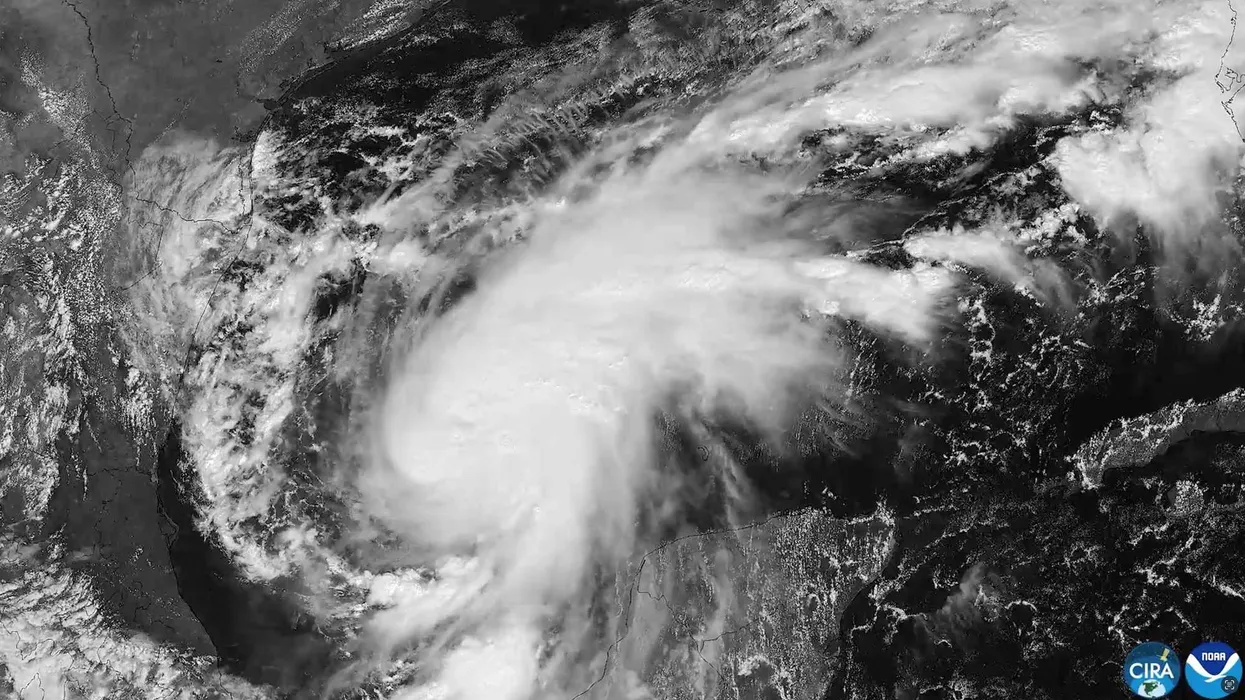
Hurricane Isaias, rapidly intensifying, was expected to reach the Gulf shore sometime today or overnight, putting Alabama's coastline on alert — even as a new state law governs what residents and public employees may call the body of water the storm is approaching.
Under Alabama's House Bill 2, which took effect last week, it is now state law that the storm will strike from the "Gulf of America" rather than the Gulf of Mexico.
For anyone along the Mobile coastline, the name may matter little. What could matter more is whether the government engages effectively with the Federal Emergency Management Agency (FEMA), the agency that coordinates federal disaster response and administers recovery assistance. But for the state Legislature, what the Gulf is called has apparently been a matter of priority.
House Bill 2 requires "all state and local entities and their employees" to call the Gulf of Mexico the "Gulf of America," following Donald Trump's directive to reflect the terminology "in all newly created maps, documents, educational materials, websites, official communications, and other resources," enacted through a Trump executive order.
The body of water at the center of the dispute is not Alabama's alone: the Gulf is bordered by the United States, Mexico and Cuba, with Texas, Louisiana, Mississippi, Alabama and Florida on its northern rim, even as the statute's requirements run only to Alabama's state and local entities.
The law is understood to cover anyone working in the state university system, including journalists at WBHM, the University of Alabama at Birmingham-sponsored NPR affiliate radio station, as well as state employees issuing statements on matters such as hurricane damage. Republican lawmakers say faculty may still refer to the Gulf of Mexico "for historical purposes" during instruction.
University faculty have told publications such as Inside Higher Ed that the measure sounds restrictive to academic freedom, though it is unclear just how often classroom professors refer to the Gulf by name at all.
Public Radio Caught in the Middle
The University of Alabama at Birmingham has ordered journalists at WBHM to comply, according to emails obtained. Neither the Associated Press nor NPR, which supply news content to the station, accept the name change, which stemmed from the executive order. Station workers said they will follow the law but do not understand how they are supposed to monitor mentions of the Gulf, as suggested by the university's top lawyer. The timing gives the dilemma an immediate edge: with Isaias closing in, hurricane tracking, warnings and damage updates are precisely the coverage in which references to the Gulf are difficult to avoid, making WBHM's storm reporting a real-time exercise in applying the mandate on air.
'Period'
A spokesperson for Republican Alabama Gov. Kay Ivey said: "The state of Alabama refers to the Gulf as the Gulf of America, period. It is not hard to see that these so-called 'free speech' complaints are just a cover up for blatant bias against the Trump Administration."
The law requires public employees to "make reasonable efforts to update all pre-existing resources owned by state and local entities" under their jurisdiction — including maps, educational materials and communications — to reflect the name change "where practicable," with an exception where doing so "would impose an operational or financial burden." How that exception is interpreted — and by whom — is among the practical questions now facing state agencies and campuses as they sort through existing maps, course materials and archives.
Jason Senkbeil, a tenured professor in the University of Alabama at Tuscaloosa's Department of Geography and the Environment, said he has "been calling it 'the Gulf' and not saying which one for years because I didn't know where this was going." Now, he indicated, he will do as ordered.
Critics have raised a series of questions: if state professors can be mandated to use Trump's preferred name for the Gulf, why not for other elements of teaching and research? Is there a difference between a professor discussing some aspect of the Gulf environment and a state mapmaker? And does extending the requirement to what the NPR station says on the air amount to an abridgment of freedom of speech and of the press?
The episode has also prompted a broader political question: why is this the issue before a midterm election in which voters are angry about runaway prices from tariffs and the war with Iran, excesses in mass deportation, and concerns about government corruption?
The original article was written by Terry H. Schwadron, who retired as a senior editor at The New York Times, served as Deputy Managing Editor at The Los Angeles Times, and held leadership roles at The Providence (RI) Journal-Bulletin. He was part of a Pulitzer Gold Medal team in Los Angeles, and his team was part of several Pulitzers in New York. Source: Alternet

