Ajinomoto Raises AI Chip Film Prices 30% as Quarterly Profit Surges 127%
Key Takeaways
- •Ajinomoto controls more than 95% of the global ABF market, a position that makes it a critical supplier to major chipmakers including Nvidia, Intel, and AMD.
- •The company implemented an approximately 30% price increase for ABF after activist shareholder Palliser Capital publicly advocated for a hike exceeding 30% in March 2026.
- •The ABF supply-demand gap is projected to widen from roughly 10% in the second half of 2026 to 42% by 2028 as AI accelerator production scales faster than substrate capacity can expand.
- •Analysts estimate the price increase could raise substrate costs across the semiconductor industry by 3% to 6%, with those costs ultimately flowing through to hyperscalers such as Microsoft, Google, and Amazon.
- •Ajinomoto raised its full-year forecast to 1.732 trillion yen in projected sales and 202 billion yen in business profit, while its seasonings and frozen food segment saw profit decline due to higher costs and slow recovery from North American recalls.
Ajinomoto (TYO: 2802), the 117-year-old Japanese company best known for inventing MSG in 1909, has raised prices by approximately 30% for the insulating film used in nearly every advanced AI chip. The move follows a 127% year-over-year surge in quarterly business profit and prompted the company to lift its full-year earnings forecast.
A Seasoning Company at the Heart of AI Hardware
Ajinomoto has become a critical node in the AI hardware supply chain through its Ajinomoto Build-up Film (ABF), a thin resin layer that provides electrical insulation inside the substrates of high-performance processors. The technology traces its origins to the company's amino acid chemistry research—the same scientific foundation behind its flagship MSG product.
Ajinomoto currently controls more than 95% of the ABF market, with Sekisui Chemical holding roughly the remaining 5%. A single AI accelerator can require between 8 and 16 layers of the film. Nvidia, Intel, and AMD all depend on ABF to insulate the microscopic wiring inside their chip packages. This concentration of supply in a single Japanese firm places Ajinomoto alongside other Japanese materials specialists—such as Shin-Etsu in silicon wafers and JSR in photoresists—as a linchpin of global semiconductor manufacturing whose output disruptions ripple across the entire chip industry.
The film was first adopted by a semiconductor manufacturer in 1999 and has been continually refined to meet the demands of increasingly dense CPU architectures. Big tech companies are projected to spend more than $670 billion on AI infrastructure in 2026, as reported by Cryptopolitan.
Price Hike and Supply Constraints
The 30% price increase was confirmed in a May announcement and has been implemented on a client-by-client basis. The decision came after activist shareholder Palliser Capital publicly called for a hike exceeding 30% in March 2026.
The ABF supply-demand gap is projected to reach approximately 10% in the second half of 2026, widening to 21% in 2027 and 42% by 2028. The accelerating shortfall reflects a structural mismatch: AI accelerator shipments are scaling rapidly as Nvidia, AMD, and custom-silicon programs at Microsoft, Google, and Amazon ramp production, while substrate-grade resin capacity requires multi-year lead times to qualify and bring online. Ajinomoto has committed more than 25 billion yen (about $150 million) to expand production capacity by 50% by 2030, though a planned new plant in Japan is not expected to begin operations until around 2032.
Previous ABF shortages in 2020 and 2021 stretched substrate lead times and triggered price surges of as much as 40%. During that period, substrate makers in Taiwan and elsewhere were forced to allocate output to their largest customers, squeezing smaller chip designers—an allocation pattern that could recur if the projected 2028 gap materializes.
Stock Performance
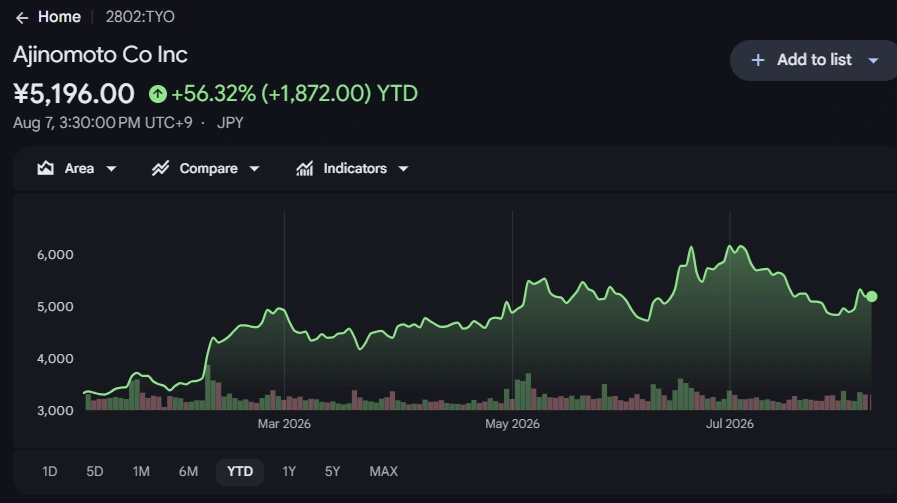
By mid-2026, Ajinomoto's stock had climbed approximately 65% for the year, trading at 5,196 yen ($32.93)—near the upper end of its 52-week range of 3,270 yen ($20.72) to 6,340 yen ($40.18). (Google Finance)
Impact on Chipmakers and Hyperscalers
A 30% increase in ABF prices does not translate into an equivalent rise in chip costs, as the film represents one input among many. Analysts estimate the hike could add 3% to 6% to substrate costs across the semiconductor industry.
Those costs will flow through foundries and packaging firms before reaching the balance sheets of hyperscalers such as Microsoft, Google, and Amazon. Because newer GPU and ASIC designs incorporate more ABF layers per chip, demand continues to outpace even aggressive capacity expansion plans. A key variable to monitor is whether Sekisui Chemical or other entrants can scale alternative ABF-type materials quickly enough to erode Ajinomoto's pricing power—a process that typically requires multi-year customer qualification cycles given the stringent reliability standards of AI-grade substrates.
Revised Forecast and Segment Performance
Strong ABF sales for AI servers and networks drove Ajinomoto's first-quarter earnings to record highs. The company has consequently raised its consolidated forecast for the fiscal year ending March 2027, lifting projected sales to 1.732 trillion yen ($10 billion) and business profit to 202 billion yen ($1.2 billion).
Electronic materials for AI, server, and network boards contributed an additional 9 billion yen ($57 million) to the sales outlook and 5 billion yen ($31 million) to the business profit projection. By contrast, the seasonings and frozen food forecasts were left unchanged, as profit in that segment fell by 600 million yen this quarter due to higher costs and a slow recovery from North American product recalls.
Ajinomoto also expects approximately 25 billion yen ($158 million) in added annual costs stemming from Middle East tensions.

