Airtel Africa CEO Calls for Industry-Wide Infrastructure Sharing to Cut Costs and Expand Coverage
Key Takeaways
- •Airtel Africa CEO Sunil Taldar called on African telecom operators to share equipment and spectrum, arguing the approach would remove duplicated investment and bring connectivity to underserved communities.
- •In March 2025, Airtel and MTN announced plans to share heavy network infrastructure, including towers, base stations, fibre and the Radio Access Network, in Nigeria and Uganda while remaining independent competitors in the consumer market.
- •In early August, Airtel launched Africa's first commercial satellite-to-mobile service in the Democratic Republic of the Congo through its Starlink partnership, with a Kenya launch nearing and plans to extend the service across Airtel's 14 African markets.
- •GSMA research has consistently identified sub-Saharan Africa as carrying the world's largest mobile coverage gap, with tens of millions of people living beyond the reach of mobile broadband networks.
- •Airtel Africa plans to direct a major share of its $1.1 billion capital expenditure in 2026 toward spectrum acquisition and fibre rollout.
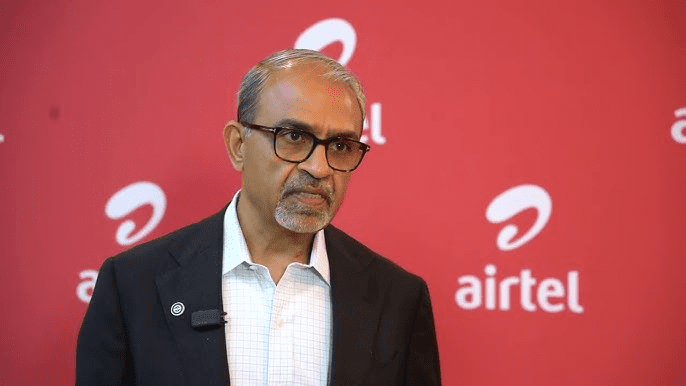
Airtel Africa Chief Executive Officer Sunil Taldar has called on telecoms operators across Africa to open their infrastructure to one another through coordinated equipment and spectrum sharing, describing the approach as cost-effective and a way to expand coverage and reach more customers.
Taldar made the remarks during an interview with Arise News on Friday, on the broadcaster's Business Report programme.
Operators, he said, spend millions of dollars deploying telecom infrastructure, yet coverage gaps persist because of funding limitations. Colocation and shared infrastructure, he added, would allow operators to penetrate underserved communities and gain new users. That constraint is not unique to Airtel: industry research, including the GSMA's annual connectivity studies, has consistently identified sub-Saharan Africa as carrying the world's largest mobile coverage gap, with tens of millions of people living beyond the reach of mobile broadband networks.
"If the need is to deploy 1,000 kilometres of fibre and Airtel deploy 1,000 kilometres of fibre while our competitor also deploys 1,000 kilometres of fibre in the same area, what are we doing? We're duplicating fibre," he said.
"If we share fibre, the same 1,000 kilometres of fibre on which our network can run and the competitor's network can run the other 1,000 kilometres that we've saved covers another 1,000 in another area. So what we're doing is we are removing duplication of investment," he explained.
The approach, he said, means "removing duplication of investment, covering more areas, solving real problems, reaching out to underserved communities and rural areas, and bringing more people into digital inclusion."
Airtel has already moved in this direction. In March 2025, Airtel and MTN announced plans to share heavy network infrastructure — including towers, base stations, fibre-optic networks and the Radio Access Network (RAN) — in Nigeria and Uganda. The partnership was designed to lower operational expenses and avoid the duplication of expensive telecom infrastructure. The pact pairs two of the continent's largest pan-African operators. Passive sharing of towers and fibre is already widespread across Africa, where operators have long leased sites from independent tower companies such as IHS Towers, American Tower and Helios Towers; extending cooperation to the active RAN layer between direct competitors is a rarer and deeper step.
Taldar noted that infrastructure sharing between operators does not change the fact that they compete in the same industry. Despite sharing physical infrastructure assets, he said, both operators will remain completely independent competitors in the consumer market.
The push for shared infrastructure comes as Airtel Africa bets a major share of $1.1bn CAPEX on spectrum acquisition and fibre rollout in 2026. The efficiency argument also lands at a time when African operators fund largely dollar-priced network equipment out of local-currency revenues, a squeeze that has weighed on earnings across the sector in recent years.
Beyond terrestrial networks, the CEO pointed to the Airtel and Starlink direct-to-cell partnership as a collaborative effort to deepen penetration beyond terrestrial towers' capacity. Direct-to-cell services are designed to connect standard smartphones via low-earth-orbit satellites without specialised hardware, treating satellite capacity as an extension of the terrestrial network rather than a replacement for it.
Setting out why African telecom operators need network sharing and a partnership with Starlink, he said: "Africa is not 100% covered. It's a continent where the population is sparse. There are many areas where putting up a tower and laying down fibre is not economically viable."
That reality, he said, presents three choices. The first is to forget about covering the areas that infrastructure cannot reach owing to limited funds, leaving large numbers of Africans outside the connected world. "Now that is not something that we are here for," he said.
The second is to find the funds and install the infrastructure, which does not make economic sense. "So both these choices are not choices available to us."
The third, according to the Airtel chief, is the partnership with Starlink, which solves the coverage issue. Satellite technology, he said, can provide connectivity in areas where terrestrial networks do not reach. "And that is the reason we signed up this agreement with Starlink," he said.
In early August, Airtel launched Africa's first commercial satellite-to-mobile service in the Democratic Republic of the Congo (DRC) through its partnership with Starlink. The service is also nearing launch in Kenya, with plans to extend it across Airtel's 14 African markets.
"This agreement brought us enterprise connectivity. A small enterprise in a rural area has the same right to operate as a small enterprise in an urban area. But they don't have access to connectivity in the absence of a terrestrial network. With Starlink connectivity or satellite connectivity, we can solve that problem," Sunil Taldar, Airtel Africa CEO, explained.
The markers of progress ahead are already laid out: a Kenya launch following the DRC debut, extension of the satellite service across Airtel's 14 markets, and the practical rollout of the MTN sharing arrangement in Nigeria and Uganda under the countries' colocation and infrastructure-sharing frameworks — alongside how the operator's 2026 capital spending translates into spectrum and fibre on the ground.

