AI Stocks Slide After Anthropic's Record IPO, and Wall Street Is Split on Whether This Is the Top
Key Takeaways
- •Anthropic raised $81.34 billion in the largest IPO in history, pricing at $83 and closing its Thursday debut up 17% at $97.17, before sliding 11% to roughly $86 on Friday.
- •Thursday's selloff sent the Dow down 1,101 points to 49,097—its first close below 50,000 since June—and 92% of S&P 500 stocks finished lower, the weakest market-breadth reading of the year.
- •Goldman Sachs Research estimates AI capital spending accounted for about half of S&P 500 earnings growth this year and lifted index earnings 25% above trend.
- •Since the S&P 500's record high on Oct. 6, Nvidia has fallen 39% and Intel has dropped 50%, while UBS cut global equities from Attractive to Neutral on elevated expectations and high index concentration.
- •Goldman Sachs forecasts the S&P 500 will rise 17% to 8,700 by the end of 2027, with earnings growth expected to slow from roughly 30% in 2026 to 18% in 2027 as AI capital-expenditure growth cools.
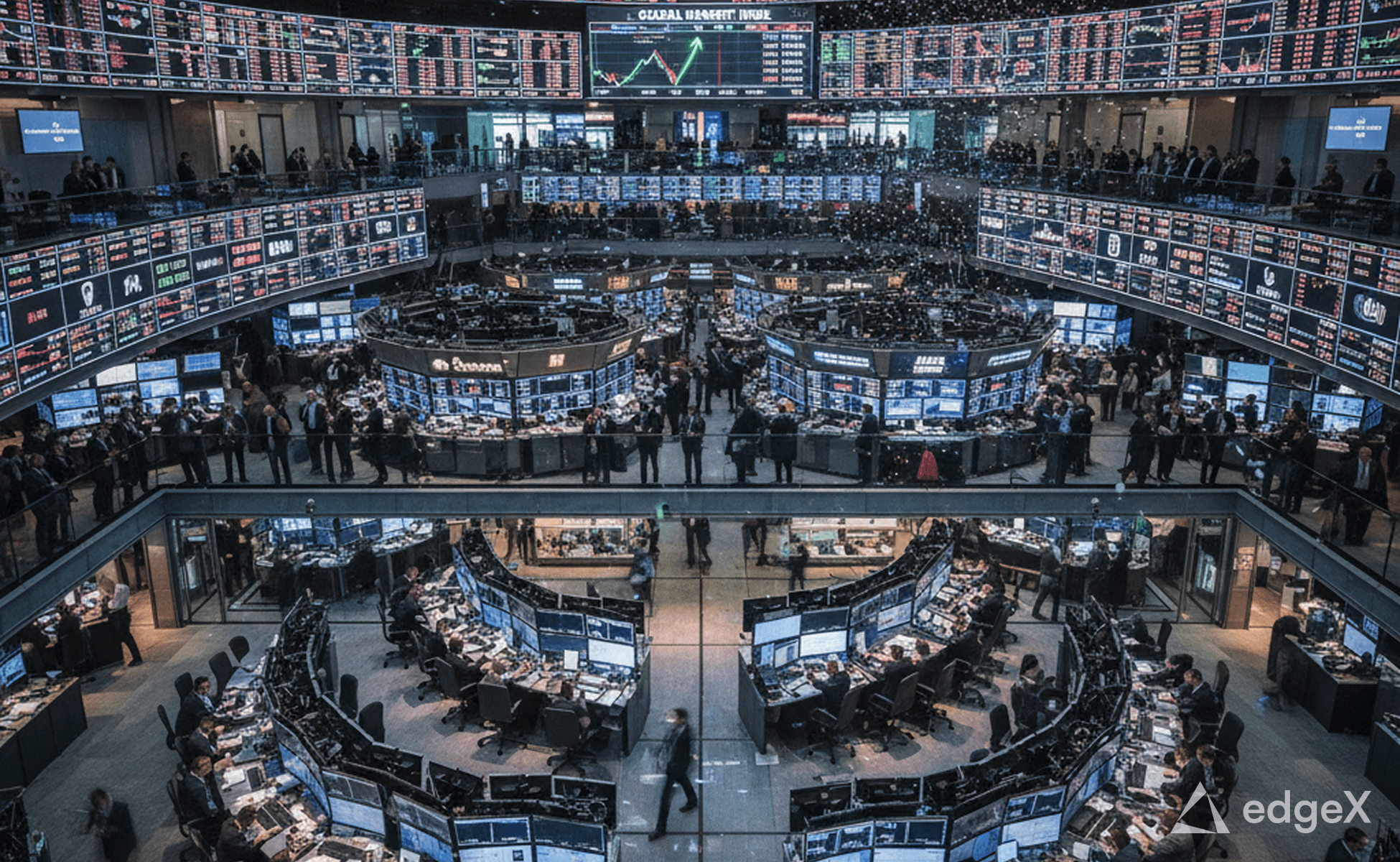
AI stocks sold off again on Friday, a day after Anthropic's record-breaking IPO failed to steady the broader market, leaving Wall Street divided over whether the artificial-intelligence rally has reached its peak.
Anthropic priced its shares at $83 and closed its first day of trading on Thursday at $97.17, up 17%, after raising $81.34 billion in the largest initial public offering in history, as Fortune's Shawn Tully reported. The milestone did little to lift the rest of the market. The Dow Jones Industrial Average fell 1,101 points, or 2.19%, to 49,097, closing below the 50,000 level for the first time since June. The S&P 500 dropped 2%, and the Nasdaq lost 2.2%.
The selling spread to Asia and Europe overnight, as Fortune's Jim Edwards reported. Anthropic slid 11% on Friday to roughly $86 per share, while the Nasdaq lost 1.55% and the S&P 500 fell 0.5%.
The stakes extend well beyond a single stock. AI capital spending accounted for "about half" of S&P 500 earnings growth this year, according to Goldman Sachs Research, and the bank's equity strategists estimate the AI investment boom has lifted S&P 500 earnings 25% above trend. In practical terms, an index-fund investor holds a bet on the data-center buildout.
The bear case
James Reilly, senior markets economist at Capital Economics, wrote on Friday that the declines in tech stocks and the S&P 500 "have further to run." The fact that Anthropic's IPO succeeded while other AI-related stocks tumbled, he argued, "highlights how different parts of the AI ecosystem no longer move as one."
That divergence is already visible in prices. Since the S&P 500's record high on Oct. 6, Nvidia has fallen 39% and Intel has dropped 50%. Yet investors still bought into Anthropic's IPO at a $1.5 trillion valuation.
Longtime AI skeptic Gary Marcus went further. In a Substack post on Friday, he wrote that Anthropic "is on pace to have one of the most embarrassing IPOs in history," calculating that AI stocks have lost more than 50% of their value in five months.
The middle ground
UBS's chief investment office recently cut global equities from "Attractive" to "Neutral," citing "elevated expectations, high index concentration, and a wider range of potential outcomes around AI." Index concentration describes how much of an index's performance rests on a small number of its largest stocks.
Ulrike Hoffmann-Burchardi, UBS's chief investment officer for the Americas and global head of equities, said the bank does not believe "the economic expansion, corporate earnings cycle, or structural AI investment story has broken."
"The AI debate is shifting from whether investment will continue to whether it can generate sufficient revenues and shareholder returns," she said. "Today's price action supports this shift in focus."
David Lefkowitz, UBS's head of U.S. equities, still expects the S&P 500 to reach new highs in the months ahead. But "AI monetization will need to ramp quite rapidly for investors to have confidence in the return on investment," he wrote.
Adam Turnquist, chief cross-asset strategist at LPL Financial, quantified how broad Thursday's selling was: 92% of S&P 500 stocks closed lower, the weakest market-breadth reading of the year, and the index broke below its 200-day moving average, a long-term trend line widely watched as a gauge of the market's underlying direction. Across nearly 300 such breaks since 1928, he wrote, the median time for the S&P 500 to climb back above that line has been four days.
The catch is volatility. When realized volatility was elevated heading into a break—as it is now—60% of those episodes saw a further drawdown of at least 10%, compared with 35% when volatility was low. Turnquist is watching whether the index holds "key support near 7,000."
The bull case
Goldman Sachs is the most bullish of the three firms. In a 2027 outlook titled "The beginning of the middle," published Nov. 17—two days before Thursday's drop—chief U.S. equity strategist Ben Snider's team forecast that the S&P 500 will rise 17% to 8,700 by the end of 2027.
Snider expects earnings to keep driving returns. The index's forward price-to-earnings ratio—a valuation measure that compares share prices with projected earnings—has fallen 19% this year to about 18 times, near its 10-year average, his team wrote. The strategists expect earnings growth to slow from roughly 30% in 2026 to 18% in 2027 as AI capital-expenditure growth cools, with the AI trade rotating from infrastructure stocks toward the beneficiaries of AI monetization and adoption, including the hyperscalers, the largest cloud-computing providers.
"Positive but decelerating growth has historically been associated with positive but moderating S&P 500 returns as well as rotations within the equity market," Snider wrote. His team also cautioned that the outlook for AI investment and corporate profit margins "in 2028 and beyond is highly uncertain."
Interest rates form part of the backdrop. UBS attributed Thursday's drop to AI concerns "combined with a more hawkish interest rate backdrop," while Goldman's economists expect the Federal Reserve to raise rates in December and again in March, to a peak of 4.25% to 4.5%.
The first test of which view proves correct arrives at Friday's close. The S&P 500 was on track for a seventh consecutive day of declines, which would mark its longest losing streak since the pandemic began in 2020. Goldman's 8,700 target was issued before Thursday's sell-off. Fortune's report has been updated with comments from LPL Financial's Adam Turnquist.
This story was originally reported by Fortune: AI stocks are selling off after Anthropic's record IPO, and Wall Street is split on whether this is the top

