AI Hyperscalers Are Pricing Bitcoin Miners Off the Grid — Here's Why It's a Massive Win-Win
Key Takeaways
- •AI data centers require continuous, high-quality grid power and low-latency connectivity, while Bitcoin mining can run in remote or interrupted power environments.
- •Grid interconnection delays and AI demand for power are pushing Bitcoin miners toward stranded and curtailed energy sources outside the main grid.
- •AI hosting contracts can provide miners with steady dollar-denominated revenue and reduce the need to sell mined Bitcoin during weak market conditions.
- •The article says Bitcoin’s April 2024 halving intensified revenue pressure on miners by cutting the block subsidy from 6.25 BTC to 3.125 BTC.
- •It argues that AI and Bitcoin are complementary in energy use, with AI taking prime grid power and Bitcoin monetizing otherwise wasted energy.
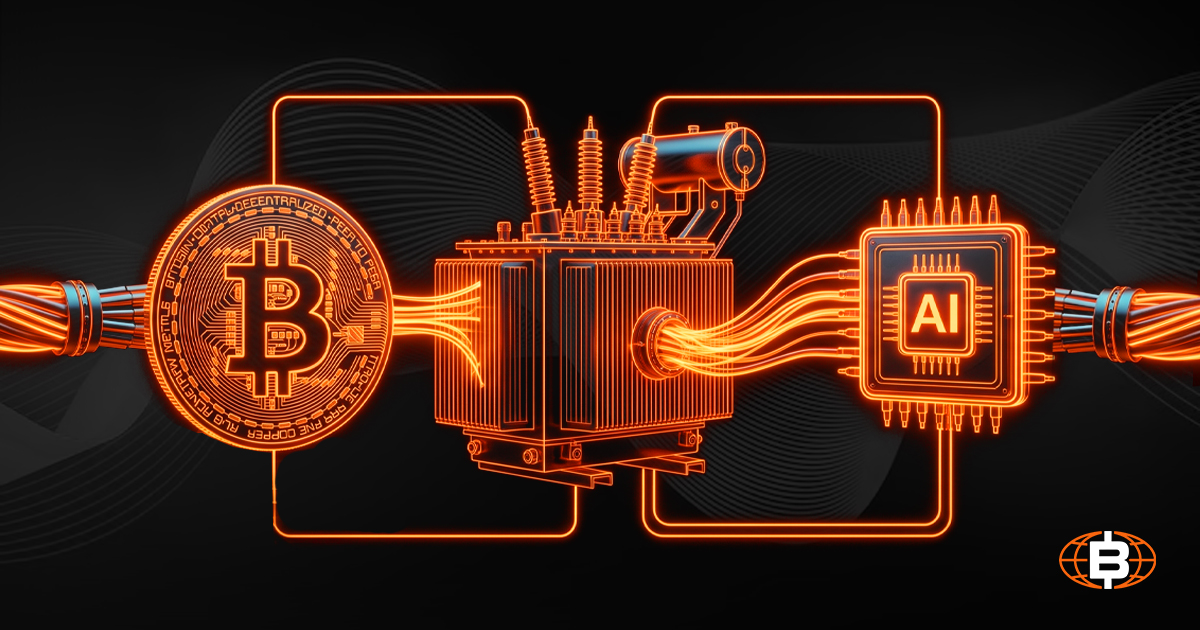
Over the past year, a prevailing market narrative has taken hold: Bitcoin miners are abandoning proof-of-work operations and pivoting to AI data centers. To casual observers, this appears to be a surrender — evidence that Bitcoin was merely a placeholder until a superior compute workload emerged. Viewed through the lens of power infrastructure and thermodynamics, however, that interpretation gets the reality backwards. The migration is not a sign of Bitcoin weakness but rather a long-overdue, structurally bullish rebalancing of global energy pricing.
AI vs. Bitcoin: Fundamentally Different Data Center Requirements
The misconception stems from the assumption that all digital workloads have similar infrastructure needs. In reality, artificial intelligence and Bitcoin mining demand completely opposite physical and digital environments.
An AI training cluster is inherently fragile. If a 100-megawatt facility loses power mid-run, millions of dollars worth of training state can be destroyed. AI workloads require high-grade baseload power, ultra-low latency fiber connectivity, and 99.999% continuous uptime.
Bitcoin mining, by contrast, is indifferent to latency, location, or uptime. ASICs can operate in a remote desert, beside a stranded hydroelectric dam, or on an off-grid natural gas flare pad. If grid power prices spike, a miner can shut down within seconds without losing data or damaging hardware.
The Power Grid Eviction: AI Pushing Bitcoin Toward Stranded Energy
For roughly the past decade, Bitcoin miners operated on major electrical grids because that was where existing power substations were located. Using prime, grid-connected baseload electricity for an interruptible, location-agnostic program, however, represented an economic inefficiency.
AI hyperscalers now face a significant bottleneck: securing utility approval for new 100+ megawatt grid interconnections can take three to five years. According to Lawrence Berkeley National Laboratory, over 1,500 gigawatts of proposed generation capacity was stuck in U.S. interconnection queues as of 2023, a figure that has grown sharply each year. In response, hyperscalers are acquiring every available megawatt of prime, grid-tied power real estate. This dynamic is effectively pricing Bitcoin off the main electrical grid.
Rather than undermining Bitcoin, this eviction is restoring it to what proponents describe as its ideal thermodynamic role. Pushed off the grid, miners are seeking out energy that no other consumer can use: stranded wind in West Texas, flared natural gas in remote oil fields, or off-peak hydroelectric power in mountainous regions. The World Bank estimates roughly 140 billion cubic meters of natural gas is flared annually worldwide — energy that is currently wasted with no economic capture mechanism.
AI consumes the expensive grid power; Bitcoin captures the world's wasted energy at the edge, functioning as the buyer of last resort for stranded, wasted, or curtailed energy sources.
Eliminating Miner Sell Pressure
The primary structural weakness of pure-play Bitcoin mining companies has long been balance sheet volatility during bear markets. When hash price declines, debt-heavy miners are forced to sell their mined Bitcoin reserves onto the open market to cover electricity bills and corporate overhead. This forced liquidation creates artificial downward pressure on Bitcoin's price. The economic pressure intensified following Bitcoin's April 2024 halving, which reduced the block subsidy from 6.25 BTC to 3.125 BTC per block, effectively cutting miner revenue from issuance overnight absent a proportional price increase.
The AI pivot addresses this structural flaw in several ways:
- Fixed USD Cash Flow: Multi-year hosting leases with AI companies generate steady, high-margin dollar-denominated income. In 2024, companies including Core Scientific and Hut 8 announced multi-billion-dollar AI hosting and compute agreements with AI infrastructure providers such as CoreWeave, demonstrating that these arrangements are already being executed at scale.
- Eliminating Forced Sales: With corporate overhead and debt service covered by AI lease revenue, operators no longer need to liquidate their Bitcoin treasury at market lows.
- The Hybrid Model: Some forward-thinking operators run what has been termed a "mullet" data center — high-margin AI workloads on grid-tied power covering fixed costs, while flexible Bitcoin operations monetize off-peak power and help balance local grid loads.
The Big Tech Paradox: Why AI Hyperscalers May Eventually Hold Bitcoin
The final dimension of this shift involves a paradox that technology hyperscalers are only beginning to confront.
Big Tech is spending hundreds of billions of dollars building AI infrastructure designed to make intelligence and digital content infinitely abundant. Yet when a digital good becomes infinitely abundant, its marginal cost trends toward zero. The question arises: how does a company protect a multi-trillion-dollar balance sheet when its primary product — digital output — is essentially unconstrained?
While AI makes digital intelligence infinite, Bitcoin imposes absolute, unalterable digital scarcity, capped strictly at 21 million units. Furthermore, Bitcoin is the only monetary asset whose issuance is directly tied to the same thermodynamic laws of work and energy that underpin data center operations.
Data from Bitcoin for Corporations illustrates the opportunity cost already compounding on hyperscaler balance sheets. Had Amazon (AMZN) allocated its $123.03 billion cash reserve to Bitcoin over a three-year period instead of cash and short-term Treasuries, its treasury productivity would have risen from 12.21% to 119.55% — a tenfold increase in capital efficiency representing over $132 billion in unrealized gains. Readers can explore these scenarios using the Bitcoin Treasury Simulator.
Just as a technology company signs a long-term Power Purchase Agreement (PPA) to lock in electricity costs, holding Bitcoin functions analogously as a PPA for monetary value. By holding massive cash stockpiles that yield nominal paper returns while simultaneously spending billions securing physical energy, Big Tech forfeits hundreds of billions in potential value.
A Market Optimization, Not a Zero-Sum Trade-off
The transformation underway across data centers is not a trade-off in which one technology wins at the other's expense. It is a market optimization.
AI secures the high-speed, grid-connected real estate needed to build synthetic intelligence. Bitcoin moves further toward stranded and wasted energy sources, supported by miners who no longer must sell their coins to sustain operations. As the opportunity cost of holding depreciating fiat currency grows too large to ignore, hyperscalers may ultimately recognize that securing the power grid is only half the equation — the ultimate reserve asset for an empire of infinite compute is absolute digital scarcity.
Disclaimer: This content was prepared on behalf of Bitcoin for Corporations for informational purposes only. It reflects the author's own analysis and opinion and should not be relied upon as investment advice. Nothing in this article constitutes an offer, invitation, or solicitation to purchase, sell, or subscribe for any security or financial product.
This article first appeared on Bitcoin Magazine and was written by Nick Ward. The original publication is available here.

