Why the AI Pacing Debate Is Missing the Real Adoption Challenge
Key Takeaways
- •Both critics and defenders of slowing frontier AI development share the 'Compute-to-GDP Fallacy,' wrongly assuming that incremental model improvements immediately become macroeconomic output.
- •Historical general-purpose technologies required decades to raise productivity—electricity took 75 years, computers 50, and the internet roughly 25—suggesting AI diffusion will follow a similar, if accelerated, path.
- •Data readiness remains the primary barrier to enterprise adoption, with only 7% of companies calling their data completely ready for AI and McKinsey finding just 6% report significant impact.
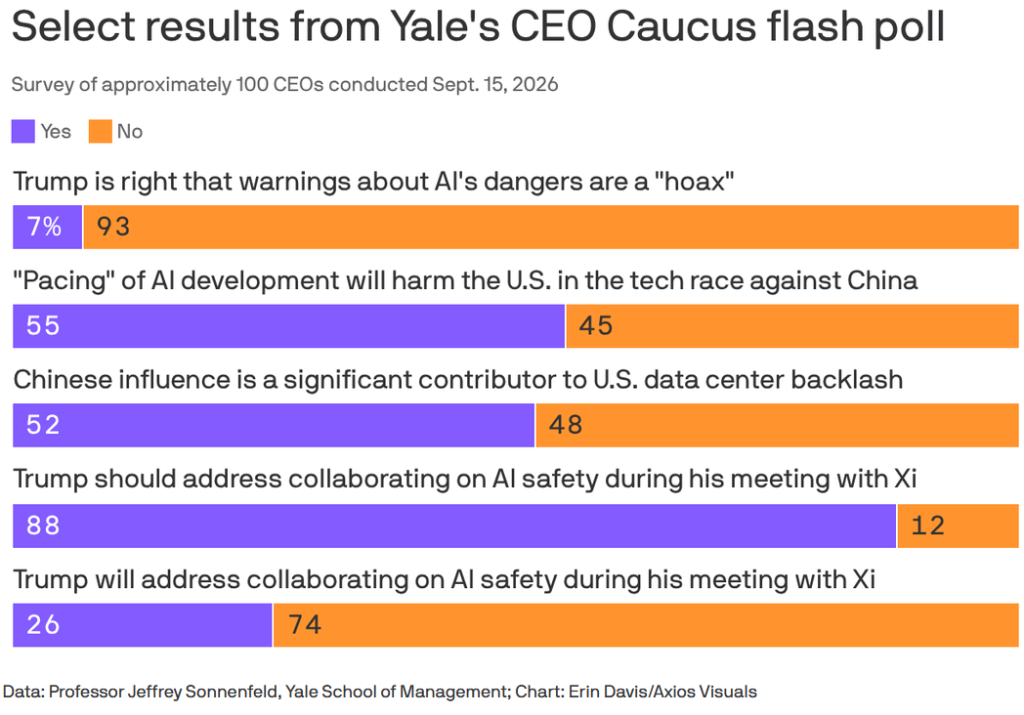
- •At the Yale CEO Caucus, 93 of roughly 100 surveyed CEOs rejected calling AI danger warnings a 'ho,' and nearly 90% said the president should pursue joint AI-safety guidelines with China.
- •The authors contend frontier laboratories' commercial fortunes will hinge on earning enterprise, regulatory, and public trust rather than on raw capability, with pacing serving as an active period of defensive infrastructure hardening.
Washington and Silicon Valley are engaged in a new dispute over artificial-intelligence “pacing”: deliberately slowing the development of frontier models until safety measures, alignment, and society can catch up. Critics describe pacing as unilateral disarmament in the competition with China. Supporters view it as the only responsible approach for a technology whose creators themselves warn of catastrophic risks.
Both sides, however, have embraced what can be called the “Compute-to-GDP Fallacy”—the assumption that every incremental improvement in AI performance immediately becomes macroeconomic output. Previous general-purpose technologies—foundational innovations such as electricity, the computer, and the internet that cut across every industry—took decades to diffuse through the economy and produce measurable productivity gains. AI is following a similar path at an accelerated rate, but public discussion often assumes that historical and economic patterns no longer apply.
America is already years behind the AI frontier. The commercial fortunes of frontier laboratories will be determined less by raw capability than by trust and adoption. A period of pacing would therefore cost the economy relatively little, because the central debate is focused on the wrong constraint.
Skepticism about pacing is not without basis. Is it a genuine safety measure, or a marketing strategy by frontier laboratories and cybersecurity companies seeking to strengthen their finances ahead of initial public offerings? Would slowing development surrender the U.S. lead to China, or would Beijing respond with its own form of pacing?
The frontier problem
AI has reached a critical capability milestone. Warnings about catastrophic or existential risks can no longer be dismissed outright, even if their near-term probability remains modest. Yet by concentrating so heavily on cutting-edge models, frontier laboratories have mishandled both their public messaging and the trust issue.
More than 100 recent conversations with CEOs, policy leaders, and AI scientists conducted for the forthcoming book When Machines Act convinced the authors that the pacing debate has lost sight of first principles. A key distinction has been obscured: the advanced research laboratories conduct behind closed doors is not the same as the products they release to the public.
The more relevant question may be whether laboratories need to slow their research at all, or whether they simply need to do a better job ensuring that commercial products are safe for use.
The alignment problem
Since ChatGPT was released in 2022, corporate leaders have mobilized with a speed rarely seen in modern commercial history. But the structure of enterprise technology makes broad economic absorption inherently slow. Fragmented data silos, legacy enterprise-resource-planning systems, strict compliance requirements, and poor data hygiene all stand in the way.
Corporate budget shocks caused by runaway “tokenmaxxing”—the practice of routing routine tasks through far larger models than the work requires—have also shown that many everyday enterprise workflows require much simpler models. Very few tasks at the average Fortune 500 company require a frontier system. Pacing would therefore neither materially damage economic output nor choke off laboratory revenues, because companies need time to absorb capabilities that are already available.
More than two-thirds of high-performing companies identify data as the primary barrier to AI implementation, according to McKinsey. That obstacle has remained persistent even as models have advanced rapidly. Only 7% of companies describe their data as “completely ready” for AI, fewer than one-quarter have a data strategy, and 63% either lack AI-suitable data management or are unsure whether they have it, according to a Cloudera and Harvard Business Review Analytic Services report and a Gartner release.
The compute-to-GDP fallacy
As McKinsey Senior Partner Asutosh Padhi emphasized during an appearance with Fareed Zakaria, technical availability is fundamentally different from economic transformation. General-purpose technologies have historically required decades to reorganize workflows and generate broad productivity gains.
Electricity took 75 years to raise productivity across the economy. Computers required 50 years, while the Internet and mobile devices took 25 years. AI models may be ready, but the organizational restructuring required to use them at scale will take substantial time. In a survey of the business community, McKinsey found that only 6% of companies reported a “significant” impact and modest earnings attribution. The State of AI report provides additional context on enterprise adoption.
Companies are focusing on high-reward, low-risk automation tasks that models one or two generations old can already perform. One highly respected former Wall Street CEO said these systems would operate alongside legacy systems for years, allowing companies to confirm that they work properly and that no regulatory risk is being absorbed unknowingly.
Corporate America will therefore determine the pace of deployment itself, regardless of decisions made by frontier laboratories. No company in any industry should release a product it believes is dangerous, and AI should be treated no differently.
A similar pattern is emerging in the semiconductor market. Older-generation chips that were initially sidelined during the race for the newest accelerators are finding a second life as workhorses for practical inference workloads—the day-to-day running of deployed models rather than their training—which account for much of enterprise demand.
Miro Dimitrov, founder and CEO of Growth Protocol, said at the previous week’s Yale CEO Caucus that neuro-symbolic architectures had reduced inference costs by roughly 80-fold in live client deployments. The savings largely came from moving workloads away from extremely expensive graphics-processing units and onto standard enterprise central-processing units.
Three phases of AI adoption
Corporate adoption can be understood as three phases, each defined by how much work a company can responsibly delegate. Progress is constrained by data readiness and the level of trust systems have earned.
The first phase is assistance. It consists of off-the-shelf copilots built on enterprise platforms such as Salesforce. These tools connect data across existing applications and help employees work faster without extensive re-architecting. Payback can arrive quickly, while risk remains limited because a human continues to perform much of the work.
The second phase is orchestration. It involves agentic workflows—AI systems that plan and execute multi-step tasks on a worker’s behalf—which require significant investment in proprietary data and in connecting distant data lakes that were never designed to work together. A human remains in the loop to approve each consequential step.
The third phase is autonomy, in which end-to-end agentic operations run across seamlessly connected systems while humans supervise by exception.
The potential reward increases with each phase, but so do the associated risks and the trust required. That is why the average Fortune 500 CEO remains in the assistance phase while making substantial early investments to prepare for orchestration. The phases also will not advance uniformly throughout a company. Most businesses will manage a portfolio spanning multiple phases, testing orchestration in select forward-looking departments while the rest of the organization becomes comfortable with basic assistance.
All three phases depend on CEOs trusting that AI will follow employee-handbook rules, obey the law, and maintain a foundation of human values and judgment. Investors, media commentators, and markets therefore misdiagnose how enterprise value is created when they worry that pacing for AI alignment will obstruct frontier-model progress.
The debate is further complicated by vague promises and warnings surrounding “AGI,” or artificial general intelligence—systems that could match or exceed human performance across most cognitive tasks—as well as the opportunities and catastrophic risks associated with reaching the “singularity.” Alignment is itself subjective, with different laboratories and individuals defining the term differently. The response to any reference to alignment is a further question: alignment to what?
If AI technologies are intended to automate human tasks, they should meet the same standards of values, judgment, and moral conduct expected of a current or prospective employee. If the most advanced frontier models cannot meet those standards in testing, they are not ready for release. That principle is consistent with the laws the United States has long maintained to protect consumers from dangerous products.
Former Federal Trade Commission Chair Lina Khan made a similar point on X: “There is an extensive set of laws that govern dangerous and defective products… releasing unvetted AI models or agents can violate consumer protection laws. Shipping flawed AI tools without implementing adequate measures to detect and stop rogue or defective AI agents can be an ‘unfair or deceptive’ act or practice under the FTC Act (and analogous state laws).” The post is available at https://x.com/linamkhan/status/2099204390548639960.
Those laws make companies responsible for harm to consumers, employees, investors, patients, and competitors, as well as to the markets and financial systems on which they depend.
America, China, speed, and trust
Regardless of where one stands on the debate over China’s distillation of AI models—the technique of training smaller models to reproduce the outputs of larger frontier systems—China now has systems that rival the frontier models available on the market. The Chinese Communist Party has also signaled that it is shifting attention toward distributing AI throughout the economy rather than continuing to push the frontier.
Frontier laboratories are therefore competing in two races: one to reach “AGI” or “superintelligence,” and another to win customers’ share of wallet. Their most established customers, primarily Fortune 500 enterprises, can attest that winning back a customer after a purchasing decision has been made is extremely difficult. China understands this dynamic, which helped drive its victory in global telecommunications—a race the United States largely lost.
The Chinese Communist Party has also expressed deep concern about alignment. Beijing’s domestic version of alignment emphasizes state control, party orthodoxy, and consistency with official narratives. Western alignment focuses more on fiduciary reliability, consumer safety, and product liability. Beneath that ideological divide lies the same commercial reality: unpredictable, “hallucinating” agents that do not follow organizational rules, exercise sound judgment, or respect institutional guardrails cannot be trusted with mission-critical workflows or relied upon to produce durable economic growth.
The Trump administration should continue pursuing opportunities to collaborate and coordinate with President Xi to ensure that AI does not cause mass destruction or catastrophe, whether intentionally or accidentally. Whether Trump will raise the issue is a separate question.
At the CEO Caucus, 93 of approximately 100 surveyed CEOs said they did not believe the president was correct to call warnings about AI’s dangers a “hoax.” Nearly 90% said the president should emphasize the need for joint AI-safety guidelines with China during the state visit, while nearly three-quarters did not expect him to do so. According to Axios, preparatory discussions between Treasury Secretary Bessent and his Chinese counterpart could soon prove those roughly 75 business leaders wrong.
A pacing interval would not be a passive holiday or an economic ceasefire. It would be an active period of defensive hardening. Washington and Beijing need time to strengthen critical infrastructure against autonomous-agent exploits before unlocking the next generation of frontier capabilities.
Human alignment is only half the challenge. During such a period, the immediate priority should be reinforcing the institutions that underpin society. Financial, healthcare, and education systems should be tested for vulnerabilities by the most advanced models, as Anthropic demonstrated through its restricted deployment of Mythos under Project Glasswing. Those models breached defenses through sophisticated engineering, but the exploits succeeded because of systemic weaknesses in corporate digital infrastructure.
Frontier laboratories may believe they are running a single race toward superintelligence. The race that will determine their commercial fortunes, however, is the slower contest to earn the trust of enterprises, regulators, and citizens who must live with what they build. Speed may generate headlines, but trust wins customers.
That race is a marathon, not a sprint. The first half of a long-distance race is for pacing and the second half is for passing. In every technological revolution, from railroads to the Internet, the greatest fortunes went to those who understood that a frontier has little value until settlers arrive.
The opinions expressed in Fortune.com commentary pieces are solely those of their authors and do not necessarily reflect the opinions and beliefs of Fortune. The report was updated with additional comments from co-author David Siegel. This story was originally featured on Fortune.com: https://fortune.com/2026/09/22/ai-pacing-debate-how-fast-slow-wrong-debate-frontier

