AI Model Costs: Training Spending Soars While Inference Prices Collapse
Key Takeaways
- •Epoch AI estimates that the amortized hardware and energy cost of frontier training runs has grown about 2.4 times per year since 2016, and projects the largest runs could pass $1 billion around 2027 if the trend continues.
- •Estimated training compute reached roughly $79 million for GPT-4, $192 million for Gemini 1.0 Ultra and $170 million for Llama 3.1 405B, while hardware makes up 47% to 67% of frontier development costs and research staff account for another 29% to 49%.
- •DeepSeek reported about $5.576 million in training compute for DeepSeek-V3, based on roughly 2.788 million Nvidia H800 GPU-hours, a figure that excludes earlier research, ablation studies and other development expenses.
- •The cost of reaching a fixed level of AI performance has declined about 47% per quarter since 2023, roughly 13 times per year, a pace Epoch AI says is faster than earlier cost curves such as DNA sequencing and lithium-ion batteries.
- •GPT-3.5-level inference fell from about $20 per million tokens in late 2022 to $0.07 by October 2024, and by October 2026 small commercial models such as GPT-6 Luna and Claude Haiku 5.5 charged $0.10 per million input tokens and $0.50 per million output tokens.
Artificial intelligence has entered an era of split economics: the cost of building frontier models keeps climbing, while the cost of using them keeps falling. Both trends are advancing at the same time.
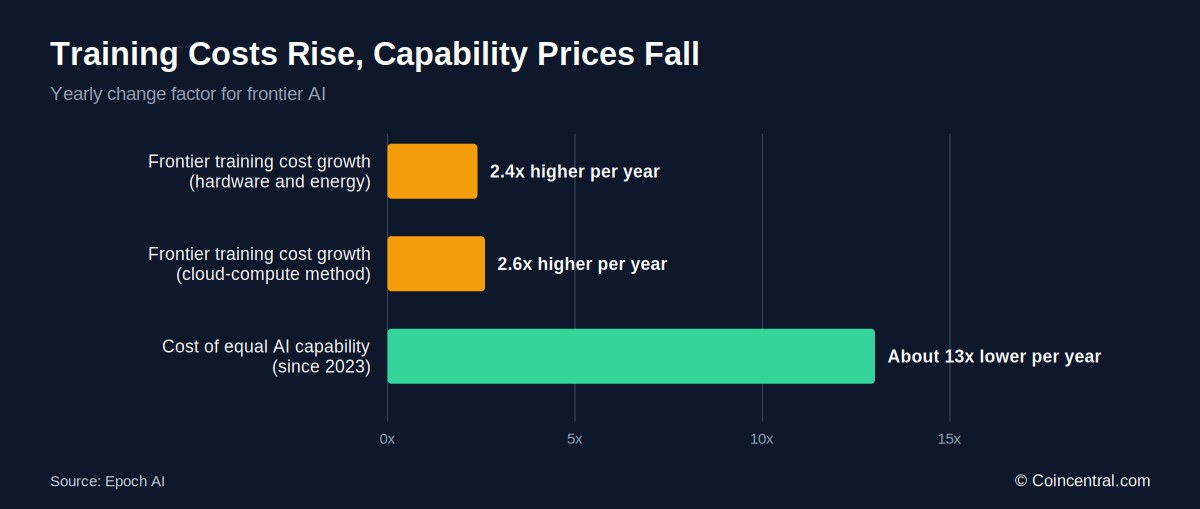
Training a frontier AI model can require tens or even hundreds of millions of dollars in computing power. Epoch AI estimates that the hardware and energy cost of these training runs has grown roughly 2.4 times per year.
Once a model is trained, the picture reverses. According to Epoch AI, the price of reaching a fixed level of AI performance has dropped about 47% every quarter since 2023 — roughly a 13-fold decline per year.
This article compiles the principal figures on training costs, inference costs and token pricing, drawing on data from Epoch AI, Stanford University, DeepSeek, OpenAI, Anthropic and Google. All prices are standard published rates as of October 2026.
AI Model Cost Statistics at a Glance
- Frontier AI training costs have grown about 2.4 times per year.
- Epoch AI projects that the largest training runs could pass $1 billion around 2027 if the trend continues.
- GPT-4 training compute is estimated at about $79 million.
- Gemini 1.0 Ultra is estimated at about $192 million.
- Llama 3.1 405B is estimated at about $170 million.
- Grok-2 is estimated at about $107 million.
- DeepSeek reported $5.576 million for the official DeepSeek-V3 training run, a figure that excludes earlier research and staff costs.
- Hardware makes up about 47% to 67% of frontier model development costs; research and development staff account for another 29% to 49%.
- Energy accounts for only about 2% to 6%.
- The cost of equal AI performance falls about 47% per quarter, or about 13 times per year.
- GPT-3.5-level inference fell more than 280-fold in cost between late 2022 and late 2024.
- GPT-6 Luna and Claude Haiku 5.5 cost $0.10 per million input tokens and $0.50 per million output tokens.
- Cached tokens can be 90% to 95% cheaper than ordinary input tokens on some APIs.
The widening gap between rising training costs and falling usage costs sits at the center of AI economics. The remainder of this article examines each side in turn.
How Much Does It Cost to Train an AI Model?
There is no single answer. Costs run from a few hundred dollars for early research models to hundreds of millions of dollars for frontier systems.
Stanford's AI Index, using estimates developed together with Epoch AI, tracks how training costs have evolved. Stanford notes that these figures mostly estimate the computing resources consumed rather than the full economic cost of building each model. Even so, the change over seven years is dramatic: the original Transformer cost less than $1,000 in estimated compute to train, while GPT-4 cost about $79 million — more than 100,000 times as much.
Not every model follows the upward line. Llama 2 70B, at about $3 million, cost less than GPT-3 at $4 million and far less than PaLM 540B at $12 million. Model size, chip type and training method all shape the final bill.
Frontier Training Costs Grow 2 to 3 Times Per Year
Epoch AI studied dozens of major AI systems and estimates that the amortized hardware and energy cost of frontier training runs has grown about 2.4 times per year since 2016. A separate method based on cloud-compute prices found a similar rate of 2.6 times per year. Two independent approaches pointing to the same range lends the estimate additional weight.
If the trend continues, Epoch projects that the largest frontier models could cross $1 billion per training run around 2027. Stanford noted in 2026 that industry estimates for new frontier systems now range from hundreds of millions of dollars toward $1 billion per iteration.
That does not mean every future leading model will cost a billion dollars. Mixture-of-experts designs, better data, improved algorithms and cheaper hardware can all reduce the compute required to reach a given level of performance. DeepSeek demonstrated how large that difference can be.
DeepSeek-V3 Training Cost
DeepSeek drew wide attention after reporting a training compute cost of about $5.576 million for DeepSeek-V3. Its technical report states that the full official training process used about 2.788 million Nvidia H800 GPU-hours. At an assumed rental price of $2 per GPU-hour, the total works out to the $5.576 million figure.
The number is frequently misread. It is not the total cost of developing V3. DeepSeek said the figure excludes earlier research, architecture experiments, ablation studies, data work and other development costs. For that reason, it cannot be compared directly with estimates that include broader R\u0026D spending; a fair comparison requires the same scope on both sides.
What the figure does demonstrate is that design and engineering choices can sharply cut the cost of a final large training run — a finding with implications for the entire industry.
Compute Is Only Part of the Cost
Building a frontier model takes more than GPUs. Epoch AI estimates that total development cost splits across three main areas: hardware makes up roughly 47% to 67%, research and development staff account for another 29% to 49%, and energy represents only about 2% to 6%.
Additional costs can include data acquisition, data cleaning, failed experiments, post-training and reinforcement learning. Safety testing, model evaluations, networking, storage and data-centre facilities all add to the total.
As a result, the headline cost of a final training run can substantially understate what it takes to build a competitive frontier model, and the gap between the two numbers can be large.
Inference and Token Pricing
Training vs. Inference
Training creates a model; inference runs it. Companies pay for inference every time someone uses the model. If millions of people use a model each day, total inference spending can exceed the cost of the original training run.
This dynamic matters more as AI moves into coding agents, AI search, customer service, voice assistants, video analysis and business automation. A chatbot reply of a few hundred tokens is cheap; a coding agent that reads millions of tokens, calls tools repeatedly and runs for hours consumes far more computing.
Current Token Prices
Most commercial AI APIs charge by the token. A token is a small piece of text, and one million tokens corresponds to hundreds of thousands of English words, although the exact ratio varies.
Gemini 4 Argon's $2 and $10 pricing is introductory through November 30, 2026. Google says standard pricing rises to $4 for input and $20 for output afterward.
These are list prices. They are not the providers' own costs of running the models.
Small Models vs. Frontier Models
OpenAI's GPT-6 Luna charges $0.10 per million input tokens and $0.50 per million output tokens. Anthropic's Claude Haiku 5.5 carries the same headline price for prompts under 100,000 tokens. Anthropic released Haiku 5.5 in October 2026 and says the model costs about 75% less to run than Haiku 4.5 on average.
At these rates, a business that sends 100 million input tokens to a $0.10 model pays only $10, while 10 million output tokens at $0.50 per million cost another $5. Output costs more because models generate tokens one at a time, which requires more compute.
Cheap models do not suit every task. Frontier reasoning systems need far more compute, and providers charge accordingly: Anthropic lists Claude Opus 5.5 at $4 per million input tokens and $20 per million output tokens — 40 times the output price of Haiku 5.5.
That spread gives AI agents a clear incentive to route simple tasks to small models, reserving the expensive ones for hard reasoning.
AI Inference Costs Have Fallen Sharply
Stanford's AI Index offers a stark example. In November 2022, GPT-3.5-level performance on the MMLU benchmark cost about $20 per million tokens. By October 2024, Gemini 1.5 Flash-8B reached the same benchmark level for $0.07 per million tokens — a drop of more than 280-fold in under two years.
Stanford found that inference prices fell between 9-fold and 900-fold per year, depending on the task measured. The range is wide because each benchmark and each performance level has its own price history.
Lower profit margins are not the only cause. AI models and the hardware that runs them have become far more efficient.
The Price of Equal AI Capability Falls 13 Times Per Year
Epoch AI's September 2026 research goes beyond raw token prices and measures what it costs to reach a fixed level of model performance. Epoch estimates that this cost has fallen about 47% every quarter since 2023. Over a full year, that adds up to a decline of about 13 times.
The arithmetic is straightforward. If prices fall 47% each quarter, 53% remains. After four quarters, about 7.9% remains — close to one-thirteenth.
Epoch says this decline is faster than earlier major technology cost curves, including DNA sequencing, general computing, lithium-ion batteries and electricity costs. The rate varies by task.
Hardware and Software Make AI Cheaper to Run
AI inference benefits from steady gains in chip economics, which Stanford tracks through three yearly trends for machine-learning hardware. Modern GPUs also use lower-precision number formats, better memory systems and faster links between chips. Each change lets a data centre do more work for the same money.
Software compounds the gains. Techniques such as quantization, distillation, sparsity, mixture-of-experts designs, speculative decoding, continuous batching and better compilers all reduce the compute needed per answer. As a result, the same amount of AI capability can be delivered with fewer computing resources over time.
Caching and Batch Processing Cut Costs Further
Modern APIs increasingly discount repeated information. Consider an AI agent that sends the same 100-page company handbook with every request: a provider can cache that text instead of processing it again each time.
OpenAI charges $0.20 per million cached input tokens for GPT-6 Sol, compared with $2 for ordinary input — a 90% discount. Google's Gemini 4 Argon currently discounts eligible implicitly cached input by 95%.
Users who do not need instant answers can also pay less. OpenAI prices Batch and Flex processing for GPT-6 Sol at about 50% of standard rates. Batch processing suits document classification, overnight analysis, data extraction, large-scale summarization and offline evaluations.
AI pricing is starting to look like cloud computing, with customers paying different rates depending on speed, reliability and how flexible the workload is.
Cost per Task and Total AI Spending
Why Price per Token Can Mislead
A model that costs $1 per million tokens is not always cheaper than one that costs $2. Suppose the first model needs 5 million tokens to finish a task, while the second finishes it with 1 million. The first model costs $5 for the task and the second costs $2.
Reasoning models make this check more important, because they can produce large numbers of internal thinking tokens — and some of those are billed. Anthropic says Claude Sonnet 5.5 uses fewer tokens per task than Sonnet 5, which can make it cheaper in real workflows even where list prices look similar. Businesses increasingly track the cost per successfully completed task rather than the cost per million tokens alone.
What Keeps Prices Falling
Three forces push inference costs down: more efficient hardware, more efficient model designs and strong competition between providers.
OpenAI cut GPT-6 Sol and Luna API prices by about 50% compared with their GPT-5.6 promotional counterparts, while also improving capability. Anthropic says Haiku 5.5 costs about 75% less per typical workload than Haiku 4.5. Google is also competing on token pricing.
The result is that uses of AI that were too costly two or three years ago can now fit inside ordinary products.
Falling Costs Can Raise Total Spending
Cheaper AI does not always mean lower industry spending. A company might not automate one million customer chats if each one costs $1. At one cent each, it might automate all of them.
The pattern resembles the Jevons paradox, in which more efficient use of a resource leads to more total use. It may help explain why the largest cloud companies keep spending hundreds of billions of dollars on AI data centres even as the cost of each query falls.
The Bottom Line
AI economics are moving in two directions at once. At the frontier, training costs have grown fast: GPT-4 needed an estimated $79 million of training compute, Gemini 1.0 Ultra about $192 million and Llama 3.1 405B about $170 million, with Epoch AI estimating that frontier training costs have grown about 2.4 times per year.
Once models are available, the cost of using them falls quickly. GPT-3.5-level inference dropped from about $20 per million tokens in 2022 to $0.07 in 2024, and newer Epoch research puts the fall in the cost of a fixed level of AI performance at about 47% per quarter, or about 13 times per year. By October 2026, small commercial models cost as little as $0.10 per million input tokens and $0.50 per million output tokens.
In short, the most advanced models cost more to build, while the output of those models costs less to use. If that continues, the effect of AI may depend less on what one model costs to train and more on what happens when billions of people and businesses can reach capable AI at prices near ordinary cloud software.
Sources
- Epoch AI: The Plunging Price of Thought
- Epoch AI: How Much Does It Cost to Train Frontier AI Models?
- Stanford University: 2025 AI Index Report, Research and Development
- Stanford University: 2026 AI Index Report
- DeepSeek: DeepSeek-V3 Technical Report
- OpenAI: Introducing GPT-6 Sol and Luna
- OpenAI: API Pricing
- Anthropic: Claude Haiku 5.5
- Anthropic: Claude Sonnet 5.5
- Google AI: Gemini 4 Argon Pricing
This article originally appeared on CoinCentral.

