Vanguard Chief Economist: AI's Impact on Jobs Still in the 'ATM Phase,' Not Mobile Banking
Key Takeaways
- •ATMs did not eliminate bank teller employment as predicted; total U.S. teller jobs remained broadly stable from 1980 through 2010 because reduced operating costs made branch expansion economically viable.
- •The major decline in teller employment began around 2010 when mobile banking automated the entire branch visit, with only 9% of customers identifying branches as their primary channel by 2025 compared to 36% in 2007.
- •Since ChatGPT's release in late 2022, occupations with the greatest AI exposure have generally kept pace with or outpaced less-exposed fields in employment growth, and layoff rates have remained low.
- •Historical general-purpose technology transitions—including factory electrification and personal computing—show that the deepest productivity and organizational gains materialized years after initial adoption, during a subsequent redesign phase.
- •Current large language models are more analogous to the ATM era of task-specific automation, and more significant labor market disruption would likely require a systemic reconfiguration of business processes comparable to the shift from ATMs to mobile banking.
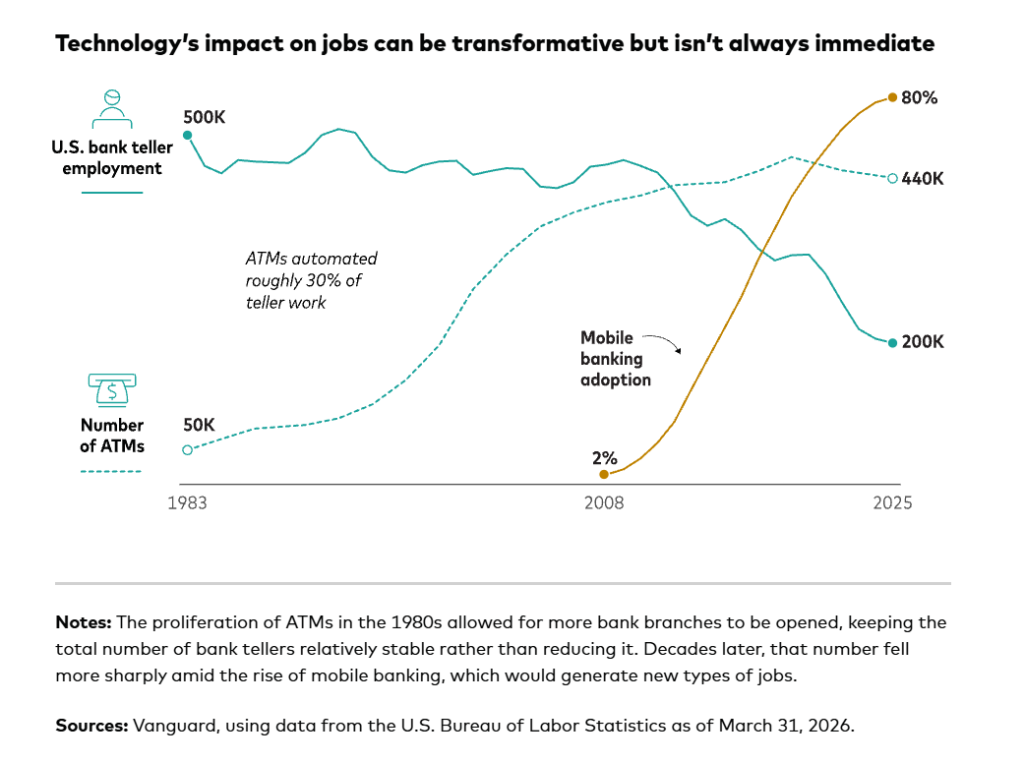
Each wave of technological change brings a familiar prediction: this time, jobs will disappear for good. Yet the history of automated teller machines (ATMs) and their effect on the bank teller profession offers a more nuanced reality—and a revealing parallel for today's debate over artificial intelligence.
When ATMs proliferated in the 1980s, many observers assumed bank tellers would soon become obsolete. They were only partially right. The number of tellers required at individual branches did decline as ATMs automated routine transactions, but the broader employment picture proved far less dire than forecast. By reducing operating costs, ATMs made it economical for banks to expand their branch networks. As a result, total U.S. bank teller employment remained broadly stable from 1980 through 2010. For a mid-career teller at the time, the ATM turned out to pose far less of a threat than prevailing predictions suggested.
How Task Automation Creates New Demand
The expansion of retail banking generated demand for a wider array of occupations. Banks hired more loan officers, credit analysts, personal bankers, and fraud and risk specialists. Work inside branches shifted up the skill-value chain—away from processing routine transactions and toward managing customer relationships.
The real disruption arrived later. Beginning around 2010, mobile banking fundamentally changed the equation. Unlike the ATM, which automated a specific task, mobile banking automated the entire trip to a bank branch. Customers no longer needed to visit a branch for most everyday banking activities. By 2025, only 9% of bank customers identified branches as their primary banking channel, down sharply from 36% in 2007. Bank teller employment declined accordingly.
This transformation was not driven by technology alone. The Electronic Signatures in Global and National Commerce Act of 2000 granted electronic signatures the same legal standing as handwritten ones, enabling fully digital banking experiences and accelerating the shift away from in-person transactions.
The broader lesson: isolated task automation rarely produces large-scale job losses, except in occupations built around a very narrow set of activities—as the disappearance of switchboard operators illustrates. More often, meaningful disruption occurs when technologies combine with new workflows, business models, and institutional changes that fundamentally reorganize how work is done. The mobile banking revolution, for instance, created entirely new categories of employment: cybersecurity analysts, digital product managers, payment-platform engineers, and data-platform operators.
The White-Collar Job Loss Myth
This historical lens is instructive for the current AI debate. If AI becomes a general-purpose technology on the scale of electricity or the personal computer—as developments increasingly suggest—it will enable products, services, and industries that have not yet been envisioned. Economists who study prior general-purpose technology transitions have consistently found that the deepest structural changes arrive not with initial adoption but during the subsequent phase, when organizations redesign their operations around the new capabilities. Factory electrification, for example, took decades to deliver its full productivity gains after its introduction; the personal computer followed a similar pattern, with the largest organizational and productivity effects materializing years after widespread adoption.
Since ChatGPT's arrival in late 2022, many commentators have argued that AI would rapidly eliminate large numbers of white-collar jobs. Nearly four years later, the labor market data tells a different story. Occupations with the greatest exposure to AI have not experienced widespread employment declines. Employment growth in highly exposed occupations has generally kept pace with—or exceeded—that of less exposed ones. Layoff rates remain low, and while hiring has slowed, that slowdown has been broad-based rather than concentrated in AI-intensive fields.
Today's large language models may be analogous to the ATMs of the 1980s—powerful tools that automate certain tasks while augmenting many others, making workers more productive and leaving the broader structure of work largely intact. More significant labor market disruption may require something closer to the shift from ATMs to mobile banking: a deeper reconfiguration of business processes, organizational structures, and customer interactions that reshapes workers' roles rather than simply removing them.
The history of technological change suggests that capabilities alone rarely determine employment outcomes. What matters more is how organizations redesign work around those capabilities.
AI may ultimately transform the labor market just as mobile banking transformed retail banking. But the evidence today suggests we remain closer to the ATM phase than the mobile banking phase.
The opinions expressed in Fortune.com commentary pieces are solely the views of their authors and do not necessarily reflect the opinions and beliefs of Fortune.
This story was originally featured on Fortune.com.
