AI Is Reshaping the Labor Market in 2026, With Gains and Losses Unevenly Distributed
Key Takeaways
- •US employers cited AI in connection with 116,175 announced job cuts from January through August 2026, about 22% of all announced cuts and more than double the 54,836 recorded in all of 2025.
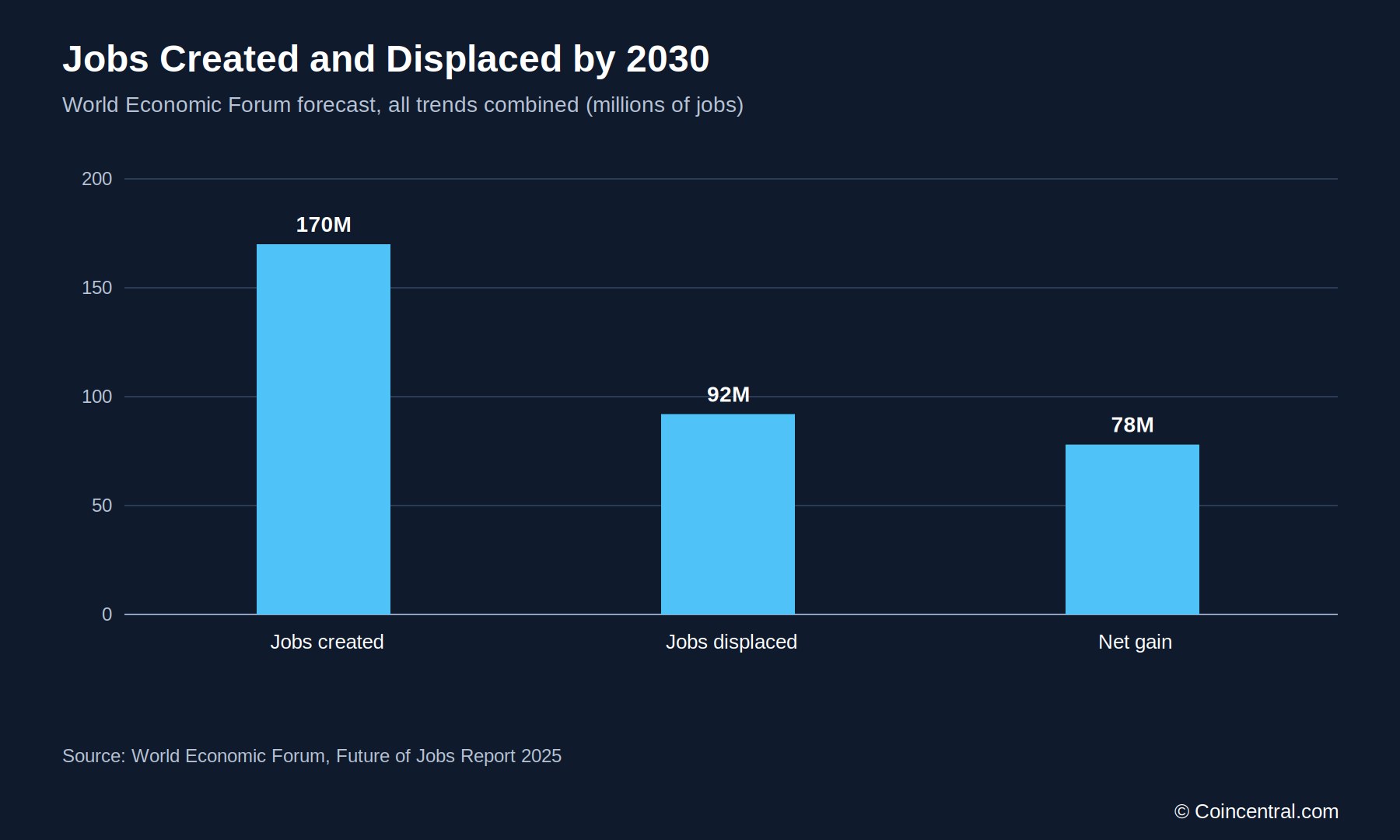
- •The World Economic Forum projects 170 million jobs created and 92 million displaced worldwide by 2030, for a net gain of 78 million jobs, though AI alone accounts for a smaller share of that shift.
- •A Stanford payroll study found a 19% relative employment decline among workers aged 22 to 25 in the most AI-exposed occupations, with no comparable gap among experienced workers.
- •PwC reports that workers with AI skills earn a 62% wage premium over peers in similar roles, and job postings requiring AI skills grew 69% compared with 9% across the overall job market.
- •The WEF estimates 59 out of every 100 workers will need reskilling or upskilling by 2030, while 41% of employers plan to reduce staff where AI automates tasks.
Artificial intelligence is both creating and eliminating jobs in 2026, but the available data points to a labor market that is splitting between groups that gain and groups that lose rather than shrinking uniformly.
This review brings together figures from the World Economic Forum (WEF), PwC, Challenger, Gray & Christmas, Stanford, the Federal Reserve Bank of Dallas, Indeed and other organizations. The figures describe different measures, and each should be read as either a forecast or an observed result. Those categories are not interchangeable.
The WEF expects 170 million jobs to be created and 92 million displaced worldwide by 2030, for a net gain of 78 million jobs. The same period is expected to bring a difficult transition for some workers. The WEF figures cover all trends tracked in its report, including demographic change the green transition; AI alone represents a smaller share.
A Harvard Business School working paper that examined nearly all US job postings from 2019 through March 2025 found that openings for routine, automation-prone roles fell 13% after ChatGPT launched in November 2022. Demand for analytical, technical and creative roles increased 20%. These figures should not be added to or compared directly with the WEF totals because they measure different aspects of the labor market.
AI-Related Job Cuts Are Increasing
Challenger, Gray & Christmas, an outplacement and research firm, tracks the reasons US employers give for announced layoffs. From January through August 2026, employers cited AI in connection with 116,175 announced cuts. That represented about 22% of the 529,914 total announced cuts and was the most frequently cited reason for the year.
The number has risen sharply. Employers cited AI for 12,742 cuts in 2024 and 54,836 in 2025. The 2026 figure through August was already more than twice the total recorded for all of 2025.
Technology companies announced 149,023 cuts through July, an increase of 67% from a year earlier. Those cuts accounted for 31% of all announced cuts in 2026.
The figures have important limitations. They are employer announcements based on employer-stated reasons, not verified employee separations. In addition, AI fell to the fourth-most-cited reason in August, ending a five-month period in which it ranked first.
Survey data provides additional context. McKinsey found that 14% of respondents at organizations using AI said the technology had contributed to a smaller workforce during the previous year. The New York Fed found that 1% of service firms using AI had laid off workers because of it, while 12% said they had hired fewer people.
Reduced hiring is more difficult to measure than layoffs, meaning job-cut trackers may capture only part of AI’s employment impact.
Forecasts Differ Because They Measure Different Things
Estimates of AI’s effect on employment vary because they address different questions. Some measure the number of jobs exposed to AI, while others estimate how many workers could be displaced.
Goldman Sachs Research estimates that 6% to 7% of the US workforce could be displaced if AI is widely adopted. Its estimated range is 3% to 14%, and Goldman describes the effect as temporary.
A frequently repeated claim says Goldman Sachs predicted that AI would eliminate 300 million jobs. Its 2023 report instead said AI could expose the equivalent of 300 million full-time jobs to automation. Exposure does not mean replacement.
The International Monetary Fund says almost 40% of global employment is exposed to AI. The share rises to about 60% in advanced economies and falls to 26% in low-income countries. McKinsey describes its estimate of 57% as technical potential rather than a forecast of job losses.
For AI and information-processing technology alone, the WEF expects 11 million jobs to be created and 9 million to be displaced by 2030. The Federal Reserve Bank of St. Louis found a 0.47 correlation between an occupation’s AI exposure and its increase in unemployment from 2022 to 2025. The researchers characterize that result as a correlation, not evidence of causation.
Measured effects to date have generally been smaller than some forecasts. A study using Danish administrative records ruled out effects greater than 2% on earnings and hours worked two years after ChatGPT’s launch. The Yale Budget Lab and Brookings found no discernible disruption to the broader US labor market during the 33 months after the release.
AI Skills Are Associated With Higher Pay
PwC reports that workers with AI skills earn a 62% wage premium compared with peers in the same roles. The premium was 57% a year earlier and 25% the year before that, although an earlier PwC report cited a 56% premium for the prior year.
The comparison covers advertised wages for similar jobs with and without AI skills across 27 countries. It does not control for education, experience or location, and it is not an estimate of an average AI-related salary.
Demand for these skills is also increasing. Job postings requiring AI skills grew 69%, compared with 9% growth across the job market overall. The premium varies by sector, reaching 118% in consumer markets and falling to 16% in government and public-sector work.
Research by Fabian Stephany of the Oxford Internet Institute found that AI skills can offset some other disadvantages in hiring. Older applicants and candidates without advanced degrees received better callback rates when AI skills appeared on their résumés.
Young and Entry-Level Workers Face the Greatest Pressure
The clearest evidence of employment harm has appeared in early-career work. A Stanford payroll study using records from ADP, one of the largest US payroll processors, found a 13% relative employment decline among workers aged 22 to 25 in the most AI-exposed occupations.
An update from Stanford’s Digital Economy Lab, using data through June 2026, placed the gap at 19%. It found no comparable gap among experienced workers. The authors describe the finding as an early indicator rather than a causal estimate.
The Stanford AI Index 2026 reports a 16% decline for the same age group. Early-career software developers experienced a larger decline of about 20%.
The Dallas Fed found that the share of workers aged 20 to 24 in AI-exposed jobs fell from 16.4% to 15.5% of employment between November 2022 and September 2025. The change was not primarily driven by layoffs; employers were hiring fewer young people into those roles.
The job-finding rate for young workers entering highly exposed occupations fell by more than three percentage points from its November 2023 peak.
Data from Ravio on European technology companies showed entry-level hiring down 73.4% and administrative hiring down 35.5% in 2025. Half of the reward leaders surveyed cited AI automation as the reason for deprioritizing administrative positions.
PwC found that junior roles exposed to AI were seven times more likely to require traditionally senior skills such as leadership. These entry-level roles grew 35% from 2019, while overall early-career postings in highly exposed sectors remained flat. Read together, the figures describe a narrowing entry path: employers are hiring fewer young workers into AI-exposed occupations, and the junior openings that remain increasingly require senior-level capabilities.
Anthropic reported no systematic increase in unemployment among workers in the most exposed occupations since late 2022, although hiring among younger workers showed signs of slowing. Anthropic sells AI models, so that source should be considered in context. The OECD has also said that young people face difficult conditions when entering the labor market, and the Stanford researchers do not claim that AI is the only cause of the changes observed.
Software Development Has Rebounded, but Unevenly
Software development provides a closely watched test case. Indeed Hiring Lab reports that US software-related postings rose almost 15% from late February 2025, while job postings overall declined about 7%.
Even after the rebound, software postings remained about 27.5% below their pre-pandemic level. The earlier decline was not solely an AI-related development; technology companies also pulled back after a pandemic-era hiring surge.
The recovery has been uneven. Senior roles accounted for 71% of the increase between May 2025 and May 2026, while jobs with AI in the title represented 37% of the increasen
GitHub, the Microsoft-owned code-hosting platform, reported that one in three pull requests now involves an AI agent, compared with fewer than one in 10 a year earlier.
Eric Kutcher of McKinsey said, “We’re seeing much more growth in the places we thought we were gonna see the biggest displacement.” Sneha Puri, an economist at Indeed Hiring Lab, said employers still need developers to oversee AI-related work and help clients implement it.
The US Bureau of Labor Statistics (BLS) projects 10% growth in software-developer employment from 2025 through 2035. That would increase employment from about 1.72 million to 1.89 million.
AI-Exposed Companies Are Expanding
PwC found that productivity growth was 40% higher at companies most exposed to AI than at companies least exposed to it. Sector productivity grew 34% from 2018 to 2025 in the most exposed group, compared with 24% in the least exposed group.
Employment also increased more rapidly among the most exposed companies. Their headcount grew 52% from 2018, compared with 36% at the least exposed companies. Wages increased 24% compared with 17%.
The top fifth of the most AI-exposed companies achieved average productivity growth of 163%, a result PwC calls a “super-star effect.”
PwC describes a two-track labor market. In what it calls professionalised jobs, AI handles basic work while people perform expert tasks. In democratised jobs, AI makes complex work more accessible to non-experts.
These are associations rather than proof of causation. Strong companies may be more likely to adopt AI first, so AI may not explain every reported gain.
There is also a gap between using AI and achieving organizational maturity. McKinsey found that nearly 90% of organizations use AI in their operations, while Gartner reports that only 9% have reached true AI maturity.
Employers Expect Rapid Skills Changes and More Retraining
The WEF expects 39% of workers’ core skills to change by 2030, down from 44% in its 2023 edition. It identifies the skills gap as the largest barrier to business transformation, cited by 63% of employers.
PwC found that skills in the most AI-exposed jobs are changing more than twice as quickly as skills in the least exposed jobs. New tasks added to those roles are 2.5 times more likely to rely on skills such as empathy, judgment and creativity.
Employers say retraining will be their main response, although some also plan to reduce staff. In the WEF survey, 41% said they planned to reduce their workforce where AI automates tasks.
The WEF estimates that 59 out of every 100 workers will need reskilling or upskilling by 2030, and that 11 of them are unlikely to receive it. Analytical thinking is the leading core skill, cited by 70% of employers. Resilience, flexibility and agility follow at 67%.
New employment is also emerging outside the technology sector. Goldman Sachs reports that data-center construction jobs have increased by 216,000 since 2022, growth that appears in construction and building trades rather than in technology roles.
Public Concerns Are Increasing
Pew Research Center found that 71% of US adults believe AI will lead to fewer jobs over the next 20 years, up from 64% in 2024. Only 5% expect AI to create more jobs.
Adults under 30 are more concerned, with 73% expecting fewer jobs, compared with 61% two years earlier. Across 34 of 37 countries surveyed, more respondents expected AI to reduce employment than to increase it. These results capture expectations rather than measured employment changes, which distinguishes them from the payroll, postings and layoff figures described earlier.
Gallup found that 18% of US employees believe it is very or somewhat likely that their own job will be eliminated within five years because of AI or automation. That figure was 15% in 2025. McKinsey found that 39% of respondents expected AI to reduce their organization’s headcount during the following year, up from 32%.
Policy and training systems also influence which workers benefit. Ireland, Finland and Denmark lead the IMF Skill Readiness Index, which covers 23 countries, because of their high shares of technology graduates and strong adult-retraining systems.
The BLS projects that employment for secretaries and administrative assistants will decline 2% from 2025 to 2035, a loss of 75,300 jobs. It attributes the decline to technology, including AI.
Goldman Sachs has described AI as the major labor-market story of 2026. Its effects remain concentrated in technology, creative and knowledge work, which account for a relatively small share of the overall economy. The BLS notes that technological displacement generally unfolds more slowly than forecasters predict.
The available data does not show either a jobs collapse or a smooth transition. Instead, pay and hiring are shifting toward workers with AI skills and experience, while early-career workers in exposed fields face more difficult entry conditions. Forecasts will continue to change, making measured layoff counts, job-posting data and payroll studies important indicators as 2026 progresses.
Sources
- World Economic Forum, Future of Jobs Report 2025
- PwC, 2026 Global AI Jobs Barometer
- Challenger, Gray & Christmas, job-cuts reports
- Stanford Digital Economy Lab, AI and early-career employment
- Stanford AI Index
- Federal Reserve Bank of Dallas, research on AI and young workers
- Harvard Business School Working Knowledge, AI and job postings
- Goldman Sachs Research, AI and the labor market
- International Monetary Fund, AI and jobs analysis
- International Labour Organization, generative AI and jobs
- Indeed Hiring Lab, software-development postings
- CNBC, “AI is automating coding, so why are software developer job postings on the rise?”
- US Bureau of Labor Statistics, Employment Projections 2025 to 2035
- Pew Research Center, public views on AI and jobs
- McKinsey, The State of AI Global Survey
- Ravio, European technology compensation and hiring data
- CoinCentral, original article

