Does Slowing AI-Related Imports Mean Slowing Investment? Maybe, BEA Data Suggest
Key Takeaways
- •The analysis compares BEA import data for computers and semiconductors with investment in information equipment and software.
- •A Granger-causality test found that import growth can help predict later investment growth at the 6% significance level.
- •The reverse relationship, from investment growth to import growth, was not supported by the data.
- •On the monthly nominal series, imports of computers, peripherals, and semiconductors peaked in April 2026.
- •The article concludes that the April peak is not enough to determine whether AI-related investment is slowing.
The answer to whether slowing imports of computers and semiconductors signal a slowdown in AI-related investment is a qualified "maybe," according to an Econbrowser analysis published on August 15, 2026.
The Quarterly Picture
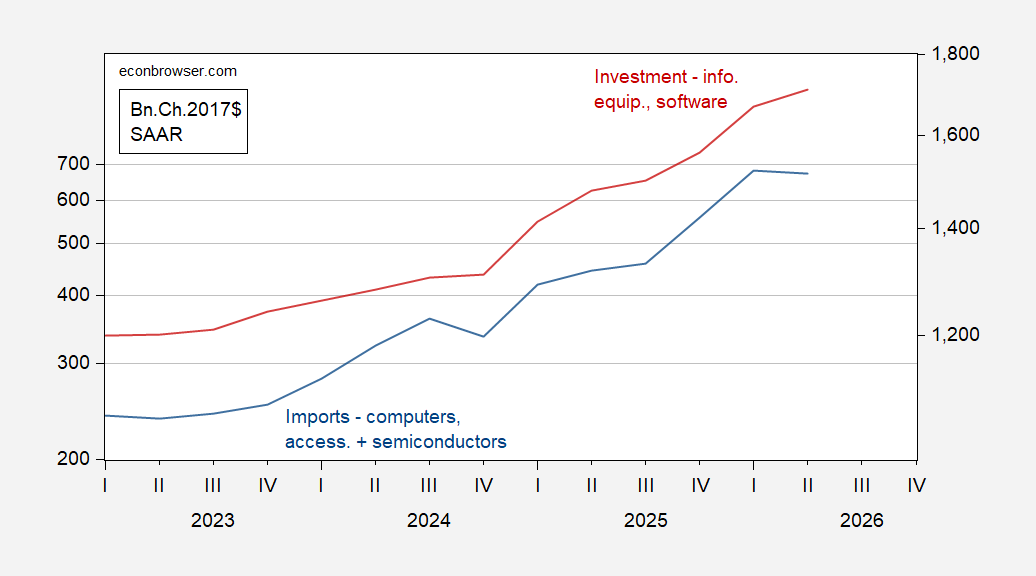
The analysis compares two series from official U.S. national accounts data:
Figure 1: Imports of computers, computer accessories and semiconductors (blue, left log scale), and investment in information equipment and software (red, right log scale), both in billions of chained 2017 dollars, seasonally adjusted at annual rates (SAAR). Source: BEA, 2026Q2 advance release, and the author's calculations.
The data come from the Bureau of Economic Analysis (BEA), the U.S. Commerce Department agency responsible for the national income and product accounts, including the advance gross domestic product estimate for the second quarter of 2026.
What Granger-Causality Testing Shows
Over this period, the null hypothesis that the growth rate of imports does not Granger-cause the growth rate of investment can be rejected at the 6% level — but not the reverse. In other words, import growth shows statistically significant predictive power for subsequent investment growth, while the opposite direction is not supported by the data.
Granger causality, a testing framework associated with 2003 Nobel laureate Clive Granger, examines whether past values of one time series improve forecasts of another. It indicates predictive precedence rather than definitive proof of economic causation.
Interestingly, however, lagged imports do not appear to correlate with investment, and imports therefore do not seem to serve as a reliable leading indicator at the quarterly frequency.
The Monthly View
That being said, it is instructive to consider imports of computers, peripherals, and semiconductors at the monthly frequency, in nominal terms:
Figure 2: Imports of computers, peripherals, and semiconductors, in millions of dollars per month, seasonally adjusted. Source: BEA.
On this monthly measure, the peak has, for now, occurred in April — that is, April 2026.
Why the Question Matters
Imports of servers, semiconductors, and related computing equipment have moved into focus amid the multi-year build-out of AI data centers and the associated surge in technology capital spending. Because monthly trade statistics are published sooner and more frequently than the official quarterly investment series, they are watched as a candidate high-frequency signal of AI-related capital formation. The BEA data cited here offer one way to compare that signal with measured spending on information equipment and software, but the quarterly and monthly series do not line up cleanly enough to make the April peak by itself definitive. On the evidence presented, whether the April peak in nominal monthly imports marks a lasting turn remains unresolved — hence the answer of "maybe."

