OpenAI's $280B Compute Build-Out Is Repricing Bitcoin Miners' Power Assets
Key Takeaways
- •OpenAI’s Stargate project surpassed its initial 10-gigawatt US target after adding 3 gigawatts during the previous 90 days.
- •Global data-center electricity consumption is forecast to reach 565 TWh in 2026 and approximately 945 TWh by 2030.
- •CoinShares values leased, operating AI facilities at roughly $27 million per megawatt, versus about $3 million for energized but unleased mining capacity.
- •Companies with contracted AI or high-performance computing capacity trade at an average 12.9 times forward sales, compared with 3.7 times for miners without such contracts.
- •Converting mining infrastructure for AI costs an estimated $8 million to $15 million per megawatt, far above the $0.7 million to $1 million required for mining infrastructure.
OpenAI expects to use roughly $278 billion in cash between 2026 and 2030 while spending about $856 billion on computing infrastructure, according to its disclosure on building the compute infrastructure for the intelligence age. At that scale, the expansion of artificial intelligence is not only about securing enough semiconductors. It is also about securing electricity, land, power lines, and sites already connected to the grid — assets many Bitcoin miners have spent years.
As AI demand grows, those mining sites are becoming more valuable. AI is not merely competing with miners for electricity; it is also lifting the value of the power infrastructure they already control. For miners, the result is a revaluation of assets built for hashing but increasingly measured in megawatts.
The bottleneck moved from silicon to the substation
OpenAI's expansion illustrates how quickly demand for AI systems is scaling. The company's Stargate project, launched in January 2025, set out to install 10GW of AI infrastructure in the United States by 2029 (1GW equals 1,000MW, the unit in which mining sites are typically valued). In April, OpenAI announced it had already surpassed that original goal, adding 3GW in the previous 90 days.
Building that capacity takes far more than deploying servers. According to OpenAI, the effort also requires sufficient energy, land, permits, transmission lines, workers, and construction partners. In January, OpenAI and SoftBank invested $500 million in SB Energy and chose the company as a partner for a 1.2GW data center planned in Milam County, Texas.
Gartner estimates that global electricity use by data centers will reach 565 TWh (terawatt-hours) in 2026, a 26% increase over 2025, with AI-optimized servers accounting for about 31% of the total. The IEA forecasts that consumption will nearly double to about 945 TWh by 2030 and warns that grid limitations could delay up to 20% of planned projects. VanEck argues that electricity, rather than chips, is becoming the main constraint. CoinShares points to “land, power and shell” as the limiting factors for AI deployment.
Why a permitted megawatt now outvalues a mining rig
Valuations are diverging sharply. According to CoinShares, its recent $3.5 billion acquisition of three leased AI facilities in Northern Virginia values stabilized infrastructure — leased, operating facilities — at roughly $27 million per MW. Registered miners with energized but unleased capacity, by contrast, trade at about $3 million per MW.
Grid access explains much of the gap. CoinShares notes that the US interconnection queue — the waiting list of projects seeking to connect to the grid — stands at around 2,600 GW, underscoring how difficult new grid connections have become. Some regions have also tightened their rules: New York imposed the first statewide prohibition in July on constructing new hyperscale data centers. For miners with live sites, those constraints make existing grid connections more valuable, given how long new projects must wait for access.
Miners are winding down hashing to keep the megawatts
CoinShares found that companies with contracted AI or HPC (high-performance computing) capacity trade at an average of 12.9 times value to next-12-month sales, versus 3.7 times for continuing miners without such contracts. S&P Global has also tracked listed miners shifting capacity from Bitcoin toward AI and HPC.
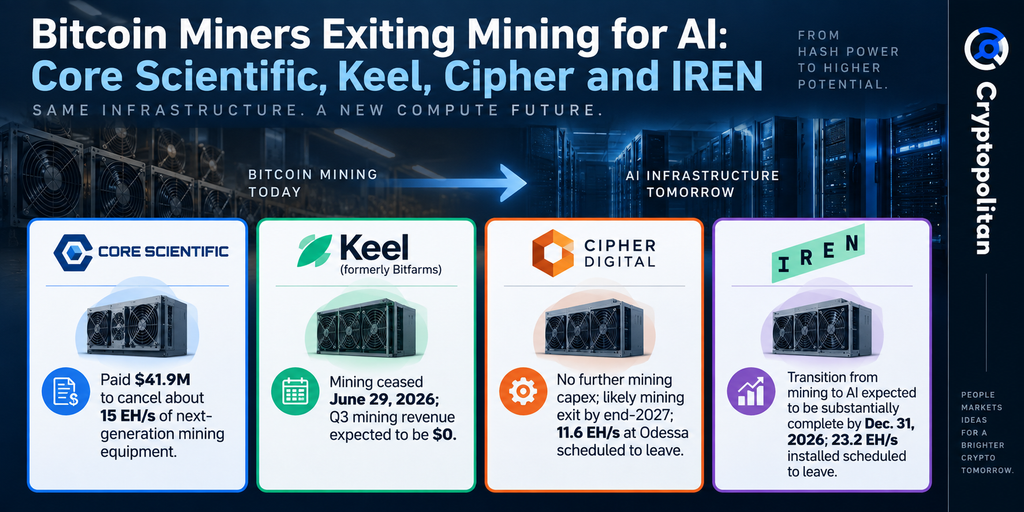
That valuation gap is reshaping capital allocation. Core Scientific paid $41.9 million to cancel about 15 EH/s of next-generation mining equipment — an exahash equals one quintillion hashes per second, the standard measure of Bitcoin mining throughput. Keel, formerly Bitfarms, halted mining on June 29 and is expected to report no mining revenue in Q3. Cipher Digital is likely to exit mining by the end of 2027, while IREN plans to complete its transition by December 31, 2026.
Conversion is a capital project, not a switch
CoinShares estimates that upgrading mining infrastructure for AI costs about $8 million to $15 million per MW, compared with $0.7 million to $1 million per MW for mining infrastructure. The spread means every converted megawatt is a major capital undertaking rather than a quick repurposing.
The AI premium also remains partly prospective. More than $100 billion of disclosed AI/HPC backlog supports only around $1.1 billion of annualized revenue, with roughly 550MW billing against more than 4GW contracted. The largest gains, therefore, should accrue to operators able to finance retrofits, secure tenants, and bring capacity online on schedule. How quickly the contracted megawatts convert into billed ones will be visible in operators' upcoming quarterly disclosures.
Crusoe is the template already running
As Cryptopolitan previously reported, Crusoe began by using otherwise-flared natural gas to power modular Bitcoin-mining data centers, then sold its mining business to NYDIG in 2025 as it pivoted toward AI infrastructure. The company now reports more than $140 billion in contracted value and 6GW of gross contracted capacity. Robinhood Ventures Fund I invested about $25 million in Crusoe's $3.9 billion Series F, valuing the company at $30.9 billion post-money.
Infrastructure built around stranded energy and Bitcoin mining is being repriced for a market in which access to megawatts can matter as much as access to GPUs.

