In Your Backyard: Jobs, Growth, and the Race We're Actually In
Key Takeaways
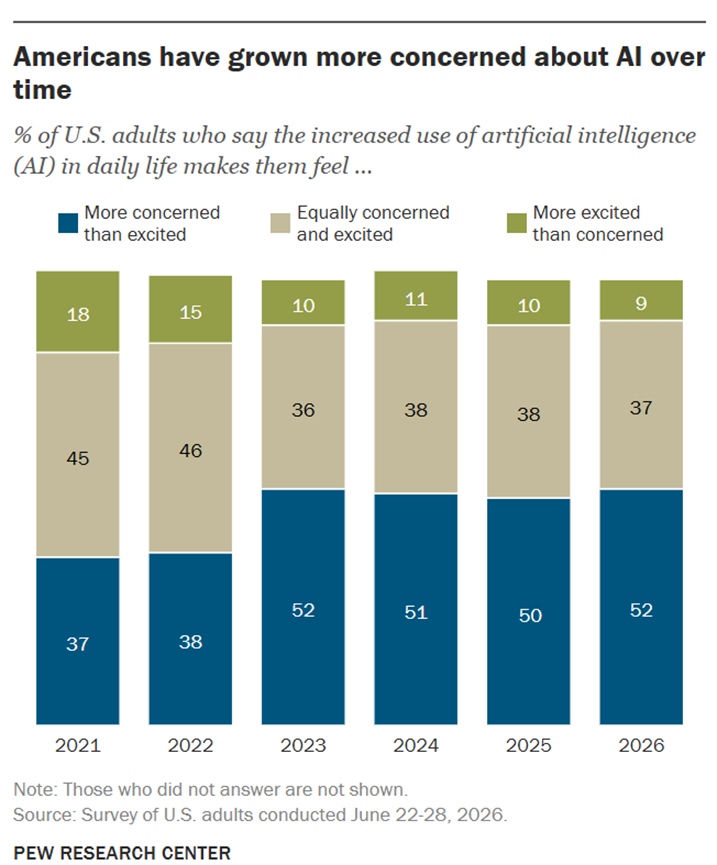
- •Pew polling shows 71% of Americans expect AI to result in fewer jobs, up from 64% a year earlier, and for the first time a majority (55%) of adults under 30 say they are more concerned than excited about AI.
- •Yale Budget Lab research found employment changes in AI-exposed jobs were statistically close to zero, with no significant wage divergence or unusual occupational switching, concluding AI is probably not yet weakening the labor market.
- •Stanford researchers found a 16% decline in entry-level hiring in AI-exposed fields such as software development for workers aged 22 to 25, and recent graduate unemployment is about 5.6%, the highest since the pandemic.
- •A study of roughly 1,500 U.S. data centers found data-processing employment rose 56% over the first decade in counties receiving their first large facility, though broader county wages showed little movement.
- •Data center construction spending reached a $59.3 billion annualized rate in May 2026, up 23% year-over-year, and the AI buildout at roughly 3.5–4% of GDP from 2025 to 2032 represents the largest capex-driven GDP boost in U.S. history.
In Your Backyard: Jobs, Growth, and the Race We're Actually In
John Mauldin
Last week we examined the water and the wires. This week we tackle the objection that frightens people most: that AI, and the data centers that run it, are coming for their jobs. This argument differs from the water and power debates because it is not really a factual dispute so much as a forecast — and forecasts about technology and employment have a long, undistinguished record of being wrong in both directions. So let's separate what people currently believe from what the data currently show, and then consider why the jobs argument, even where it has merit, points toward building more data centers rather than fewer.
What People Believe
The sentiment data is genuinely striking, and it should not be waved away. According to Pew Research Center polling, the most notable shift is among the young: for the first time since Pew began tracking this question in 2021, a majority of adults under 30 (55%) say they are more concerned than excited about AI, putting them on par with — and by some measures above — every other age group, including those over 65.
Geoffrey Hinton, the Nobel laureate known as the godfather of AI, has publicly told people to "train to be a plumber." A LinkedIn report found that 55–65% of Gen Z workers across the U.S., U.K., Germany, and France now say skilled trades offer more meaning than a traditional office job. This is a real and rational response to real uncertainty, and pretending otherwise would be its own kind of misinformation.
The Pew polling also confirms that pessimism about AI taking jobs is widespread: 71% of Americans believe there will be fewer jobs because of AI in the future, up from 64% just a year earlier.
What the Data Actually Shows
Belief and outcome, however, are different things — and right now the hard labor-market data is not cooperating with the pessimism.
The Yale Budget Lab, using a rigorous differences-in-differences approach that compares AI-exposed occupations to similar unexposed ones, found that as of its most recent analysis, employment shares in AI-exposed jobs have moved by an amount "close to zero" and are not statistically distinguishable from no change at all. Wages showed no significant divergence either. Most tellingly, the study found no unusual increase in workers switching occupations — exactly what you would expect to see first if AI were meaningfully displacing people at scale. Their conclusion: "AI is probably not (yet) the reason for labor market weakening." Note the "yet." This is a live question, not a closed one, and everyone should keep watching the data closely.
A companion analysis from MIT Technology Review, drawing on Bureau of Labor Statistics data, found something that runs directly counter to the popular narrative: the unemployment rate for workers in the most AI-exposed occupations is actually lower than for workers in less-exposed ones. Only about one in five companies currently uses AI in any business function at all, according to Census data — a useful reminder of how far "AI is everywhere" rhetoric has outrun actual corporate adoption. And a chart making the rounds from Apollo's chief economist, Torsten Slok, makes the point vividly on an industry commentators have predicted AI would gut for years: U.S. payroll employment in travel agencies today sits almost exactly where it did before the pandemic. In Slok's words, there is "still no sign of AI lowering employment in travel agencies."
There are exceptions that deserve attention, because a one-sided case is not worth much. Stanford researchers found a real, 16% decline in entry-level hiring within AI-exposed fields like software development for workers aged 22 to 25, an effect that has been growing through 2025. Recent college graduate unemployment is running around 5.6%, the highest since the pandemic and, before that, the 2008 recession. That is a genuine cost being paid by a specific slice of the workforce: new graduates trying to break into a small number of white-collar fields where AI is good at the "codified knowledge" tasks a junior employee traditionally used to cut their teeth on. It is not evidence of the broad jobs apocalypse the headlines promise, but it is real, and it deserves a real policy response — apprenticeships, different hiring pipelines, something — rather than a blanket "don't worry about it."
This is actually more concerning than it might first appear. It is those entry-level jobs where new graduates and young workers learn how to function in a business. They are the feedstock for future management positions and expansion. Just as an economy needs more workers every year in order to grow, businesses need young people who can be trained into more responsible positions. Yes, you can hire from outside, but then you are cannibalizing another company's growth.
Most people learned the basic fundamentals of working when young: showing up on time, being productive, responding to instructions, learning more, and contributing to a team. That became the springboard for greater productivity — and it is one reason employers want to know about your past employment: what have you learned and how did you perform? If 16% of the workers in AI-related fields are no longer there, that means less on-the-job training. Then again, if those jobs are not going to exist in the future, there is no point in being trained for them. It is a quandary whose answer will not be known for a very long time.
There is a second, quieter data point worth attention: Gallup finds that among workers whose employers have actually rolled out AI, engagement runs eight points higher for weekly AI users than non-users (39% versus 31%), and when management pairs AI adoption with a clear plan and active support, engagement jumps to 53%. Properly managed AI adoption looks far more like a tool that makes people more engaged in their work than a guillotine hanging over it.
One final, major point: every significant new technology has ended up creating vastly more jobs than it destroyed. Artificial intelligence is unlikely to be different, and it will likely create jobs we cannot even envision today. That is the long-term optimist view.
There is also a more optimistic and perhaps more realistic view. In the past, major technologies were adapted over long periods. The transition from the farm through the Second Industrial Revolution took 8–10 generations; there was time to adapt. The concern now is that society is trying to adapt to one of the most potentially disruptive technologies in less than half a generation. That gap can generate a great deal of pushback and would only deepen negative views of data centers and artificial intelligence.
The Jobs Data Centers Actually Create
Set aside the general AI-and-jobs debate for a moment and look specifically at what happens when a data center is built in a county, because this is the part directly relevant to the "not in my backyard" fight.
A rigorous new study covering roughly 1,500 U.S. data center facilities and 52 canceled projects compared counties that received a facility to similar counties where a planned facility was canceled — about as close to a controlled experiment as economics gets. It found that data-processing sector employment rises 56% over the first decade in counties that receive their first large data center, with telecommunications employment up 43% in counties that land a hyperscale facility from the likes of Amazon, Google, Microsoft, or Meta. Home prices in these counties rose a modest 2–5%. There is a caveat: wages in the broader county did not move much, and the researchers note that industry-funded estimates of data center job impacts tend to overstate the benefit by ignoring growth trends the county was already on. Sometimes rosy numbers from self-interested industries do not survive actual scrutiny.
The construction side of the ledger is not in dispute. Data center construction spending hit a $59.3 billion annualized rate in May 2026, up 23% year-over-year, and now accounts for roughly 8% of all private nonresidential construction in the country — a figure "The Situation" newsletter puts even higher, noting data centers account for over 3% of all U.S. construction of every kind, and that private data center construction spending has now surpassed total public spending on all transportation combined: airports, transit, marine terminals, everything. In June, the Commerce Department reported data center outlays up almost 50% year-over-year to $68.3 billion, even as spending on every other category of private construction (housing, hospitals, schools) fell by $101.6 billion over the same period. Construction wages are rising faster than the broader private sector too: 5.0% year-over-year versus 3.4% economy-wide, with construction workers now earning over 20% more than the average private-sector worker.
At the state level, the numbers get concrete quickly. A 2025 Ohio study found that a single mid-sized data center project supports nearly 9,700 construction jobs during the build phase, $2.4 billion in total economic output, a $1 billion contribution to state GDP, and roughly $84 million in annual peak state and local tax revenue.
Virginia, the most data-center-dense state in the country, sees an estimated 74,000 jobs annually tied to the industry, a $9.1 billion contribution to state GDP, and up to 30% of total local tax revenue in some jurisdictions. McKinsey estimates the broader data center build-out represents a $7 trillion opportunity over the coming years for the industrial companies that supply the power, cooling, and equipment behind it — a supply chain far larger than the hyperscalers themselves.
Without the massive investment in data centers, U.S. GDP growth would be flat at best. That raises questions about the real strength of the U.S. economy, in both very positive and very problematic ways — a subject for another letter.
The Bigger Picture: Growth, and the Race We're Actually In
Zoom out further and the case gets stronger still. A comparison of major U.S. capital-spending waves, using data from Columbia Business School, shows the current AI buildout running at roughly 3.5–4% of GDP from 2025 to 2032. That is larger, as a share of the economy, than the canal boom of the 1830s, the railroad boom of the 1870s–1890s, rural electrification, the interstate highway system, or the telecom and fiber buildout of the late 1990s. By the best available measure, this is the largest capex-driven boost to GDP in American history.
Mark Mills, whose primary-source analysis for the National Center for Energy Analytics is among the most trusted writing on this topic, makes a related point: if AI does nothing more than nudge U.S. productivity growth back to its postwar average of 2.2% a year from the 1.4% of recent years, that alone would be worth roughly $10 trillion in cumulative additional GDP over the next decade — and the energy consumed by that broader wealth creation will dwarf the energy the AI infrastructure itself consumes directly.
There is also a case here that goes beyond economics to geopolitics. China's leadership has been explicit about embracing open-weight AI models — not entirely out of generosity, but substantially because China trails the U.S. in computing power and AI capital expenditure, and open weights let it recruit the whole world's engineering talent to close the gap for free. China's answer to a slowing, aging workforce has been to install one of every two industrial robots deployed worldwide last year; that effort is succeeding where its attempts to boost domestic consumption have not. The American answer to the same demographic problem — U.S. population growth slowed to just 0.5% in 2025, with net migration near historic lows — has to come from somewhere. Data centers and the automation they enable are a large part of the "build robots" option, alongside more babies and more immigration, that keeps the American economy from following a stagnating Japan, and increasingly China itself, into a demographic wall. A country that decides not to build the infrastructure for this technology does not stop the technology from being built; it just decides that someone else builds it first. Given the critical nature of this technology, it is imperative that the U.S. maintains its lead — a matter of geopolitics and basic defense. The world is watching in real time what AI does on the battlefield.
Finally, there is the concern raised in Part 1, which applies here too: the fear that data centers are financially fragile, debt-fueled bubbles waiting to pop, stranding capital and jobs when they burst. The primary-source view from Mark Mills, who has spent his career studying industrial infrastructure cycles, is that this fear misunderstands what a data center actually is. It is not a single-purpose asset like a railroad to a ghost town; it is closer to a warehouse or a factory floor, built with extra power and cooling capacity precisely so new chip generations can be slotted in as they arrive, while the older racks do not wear out the way mechanical equipment does and keep generating income by producing cheaper tokens for years afterward. That is a very different risk profile than the popular "AI bubble" narrative assumes, and one more reason the jobs and capital tied up in this build-out are more durable than skeptics believe.
Does every dollar invested in a data center pay its developers back? Absolutely not. Some of these companies will recover only a fraction of what they invested — but nobody knows which ones at this time. Leadership has shifted across companies, and there are literally hundreds of firms in the ecosystem, any of which could rise to become the next giant killer. For the big companies, getting AI right is existential. It is an arms race. Right now, every data center built and turned on is immediately put to use; the market is demanding more data centers and more computing power, not less. Some hyperscalers may well be overly optimistic about their return-on-investment potential — but no one knows which.
In Summary
Across both letters, the pattern is consistent. The loudest objections to data centers — water, power, jobs — each contain a kernel of legitimate concern buried inside a much larger amount of exaggeration, and in every case the trend line is moving in the industry's favor: cooling technology cutting water use, grid rules adapting to speed up connections, nuclear power finding a buyer of last resort, and labor markets that, so far, are not showing the damage the headlines promise.
The main answer to the physical side of data centers is siting. A data center should not be built next to a housing development. Water issues must be resolved before ground is broken. Hyperscalers must present a viable energy plan ensuring consumers are not stuck with higher electric bills on their account. All of those are rational and doable.
A potentially much bigger problem is the transition for younger workers. People are working on it, but no grand plan has yet emerged that truly addresses the issue. History offers a caution against both complacency and panic here: when ATMs spread through banking in the 1980s and 1990s, economist James Bessen's research found teller employment actually rose as banks opened more branches and tellers shifted to relationship work — but the tasks changed, and the adjustment was not costless for individual workers. That is roughly what the data here suggests watching for: not headline job counts, but which tasks and which rungs of the career ladder shift.
Still, "not in my backyard" is, on the evidence, the wrong instinct. The country that builds this infrastructure fastest is the country that captures the growth, the jobs, and the geopolitical position that come with it. The author would rather the U.S. be that country.
Austin, New York, DC, and Cleveland
First, thanks to all who expressed concern about the author's daughter, Abbi. Mike Roizen was able to arrange a consultation with the head of neurosurgery at the Cleveland Clinic. Her brain tumor sits in the middle of her brain, making it very difficult to reach. It is 90% likely to be benign, but it must be addressed; brain surgery is scheduled for November 5th. The technology being used is remarkable — intensive MRI during surgery, with AI and robotics guiding the surgeon, effectively distinguishing which cells to remove and which to leave untouched. Only a handful of places in the world can perform this procedure. Ironically, the tumor was discovered only because she was misdiagnosed after a seizure; had it been correctly identified as a heart issue, the tumor would still be growing, and by the time symptoms appeared it would have been extraordinarily problematic.
The author will be in Austin Sunday through Tuesday, primarily to attend funeral ceremonies for Patrick Watson's wife, Grace. Sunday morning brings a late brunch with Lacy Hunt, George and Meredith Friedman, Brad Rotter, and friends; that afternoon, a barbecue party hosted by Joe Lonsdale. Trips to New York (second week of September) and DC (second week of November) are scheduled, with more being planned. Last year the author was out of Puerto Rico for only 31 days — not counting flying days, since the IRS does not count flying days as days outside Puerto Rico, which partly determines tax treatment.
An update on Lifespan Edge, the longevity clinics: clinics have officially opened in West Palm Beach and Columbia, Maryland (essentially DC), with Dallas and Dorado Beach open as well. Patients are being booked at all locations, and discussions are underway with well over a few dozen doctors and locations across the country to expand services. The interest reflects a growing view among longevity experts that the first part of a client's journey should begin with Therapeutic Plasma Exchange (TPE), which has profound effects on inflammation, age-related muscle loss, Alzheimer's and dementia, and more. The partner in the endeavor is Dr. Mike Roizen, one of the world's leading longevity experts.
And with that, the send button gets pressed. Have a great week and make sure to enjoy friends and family.
Your dealing-with-family-issues analyst,
John Mauldin, Co-Founder, Mauldin Economics
About the Author
John Mauldin, Co-Founder, Mauldin Economics, is one of the most recognized names in the financial world and regularly speaks at investment conferences and seminars around the globe, including the MoneyShow, the Agora Financial Investment Symposium, and the CFA Institute Annual Conference. More at
