Construction Inflation for Nonresidential Buildings Soars Amid AI Infrastructure Spending Boom
Key Takeaways
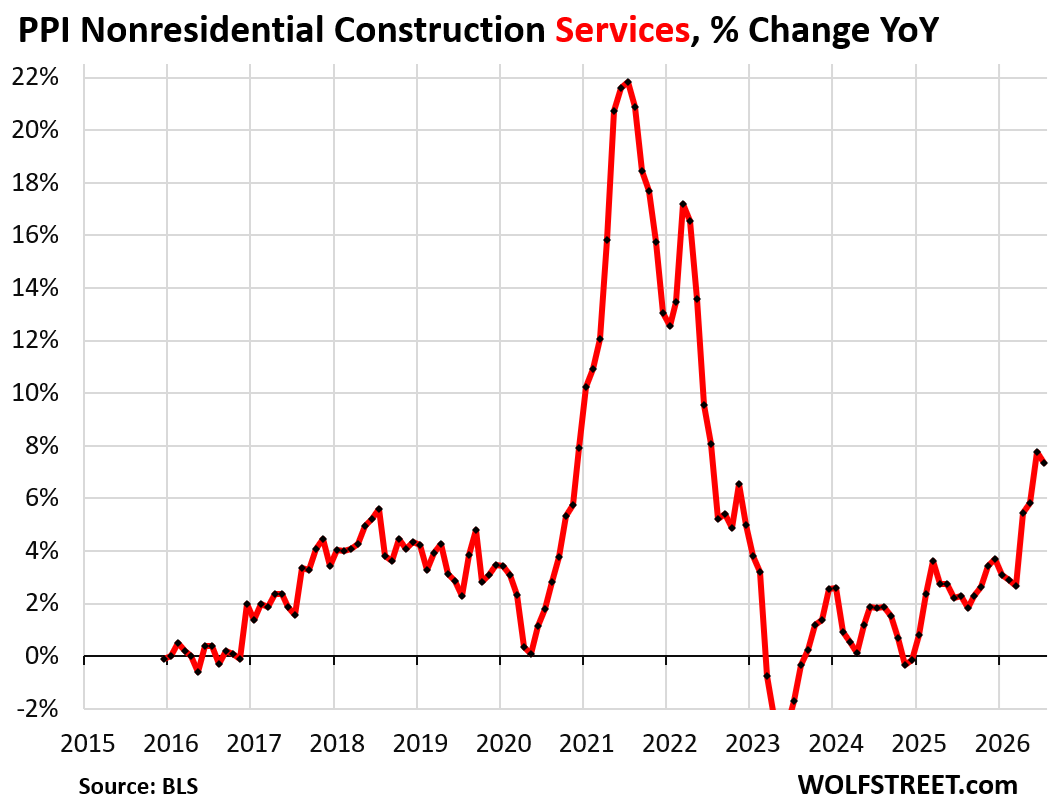
- •The Producer Price Index for nonresidential construction services rose 7.4% year-over-year in July, the sharpest annual increase since July 2022, after a cumulative 5.1% gain over the five months since March.
- •The PPI for construction materials, including steel mill products, concrete, lumber, and gypsum, increased 10.5% year-over-year, with steel joists and rebar prices up 17.7%.
- •Total put-in-place nonresidential building costs, which include direct labor, materials, services, and contractor overhead, rose 5.2% year-over-year and are up 45% since the beginning of 2021.
- •Because the PPI does not isolate data centers, the cost pressures affect all types of commercial construction projects, not only those tied to AI.
- •The data center construction boom parallels the semiconductor plant buildout that began in 2022 after the CHIPS and Science Act provided $52.7 billion for US semiconductor manufacturing, supply chain, and R&D programs.
The massive amounts of capital being thrown at AI infrastructure are now showing up in construction inflation. Building AI data centers and the infrastructure required to supply them with power has turned into a mad scramble, with spending growing at an exponential rate. Huge sums of money are being deployed to get these projects completed, equipped, and connected amid shortages of all kinds, including labor shortages such as electricians — and construction costs for nonresidential buildings in general are surging.
The Producer Price Index (PPI) for nonresidential construction services spiked by 7.4% year-over-year in July, while the PPI for construction materials — steel mill products, concrete, lumber, gypsum, and others — spiked by 10.5% year-over-year, according to PPI data released by the Bureau of Labor Statistics.
Services index posts highest increases since 2022
The PPI for nonresidential construction services began spiking in March of this year and has risen by a cumulative 5.1% over the past five months. Compared with a year ago, the index jumped by 7.4%, and the year-over-year increases in June and July were the highest since July 2022.
The index tracks domestic prices that one company pays to another company for trade services, transportation, warehousing, architectural engineering, legal services, equipment leasing, and similar inputs. It excludes direct labor costs on construction sites, capital investment such as purchases of heavy equipment, and imports.
Since January 2021, the PPI for nonresidential construction services has soared by 31%. Since January 2020, it has soared by 44%. The price surge over the past 12 months has come on top of already very high price levels for those services.
Construction materials spike 10.5%
The PPI for construction materials — steel mill products, concrete, lumber, gypsum, etc. — spiked by 10.5% year-over-year, the biggest increase since June 2022. The index tracks the change in selling prices that companies charge each other. Commercial contracts frequently include contract escalation clauses that cite this index to adjust project budgets based on real-world raw material inflation.
At the product category level, the PPI for "Fabricated Structural Metal Bar Joists and Concrete Reinforcing Bars" — steel joists and rebar — spiked by 17.7% year-over-year. These are basic structural inputs used across nearly every category of nonresidential building. It is part of the broader PPI for construction materials.
Since the beginning of 2025, over 19 months, the PPI for construction materials has spiked by 15%. Since January 2021, it has spiked by 46%. Since January 2020, it has spiked by 58%. The 15% price surge over the past 19 months came on top of already very high prices for those materials.
Total building cost index rises 5.2%
The PPI for nonresidential building construction — which tracks total put-in-place building costs including direct labor, materials, site equipment, services, and contractor overhead — jumped by 5.2% year-over-year. The 5.2% increase over the past 12 months comes on top of already very high prices. Since the beginning of 2021, the index has soared by 45%, despite the breather in 2023 and 2024 that followed the massive spike in 2021 and 2022 — an earlier surge driven by pandemic-era supply chain disruptions and sharply higher commodity costs.
Broader inflationary footprint
These soaring construction costs are only part of how the massive piles of dollars being tossed around as investment in AI infrastructure are creating inflation across various sectors of the economy. The PPI does not isolate data centers — these are construction costs for nonresidential buildings in general, meaning the cost pressures register across all types of commercial projects, not only those tied to AI.
The construction boom surrounding semiconductor plants that started in 2022 has had a similar effect. That boom followed the CHIPS and Science Act, signed into law in August 2022, which provided $52.7 billion for US semiconductor manufacturing, supply chain, and R&D programs, including $39 billion in manufacturing incentives. The construction booms for data centers and semiconductor plants are linked, amid efforts to shift some of the AI-related chip production to the US, where those chip plants are being built.
Future monthly BLS producer price releases, along with the Census Bureau's construction spending figures, will show whether the acceleration that began in March extends beyond the summer.
Source: Wolf Street
