AI Crypto Tokens Overtake Ripple's XRP as South Korea's Leading Crypto Category, Chainalysis Reports
Key Takeaways
- •Chainalysis data show AI-linked cryptocurrencies overtook payment-focused assets such as Ripple's XRP as South Korea's most-traded crypto category by June 2026.
- •Worldcoin led AI token trading volume at $7.41 billion, followed by SAHARA at $3.2 billion, VIRTUAL at $2.7 billion, BIO at $2 billion, and NEAR at $1.7 billion.
- •South Korea recorded about $449 billion in crypto activity, a 12.% increase, while its exchange ecosystem expanded 16.3% during the measurement period.
- •The AI rotation is attributed to South Korea's involvement in the AI investment cycle, particularly SK Hynix's position at the center of the global memory-chip supply chain.
- •The reported Ripple–Meritz review of custody and tokenization infrastructure remains exploratory, with no confirmed XRP usage or transaction volumes.
AI-linked cryptocurrencies had become South Korea's most-traded crypto category by June 2026, overtaking payment-focused assets such as Ripple's XRP, according to blockchain analytics firm Chainalysis. The finding points to a marked shift in retail trading preferences in a market with a long history of XRP trading — and one in which retail investors, rather than institutions, largely set the pace of activity.
Chainalysis examined crypto activity from July 2025 through June 2026 and ranked thematic categories by their share of Korean won-denominated trading volume rather than by total market activity. That lens measures where Korean traders are actually directing funds, rather than the global size of each asset class.
East Asia's $1.2T+ crypto economy shows remarkable diversity: South Korea ($449B) leads with an AI-crypto pivot, Hong Kong sees 87% institutional growth, Japan's retail market expands 36% on DEXs, and China's stablecoin P2P wallets grew 43x. Read our new chapter from the 2026…
The findings sit within Chainalysis's broader East Asia research, which describes a regional crypto economy of more than $1.2 trillion. Alongside South Korea's $449 billion in activity and its AI pivot, the firm reported 87% institutional growth in Hong Kong, 36% retail expansion in Japan driven by decentralized exchanges, and a 43-fold rise in stablecoin peer-to-peer wallet activity in China. Within that frame, South Korea stands out as the region's largest market by activity — and the one where a retail-driven thematic rotation reshaped the category rankings.
The data arrive amid reports of an exploratory Ripple–Meritz review of custody and tokenization infrastructure. The key distinction lies between a changing market narrative and a product that is actually operating — a difference that matters when weighing Ripple's institutional relationships against confirmed XRP use. The Chainalysis findings establish that AI led the defined thematic categories; they do not show that XRP has disappeared from Korean trading, nor that Ripple's corporate expansion is translating into token demand. For readers tracking XRP specifically, the report is a measure of where Korean retail attention is rotating, not a verdict on any single asset.
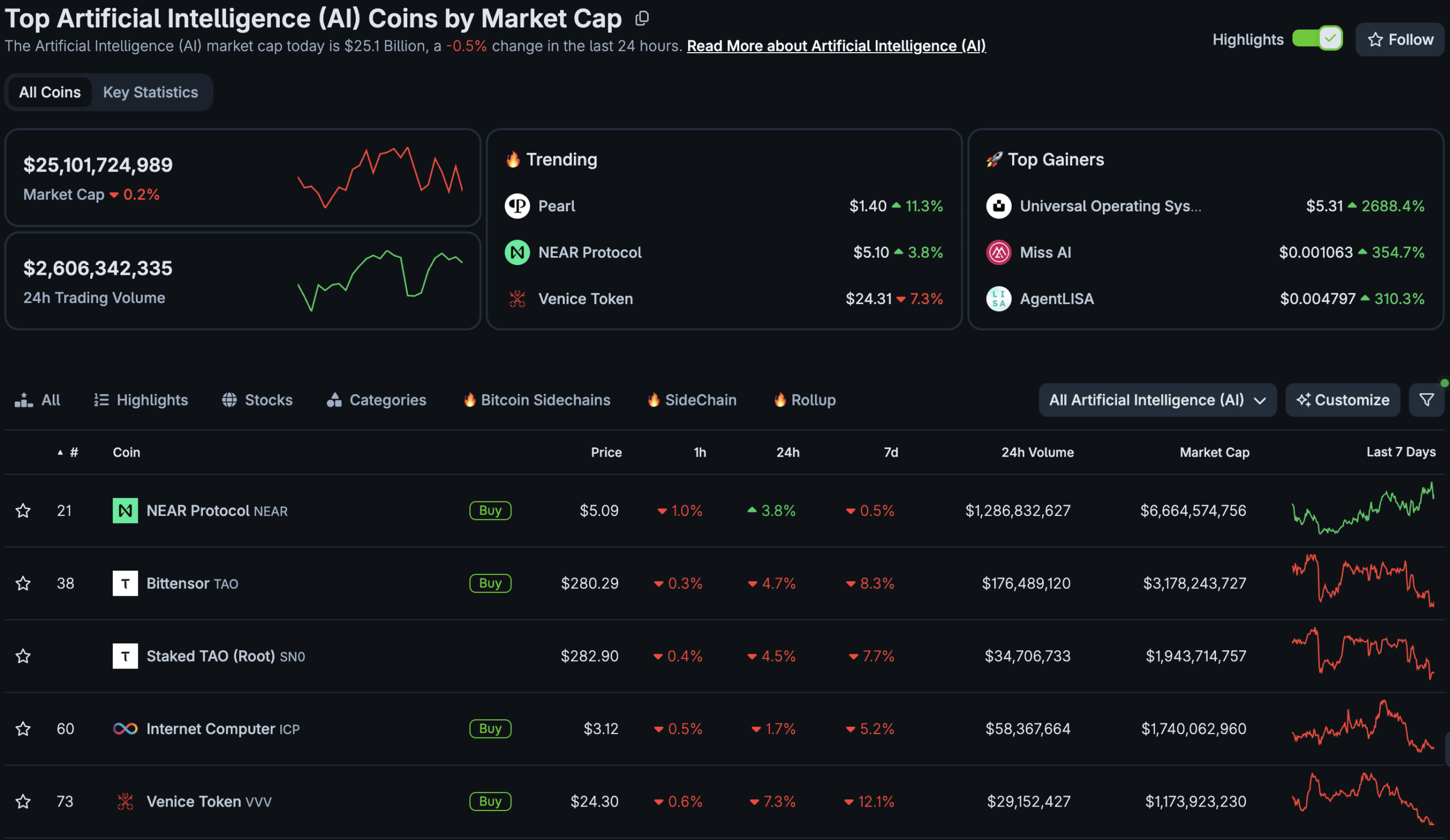
AI Tokens Lead South Korea's Crypto Rotation
(Source: CoinGecko)
Chainalysis identified AI cryptocurrencies as South Korea's most popular thematically defined investment category by June 2026. The report defines the group as assets linked to AI-focused projects or AI infrastructure, and compares categories using share of won-denominated trading — a measurement that does not capture all Korean crypto activity.
The leading AI-linked tokens by reported trading volume were Worldcoin (WLD) at $7.41 billion, SAHARA at $3.2 billion, VIRTUAL at $2.7 billion, BIO at $2 billion, and NEAR at $1.7 billion. The leaderboard has shifted as well: VIRTUAL and KAITO led AI-related tokens in 2025 before Worldcoin and SAHARA moved ahead.
Chainalysis said Korean retail traders moved through the AI category faster and more intensely than traders in the other markets it covered — a pattern consistent with a market structure in which retail investors, not institutions, dominate. That turnover illustrates how quickly thematic leadership can change. It describes activity over the report's measurement period and does not guarantee that any token will retain attention, or that every trade represents a long-term investment.
The wider South Korean crypto market also grew during the period. Chainalysis recorded about $449 billion in crypto activity, an increase of 12.3%, while the country's exchange ecosystem expanded 16.3%. Those figures describe overall market growth; they do not identify XRP as a cause or show that the token shared equally in the gains.
Why the AI Rotation Matters for Ripple XRP
HUGE: South Korea is preparing to bring $7 TRILLION worth stocks, bonds and funds onto blockchain rails from February 2027! $AVAX $XRP And there is two ecosystems already have serious Korean connections… Hanwha Investment & Securities has built a HUGE tokenised securities… pic.twitter.com/DO2Y5C1DLr
The post highlights South Korea's reported plan to move $7 trillion worth of stocks, bonds, and funds onto blockchain rails from February 2027, and points to ecosystems with established Korean connections, including mentions of XRP and Avalanche (AVAX).
In June 2026, South Korea's AI crypto trading outpaced other currency denominations, with the won's share measured at 19.5 times that of the yen. AI cryptocurrencies accounted for 0.91% of yen-denominated trading, compared with 1.02% for euros, 0.20% for the Brazilian real, and 0.03% for British pounds. By those measures, the AI theme was more prominent in won-denominated trading than in any of the other currencies Chainalysis compared.
The trend is attributed to South Korea's involvement in the AI investment cycle, particularly its link to SK Hynix, a key memory-chip manufacturer whose products sit at the center of the global AI computing supply chain. Retail investors largely drive the Korean market, a dynamic that underscores strong local interest in AI tokens and helps explain the speed and intensity of the rotation Chainalysis measured.
While AI assets surpassed payment tokens over the measured period, that does not necessarily mean Ripple's XRP has lost significance in South Korea. The reported Ripple–Meritz review remains exploratory and lacks confirmation of XRP usage or transaction volumes — and category share reflects trading attention, not an asset's underlying utility or a company's business progress.
Future developments — such as a disclosed product or a commercial deployment — would clarify Ripple's position in the market. For now, AI-linked assets hold the leading share of South Korea's retail crypto activity.
This article is based on reporting by 99Bitcoins.

