Eight AI Chatbots Forecast Bitcoin's Year-End Price — Here's the Verdict
Key Takeaways
- •Bitcoin's disclosed AI year-end forecasts span from $95,000, set by OpenAI's ChatGPT Astra, to $115,000, set by Pi AI's Inflection-2, with every figure tied to the Dec. 31, 2026 close.
- •Jev, Typesafe AI's formal verification model, identified Kimi's $96,000 target as the forecast most consistent with the provided information and generally rated the more conservative projections more favorably.
- •According to Coinglass historical return data, bitcoin gained 24.95% in August and climbed 7.03% as of Sept. 26, defying a seasonal pattern that has historically weighed on prices in August and September.
- •The identical prompt given to all eight models cited strengthened ETF demand, Strategy's resumption of bitcoin purchases, the ongoing U.S.-Iran conflict, and the T-500 countdown to the fifth halving as key inputs.
- •The report emphasized that Jev's scores measure only how closely each projection aligned with the supplied information and timeframe, and that the forecasts are model-generated estimates rather than investment guidance.
Bitcoin has flipped the script on its seasonal tendencies this year. August and September have rarely been kind to bitcoin prices historically, but the leading cryptocurrency has bucked that pattern over the past two months. According to Coinglass historical return data, bitcoin posted a significant 24.95% gain in August, and as of Sept. 26, $BTC had climbed a respectable 7.03%.
Institutional demand has returned as well, with exchange-traded fund (ETF) inflows lending further support to bitcoin's price, while $BTC proponents, prediction market bettors and even Wall Street appear increasingly bullish about its prospects.
Against this backdrop, a report published by Bitcoin.com News put a sizable roster of today's leading AI chatbots to the test, asking where bitcoin might stand by year's end — specifically on Dec. 31, 2026. Because every model had to commit to a fixed price on a fixed date, the exercise produced something market commentary rarely offers in this form: a set of dated, dollar-denominated forecasts that can later be scored against bitcoin's actual close.
The Experiment and the Prompt
The prompt was deliberately straightforward, offering a handful of relevant details without introducing unnecessary complexity or steering the AI forecasts in any particular direction. The chatbots queried included Google's Gemini Pro 3.1, Kimi AI's Kimi K3, Anthropic's Claude Opus 5.5 (High Intelligence), xAI's Grok 4.7, Mistral Medium 3.5, Pi AI's Inflection-2, Deepseek's Deepthink and OpenAI's ChatGPT Astra.
Each model received the identical prompt:
"Bitcoin is trading just below $85,000, having gained 26% over the past six months. Exchange-traded fund (ETF) demand has strengthened, and Strategy resumed its $BTC purchases last week. Meanwhile, the ongoing conflict between the U.S. and Iran continues to unsettle global markets, with no clear end to the war in sight. Bitcoin also stands 64 days away from T-500, a historical cycle milestone marking the 500-day countdown to its fifth halving. Drawing on your expertise as a seasoned bitcoin analyst, assess the cryptocurrency's potential trajectory through year-end and provide a concise, well-reasoned explanation for your forecast in no more than two to three sentences. Establish a definitive closing price for $BTC on Dec. 31, 2026, expressed in U.S. dollars. What is your precise year-end price estimate?"
Two of those inputs carry particular weight for readers: Strategy's renewed buying — Strategy is the largest corporate holder of bitcoin — and the T-500 marker, which counts down to the next halving, the mechanism that cuts the new bitcoin issued to miners in half on a roughly four-year schedule.
What the Models Said
Google's Gemini Pro 3.1 framed its forecast around supply dynamics outweighing macro headwinds:
"While geopolitical tensions and macroeconomic uncertainty create persistent risk-off friction, continuous ETF absorption and corporate treasury accumulation are systematically draining liquid exchange reserves ahead of the pre-halving cycle transition. This persistent supply constraint is expected to outpace macro headwinds, sustaining an upward trajectory toward cycle resistance as institutional liquidity anchors the market floor. Factoring in this structural accumulation against projected volatility, the modeled closing price for $BTC on December 31, 2026, is $96,500."
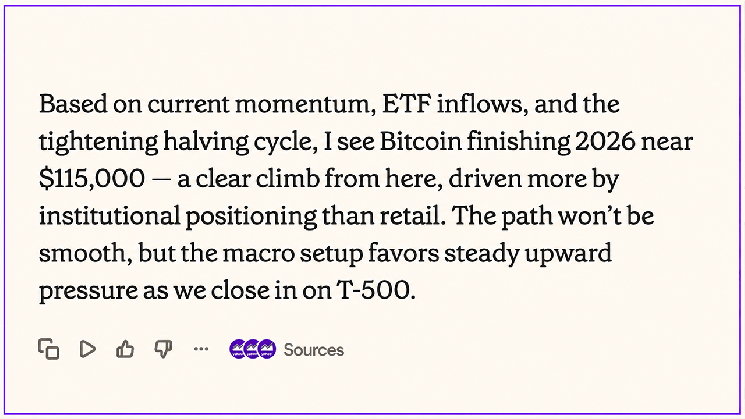
Pi AI's Inflection-2 offered the highest of the verbatim forecasts published in the report:
"Based on current momentum, ETF inflows, and the tightening halving cycle, I see Bitcoin finishing 2026 near $115,000 — a clear climb from here, driven more by institutional positioning than retail. The path won't be smooth, but the macro setup favors steady upward pressure as we close in on T-500."
Deepseek's Deepthink landed just below Pi:
"I anticipate $BTC will trade positively, albeit with some volatility, through the end of the year, as ETF inflows and corporate treasury purchases help lift its price toward the low $110,000s, while ongoing U.S.-Iran tensions limit further upside; the T-500 milestone encourages accumulation but is unlikely to trigger a major rally on its own. My exact closing price prediction for Dec. 31, 2026, is $112,000."
OpenAI's ChatGPT Astra projected the most conservative target among the published responses:
"My precise forecast for bitcoin's Dec. 31, 2026, closing price is $95,000, a base-case estimate implying roughly 12% upside from $85,000. Given the conditions you describe, stronger ETF demand and renewed Strategy purchases favor further gains, while the U.S.-Iran war could fuel inflation and risk aversion, keeping the advance uneven. I give those demand flows more weight than T-500: the milestone itself does not reduce issuance, with the next actual supply cut expected in 2028."
Verbatim responses from Kimi K3, Claude Opus 5.5 (High Intelligence), Grok 4.7 and Mistral Medium 3.5 were not included in the text of the source report. Kimi's year-end target of $96,000 was nonetheless disclosed later in the piece, when Jev — the verification model described below — singled it out.
Jev Weighs Eight AI Bitcoin Forecasts and Picks Kimi's $96,000 Target
The AI models differed less on bitcoin's direction than on which market forces would ultimately carry the most weight, with Gemini, Kimi, Claude and ChatGPT occupying the more cautious end, Grok holding the middle ground, and Mistral, Pi and Deepseek staking out the bullish territory. According to the report, this divergence may reflect differing underlying assumptions rather than access to fundamentally different information.
After consulting the conventional AI models, the report turned to the large language model Jev. Typesafe AI's Jev is a formal verification toolkit for AI-generated code that employs type theory and proof assistants to mathematically establish whether LLM outputs satisfy predefined specifications before they are trusted, rather than relying exclusively on probabilistic testing. Its distinguishing feature is the pursuit of demonstrable correctness rather than statistical confidence alone.
Bitcoin.com News gave Jev two assignments: identify the forecast most consistent with the information provided, and evaluate each bitcoin price prediction using the same four-point scale, ranging from poor fit to strong fit.
Jev selected Kimi's $96,000 forecast, and its assessments generally favored the more conservative price targets. According to Jev's output, Kimi, ChatGPT, Claude and Gemini received reasonable-fit assessments, while Elon Musk's xAI model Grok earned a weaker rating, followed by even less favorable assessments for the higher targets proposed by Deepseek, Pi and Mistral.
The report noted that these scores reflect only how closely Jev considered each projection aligned with the supplied information and timeframe. They do not establish what bitcoin will ultimately be worth, and Jev did not provide a written explanation for its selections.
The Published Targets at a Glance
Among the forecasts disclosed in the report, OpenAI's ChatGPT Astra set the low end at $95,000, followed by Kimi's $96,000, Gemini Pro 3.1's $96,500, Deepseek's $112,000 and Pi AI's $115,000.
Every figure is tied to the same deadline, so the spread from $95,000 to $115,000 amounts to a public scoreboard for AI market forecasting — one that can be settled against bitcoin's actual close on Dec. 31, 2026. Until then, the numbers stand as model-generated estimates conditioned on a single prompt, not investment guidance or guarantees about where the market is headed.
This article is based on reporting by Bitcoin.com News: We Asked 8 AI Chatbots to Predict Bitcoin's Price, Here's the Verdict.

