Pecking Order Theory and the Sustainability of AI Capex Spending
Key Takeaways
- •Major hyperscalers including Amazon, Microsoft, Alphabet, and Meta are shifting from internal cash flow to external debt markets to finance AI infrastructure spending starting in 2026.
- •AI capital expenditure is primarily directed toward data center construction, specialized semiconductors, and GPU clusters required to train and deploy large-scale AI models.
- •AI's growing capital needs are increasingly extending from equity markets into the corporate bond market, according to analysis from The Economist.
- •Free cash flow for major hyperscalers is projected to rise beginning in 2028, though this forecast depends on whether AI-related revenue streams scale sufficiently to offset heavy upfront costs.
- •As hyperscalers become more dependent on external financing, rising corporate bond rates could constrain the future pace and scale of AI infrastructure investment.
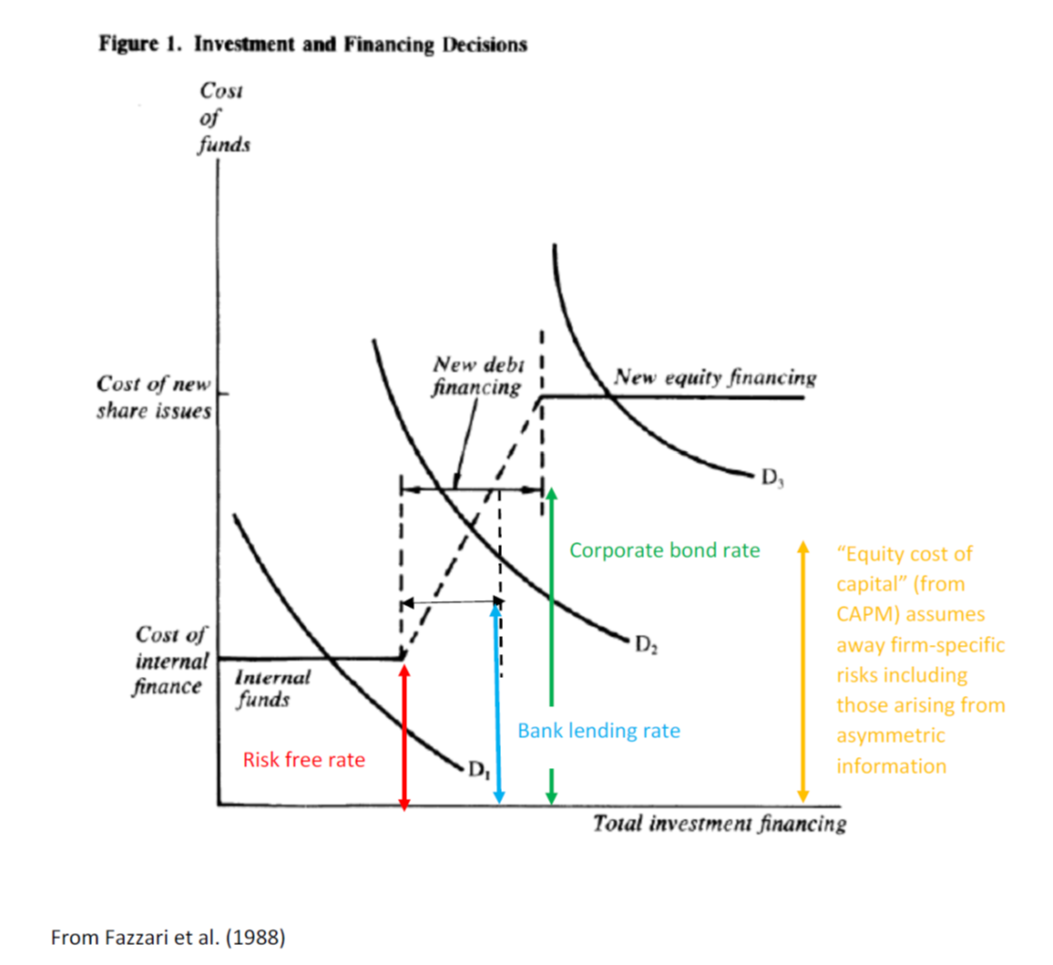
A framework adapted from Fazzari et al. (1988), as modified by Chinn, offers what may be the most instructive lens for evaluating the durability of AI-related capital expenditure (capex) spending. The original pecking order theory of corporate finance holds that firms prioritize internal financing—retained earnings and cash flow—before turning to external sources such as debt or equity issuance. The graph's lowest flat portion corresponds to financing funded out of operating cash flow.
Until recently, the demand curve for AI investment intersected this flat segment of the financing supply curve, meaning that the largest technology companies could fund their AI buildouts from internally generated cash. Starting in 2026, however, hyperscalers—the large cloud and AI infrastructure providers such as Amazon, Microsoft, Alphabet, and Meta—are increasingly turning to external financing. The spending in question is directed primarily toward data center construction, specialized semiconductors, and GPU clusters required to train and deploy large-scale AI models. Other AI-related firms that lack sufficient cash flow have been tapping external capital markets for months prior. Concurrently, the overall demand curve for AI investment capital continues to shift outward.
This shift is documented in analysis from The Economist, which notes that AI's growing footprint in capital markets is extending from equities into the bond market.
Free cash flow for the major hyperscalers is projected to rise beginning in 2028, according to research from Slok (July 28, 2026). That forecast, however, remains a projection rather than a realized outcome, and its realization depends in significant part on whether AI-related revenue streams—cloud AI services, licensing, and enterprise adoption—scale sufficiently to offset the heavy upfront capital costs.
For context, capex spending plans for four leading hyperscalers have been detailed in Bloomberg (July 30, 2026), indicating that the AI investment spree remains solid even as financing costs rise.
Returning to the pecking order framework (Figure 1), a key implication emerges: an increase in the corporate bond rate applicable to these hyperscalers will reduce the quantity of financing they demand. When hyperscalers could fund AI investment from internal cash reserves, they were largely insulated from the effects of rising bond yields. Going forward, as reliance on external debt markets grows, that insulation diminishes—potentially making interest rate dynamics a more significant constraint on the pace and scale of AI infrastructure investment.

