Econbrowser Analysis: What an AI Boom Reversal Would Mean for US GDP and Consumption
Key Takeaways
- •In GDP accounting terms, much of the AI capital spending surge is offset by imports of computers, peripherals, and semiconductors, which are subtracted from domestic output.
- •If Keynesian multipliers for investment and imports are roughly similar, an end to the AI capex boom would be close to neutral for measured GDP.
- •Reduced expectations for AI returns, whether from financing constraints or policy shifts, could lower asset prices and household wealth, slowing consumption, which represents roughly two-thirds of US GDP.
- •Banque de France researchers Bigot and Espic estimate that about half of the 2% US consumption growth recorded in 2025 was attributable to rising equity wealth, based on a marginal propensity to consume of roughly 0.027 per dollar.
- •Under a benchmark scenario of no Q4 stock market recovery, the analysis finds the resulting consumption slowdown would not push GDP growth negative, holding all else constant, though disorderly market adjustment could raise uncertainty and depress aggregate demand.
An analysis published on Econbrowser, the long-running economics weblog maintained by academic economists Menzie Chinn and James Hamilton, on November 6, 2026, considers what would happen if the AI capital investment boom recedes as asset valuations deflate, weighing the mechanical GDP arithmetic against the economics of asset prices and household wealth.
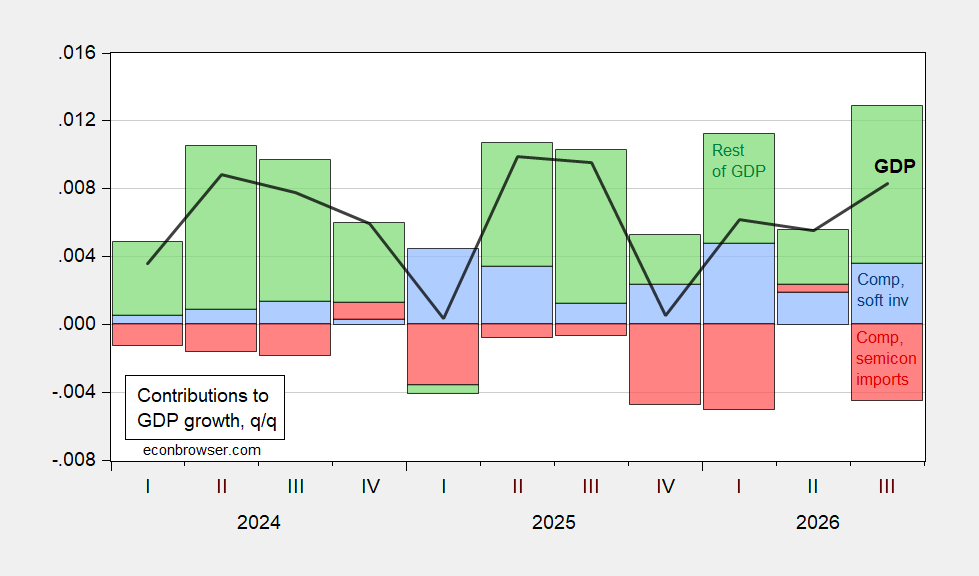
First, as has been widely discussed, the capital investment surge is offset — in GDP terms — to a large extent by imports, which enter the national accounts as a subtraction, meaning outlays on foreign-produced equipment do not directly add to measured domestic output. In an accounting sense, this is shown in Figure 1.
Figure 1: Quarter-on-quarter GDP growth (black line), contributions to quarter-on-quarter GDP growth from computer and software investment (blue bar), from imports of computers, peripherals, and semiconductors (red bar), and the rest of GDP (green bar), all not annualized. Source: Bureau of Economic Analysis (BEA), author's calculations.
While data center construction is not included in the capital expenditure component, the analysis notes that adding it in through 2025 — the extent of the available data — would not change the overall picture.
Assessing the effect on the economy overall requires, at a minimum, considering Keynesian multipliers — the amount of additional output generated per dollar of new spending — from investment and from imports alike. If the multipliers are about the same for the two categories, an end to the boom would be close to a wash, at least GDP-wise.
The economics, however, are more complicated. The capex boom is being driven by great expectations regarding the payoff from AI. If those expectations are reduced — either by a collision between spending plans and financing abilities, or by changes in the perceived policy environment — asset prices would decline, leaving consumption lower than it otherwise would have been.
Declining to predict AI-related asset prices, the analysis takes as a benchmark a scenario in which stock market capitalization sees no recovery in Q4. Household net worth would then decline, implying — all else equal — a slowdown in consumption growth.
Figure 2: Consumption, in billions of chained 2017 dollars, SAAR (blue, left log scale); household net worth in trillions of dollars (bold dark red, right log scale); implied net worth assuming non-equity net worth remains constant; a $3.4 trillion increase in stock market capitalization (red line, right log scale); a $3 trillion reduction (red +). Source: BEA, Federal Reserve Flow of Funds (bold red), author's calculations.
How much consumption slows depends on the wealth effect — a channel that matters for the broader economy because household spending accounts for roughly two-thirds of US GDP. Bigot and Espic (2026), in research published by the Banque de France, estimate that about half of the 2% consumption growth recorded in 2025 was due to an increase in equity market wealth, based on a marginal propensity to consume out of wealth of about 0.027 — 2.7 cents per dollar of equity wealth.
With consumption growing at 2.5% in the year ending in Q3, the knock-on effect would not push GDP growth negative, holding all else constant — an outcome that appears to reflect something of a consensus, as echoed in recent commentary on whether an AI spending crunch could cause a recession. For readers tracking the debate, the near-term markers are the BEA's quarterly GDP and consumption releases and the Federal Reserve's Flow of Funds estimates of household net worth — the same series that underpin the benchmark scenario — which will show how equity valuations, wealth, and spending actually move through Q4.
That said, the analysis cautions that a disorderly adjustment in financial markets in response to an AI recalibration is likely to bring elevated uncertainty, which itself depresses aggregate demand. As the author puts it: "So who knows."

