AI Agents in 2026: Adoption Accelerates While Costs Climb and Returns Stay Uneven
Key Takeaways
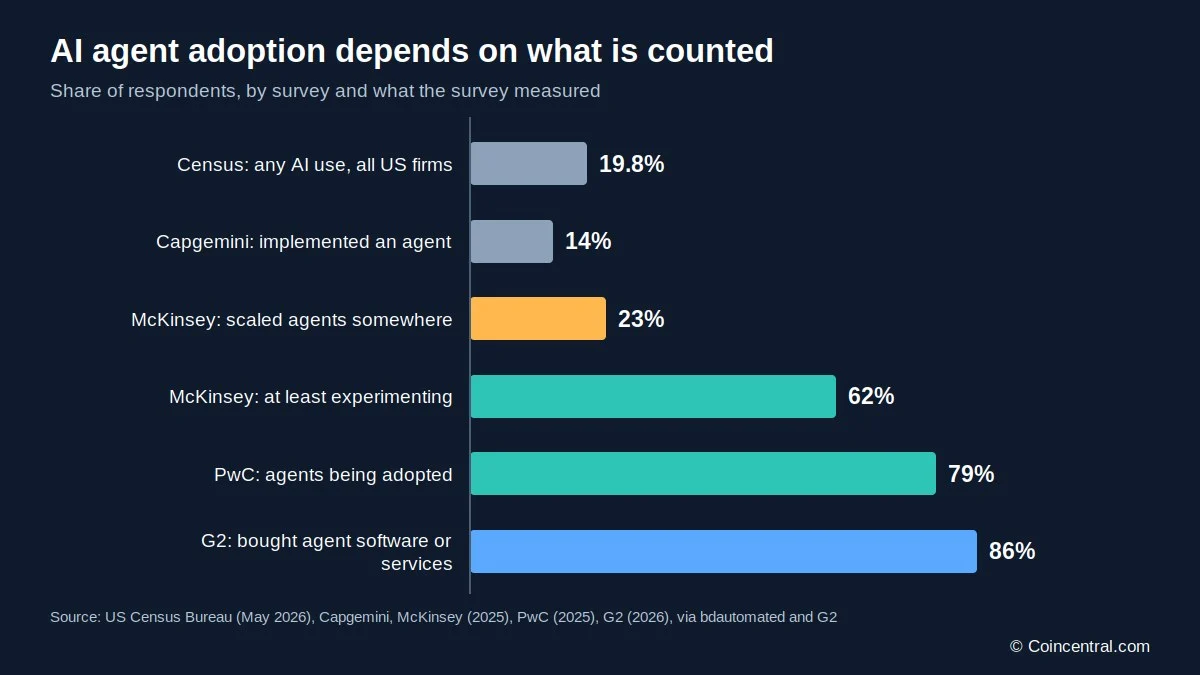
- •Reported AI agent adoption rates range from 14% to 86% across surveys, largely because studies measure different things, from organizations merely testing to firms running agents in live operations.
- •G2's 2026 survey found 86% of B2B buyers purchased AI agent software or services within the past year, up from 69% a year earlier, with 66% of agent buyers now running agents in limited or scaled production.
- •Large enterprises are scaling faster than smaller firms, with 40% of respondents at companies exceeding $1 billion in revenue scaling agents versus a flat 22% at smaller companies.
- •Only 37% of McKinsey respondents report a positive effect on EBIT, while 80% say AI improved their personal productivity, and G2 found 31% of buyers say employees spend at least six hours weekly supervising agent work.
- •Gartner forecasts that more than 40% of agentic AI projects will be canceled by the end of 2027 due to cost, unclear value, and weak risk controls, and placed agentic AI at the Peak of Inflated Expectations in its 2026 Hype Cycle.
AI agents—software systems that plan and carry out tasks with limited human involvement—are moving into wider corporate use in 2026. Surveys published this year show more companies purchasing the technology and putting it to work. The same data, however, reveals uneven results and a steady rise in the cost of running and supervising these systems.
This report compiles the key figures from five recent sources: two original surveys, conducted by G2 and McKinsey, and three reviews that aggregate findings from many studies.
One warning applies to every number below. Surveys question different populations with different wording, so their results rarely align.
Why Adoption Figures Diverge
Reported adoption of AI agents spans anywhere from 14% to 86%, and most of that gap comes down to what each survey measured. Some count organizations that are merely testing, while others include only firms running agents in live operations.
McKinsey's 2025 survey found that 62% of organizations were at least experimenting with agents. Just 23% had scaled agents anywhere in the company, and in no single business function had more than 10% done so.
A review by bdautomated identified the same pattern across other studies. PwC reported that 79% of US executives said agents were being adopted in their companies. A Capgemini survey, which probed what respondents actually meant by "agent," found that only 14% had implemented one.
The US Census Bureau, meanwhile, found that 19.8% of all US businesses used AI in any business function as of May 2026. That figure covers firms of every size and counts any AI tool—not only agents.
Definitions vary as well. Anthropic's engineering guide describes an agent as a system in which a language model directs its own steps and tool use. A chatbot answers a question; a workflow follows a fixed path. This is why a single headline number rarely tells the full story—the sections below note who was surveyed and what was measured.
The bdautomated review examined 75 figures from 18 publishers, tracing each number back to its original report and recording who was asked and what counted. Its conclusion: the numbers disagree mainly because they measure different things.
From Pilots to Production
McKinsey's 2025 survey of 1,993 executives across 105 countries traces a funnel: 88% reported regular AI use in at least one business function, 62% said their organizations had begun using agents, and 23% were scaling them.
G2 found that buyers are increasingly paying for agents. In its 2026 survey of 1,019 B2B decision makers, 86% had purchased AI agent software or services within the past year, up from 69% a year earlier. G2 also reports that 66% of agent buyers now run agents in limited or scaled production—an 18-point increase from the year before. In McKinsey's 2025 data, software engineering and IT were furthest along, yet no more than 10% of organizations reported scaling agents in those functions.
Gradually.ai cautions that these results do not form a single time series. KPMG's Q3 figure includes firms still building agents and therefore cannot be compared with its Q2 figure covering deployed agents. EY restricted its sample to large public US companies already running AI programs, which helps explain its high result.
Customer service shows clear growth. Salesforce data cited by FwdSlash indicates that 66% of service organizations now use agentic AI, up from 39% a year earlier.
Budgets are climbing as well. G2 reports that half of organizations carry an agent budget of at least $1 million, with healthcare leading at 57% spending that much or more annually. Technology and retail posted the largest increases in budgets of $5 million or more.
Large Companies Pull Ahead
McKinsey's 2026 survey of 1,719 respondents across 97 countries found that 40% of people at firms with more than $1 billion in revenue were scaling agents, up from 27% a year earlier. At smaller firms the share held flat at 22%.
Large firms lead on broader AI adoption too. 54% of respondents at companies with at least $1 billion in revenue report scaling AI across the enterprise, versus one-third at smaller firms. Across all respondents, 44% report enterprise-wide scaling, up from 38%.
Chatbots remain the most widely scaled tool, at 47% of respondents. Roughly two in ten are scaling AI agents, and a similar share are scaling software coding agents; at larger firms, the figure for coding agents reaches 31%.
Coding agents are also reshaping purchasing decisions. 32% of respondents say their organizations chose not to buy at least one software product or feature because they could build it in-house, a pattern most common in technology and healthcare. Among AI high performers, nearly half reported such a decision, compared with 31% of other respondents.
McKinsey's Lieven Van der Veken says leaders are now asking what they need to build themselves. He adds that this does not mean firms should build everything or avoid partners—the fastest movers are simply more deliberate about where to buy and where to build.
The Cost of Running and Supervising Agents
Costs surface in two places: operating bills and staff time. McKinsey found that roughly 20% of respondents say operating costs, including token costs, have limited their AI use, with similar shares across company sizes.
Companies continue spending regardless. 28% of respondents say AI consumes more than 10% of their information and communication technology budget, and 60% expect to increase AI investment within the next year.
G2 labels the price of oversight the "Distrust Tax." 31% of buyers say employees spend at least six hours a week supervising agent work—what G2 calls bot-sitting. 45% say oversight and rework consume more than a quarter of the gains they expected, while 46% report operating costs higher than anticipated.
McKinsey's Michael Chui notes that per-token prices have fallen, but the volume of tokens consumed has grown faster. High performers reported cost limits on coding agents about three times as often as other respondents.
Cost limits are not confined to one tool. About one in ten respondents say costs curbed their use of chatbots, and the same holds for agents and coding agents. Respondents in pharmaceuticals, insurance and banking were the most likely to expect higher investment.
Results: Personal Gains Outpace Company Impact
At the individual level, results are strong. McKinsey found that 80% of respondents say AI improved their productivity, and half say it helps them make better decisions. Mid-level managers and individual contributors were more likely to report strain, at 47% versus 31% of executives.
G2 documents speed gains in high-volume workflows. Four in five organizations using agents in high-volume work report cycle-time improvements of at least 11%, and nearly half report gains of at least 25%. Additionally, 83% say agents lift employee satisfaction by cutting repetitive work.
Company-wide outcomes are weaker. 37% of McKinsey respondents report a positive effect on earnings before interest and taxes (EBIT)—roughly unchanged from last year. Only 6% qualify as AI high performers, which McKinsey defines as firms crediting AI for at least 5% of EBIT alongside strong reported value.
Developer studies return mixed answers because they test different work. The GitHub test used a narrow task, while METR studied experts working in their own projects; METR's new ranges include no effect at all.
By function, McKinsey respondents most often report cost reductions in supply chain management, service operations and manufacturing, while revenue gains are most frequently tied to marketing and sales.
McKinsey also notes that employees are building AI skills on their own or through company rollouts; about half say AI helped them develop new capabilities. High performers manage the transition differently—nearly three-quarters say they redesigned workflows because of AI, up from 55% last year, while about one in four other respondents say the same.
Governance and Trust
As agent fleets grow, tracking them becomes harder. G2 found that 38% of organizations with agents in production run more than 100 of them. Yet 47% say agent ownership and controls are informal or led by individual departments, against 23% that govern them centrally. Only 27% maintain a central agent registry, 18% use automated discovery to locate approved and unapproved agents, and just 14% have real-time monitoring of unusual behavior, costs or risks. G2 refers to unmanaged tools as "shadow agents."
Buyers do test before launch: 52% require human quality review, 48% require security testing, and 41% require legal, risk or compliance review. After launch, 77% re-evaluate agents at least monthly.
Trust depends on the task. In a 2025 PwC survey, business leaders said they would trust agents with data analysis at 38%, but only 20% for financial transactions. In a Ping Identity survey of 11,000 consumers, 3% were comfortable with AI acting without final approval. G2 adds that 67% of buyers express high trust in their own organization's AI system—though comfort drops when the system acts autonomously.
G2 says central IT along with AI, data and machine learning teams manage 49% of agent operating costs and together own 60% of governance accountability. McKinsey adds that high performers more often work to reduce risks such as unauthorized or unintended agent actions.
Market Size, Pricing and Funding
Estimates for the 2026 agent market range from roughly $8 billion to $12 billion. Gradually.ai notes these are commercial estimates rather than measured revenue, and that firms use differing base years and definitions—some count standalone agent platforms while others include agent features inside business software. Gartner estimated that up to $234 billion in enterprise software spending could be at risk from agentic AI by 2030; Gradually.ai characterizes that as an exposure scenario, not a forecast of lost sales.
Pricing models are shifting. G2 found that only 9% of buyers consider per-seat pricing the fairest model for agents, while pay-as-you-go models rose from 38% in 2025 to 57% in 2026.
On the funding side, half of G2 respondents hold an agent budget of at least $1 million. Crunchbase recorded $159 billion in global venture funding in Q3 2026, of which $102 billion—64%—went to AI companies, though that covers the broader AI sector rather than agents alone. Crunchbase also counted $211 billion in AI-related venture funding for 2025, up 85% from $114 billion in 2024. G2 additionally found that 72% of buyers say a strong set of connectors, actions, skills or marketplace offerings is very important or a must-have for agent adoption.
Jobs: Expectations Versus Reports
Fears of rapid job cuts have not matched what firms report. McKinsey found that 14% of respondents at AI-using organizations said AI contributed to a smaller workforce over the past year. In the previous year's survey, 32% had expected cuts over that period. Two-thirds report little or no AI-related change in total employment. Looking ahead, 39% expect a decrease and 43% expect little or no change, while only 13% say AI makes them anxious about their own careers.
The gap is visible by function. In marketing and sales, manufacturing, strategy and corporate finance, and knowledge management, reported cuts run at about half the share that predicted them.
G2 reports a similar pattern among buyers: just 14% have reduced headcount, while 35% have moved staff into higher-value roles. In 2025, respondents most often expected cuts in service operations, supply chain management, marketing and sales, and software engineering. For the coming year, the largest share again predicts cuts in service operations and supply chain management—and in many functions, more respondents expect no change than a cut.
Outlook: Plans, Forecasts and Open Questions
Buyers intend to keep going. G2 found that 84% say agent features will influence their 2027 software decisions, with 34% calling them a primary factor. Another 56% expect agents to orchestrate work across their software stack by 2030.
Forecasts of failure exist as well. Gartner projects that more than 40% of agentic AI projects will be canceled by the end of 2027, citing cost, unclear value and weak risk controls. That remains a forecast—bdautomated notes that no one has counted actual cancellations yet.
Some headline numbers are frequently misread. An MIT study found that 95% of organizations saw zero return, but it measured profit impact roughly six months after a pilot. Its sample comprised 52 interviews, 153 survey responses and 300 public deployments, and the authors describe the findings as preliminary.
Taken together, the data depict fast adoption alongside uneven payoffs: individual gains are common, company-wide gains less so, and oversight consumes much of the time saved. Gradually.ai notes that Gartner placed agentic AI at the Peak of Inflated Expectations in its 2026 Hype Cycle. Readers should verify who was asked and what was counted before citing any single figure.
Security remains a concern in the FwdSlash review. It cites a survey of 919 organizations in which 88% reported confirmed or suspected agent security incidents, along with IBM data showing that 97% of organizations with an AI-related breach lacked proper access controls.
Sources
- G2: AI Agents Have Moved From Pilot to Production, But Oversight Comes at a Cost (2026 AI Agents Report)
- McKinsey: The State of AI in 2026: On the Road to ROI
- bdautomated: AI Agent Statistics 2026: Every Number Checked at Its Source
- Gradually.ai: AI Agent Statistics 2026: Adoption, Market & Facts
- FwdSlash: AI Agent Statistics 2026: 100+ Stats on Market and Adoption
Source: Blockonomi — https://blockonomi.com/ai-agent-statistics-2026-adoption-costs-and-results/

