Ahn Jung-geun's 'Independence' Calligraphy Remains in Limbo Despite Gyeonggi Repatriation Effort
Key Takeaways
- •Ahn Jung-geun created "Independence" at Lushun Prison shortly before his execution in March 1910, and he gave the work to a Japanese guard before his death.
- •The calligraphy is currently in the custody of Ryukoku University in Kyoto, having been entrusted to the institution by descendants of the guard.
- •Gyeonggi Province secured 1.3 billion won ($920,000) through a supplementary budget in September 2025, covering half of the work's estimated 2.6 billion won price, with the rest planned to be raised through crowdfunding that has not yet launched.
- •Negotiations with the Japanese holder will continue through the end of 2026, and the Heritage of Korean Independence will be asked to return the money if no progress is made by then.
- •A separate Ahn work, "Jangtanilseong Seonjoilbon," was successfully repatriated for 2.4 billion won and is kept in the Gyeonggi Provincial Museum's storage collection.
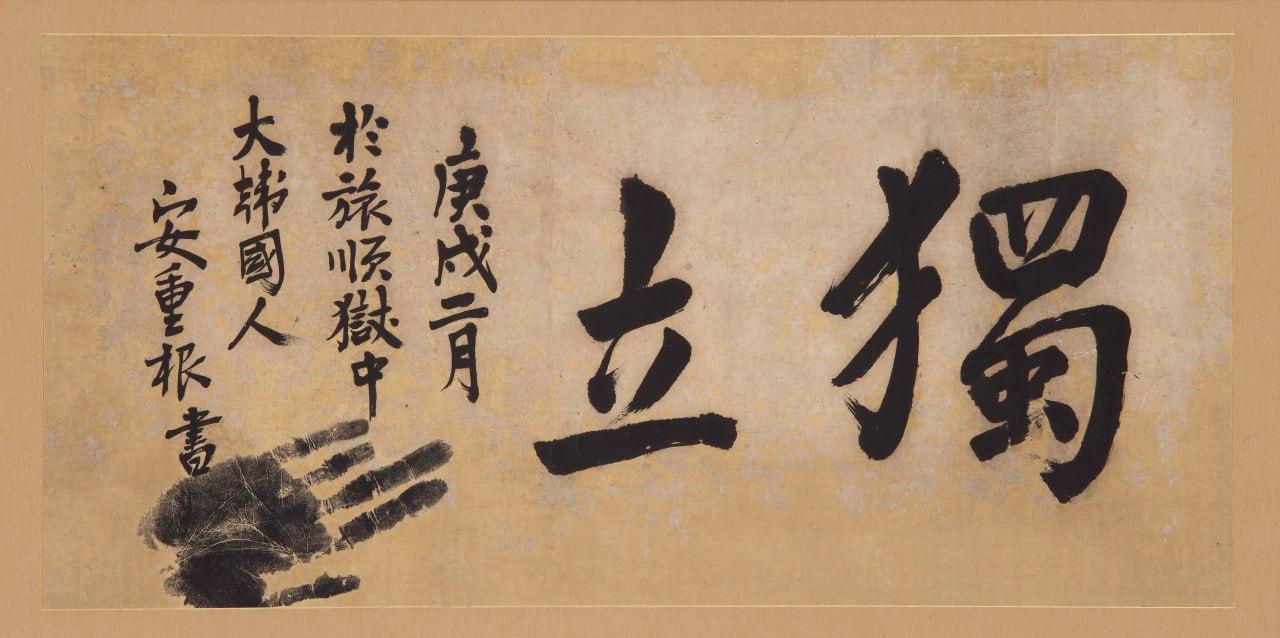
A bid by the Gyeonggi Provincial Government to bring home "Independence," a calligraphic work by Korean independence fighter Ahn Jung-geun, remains stalled as officials struggle to reach a deal with the work's Japanese holder.
The provincial government said Friday that its yearlong effort to secure the piece's return has yet to produce a result, and that it will continue talks through the end of the year. The announcement came as Korea marks the 81st anniversary of its liberation from Japanese colonial rule.
Ahn, a revered Korean independence activist, created the calligraphy at Lushun Prison shortly before his execution in 1910. He had been sentenced to death for assassinating Ito Hirobumi — Japan's first prime minister and resident-general in Korea — at Harbin Station the previous year. Ahn was executed in March 1910, months before Japan formally annexed Korea that August, opening a 35-year colonial rule that ended only with liberation on Aug. 15, 1945 — the anniversary that now frames the province's campaign. Before his death, Ahn gave the work to a Japanese guard. It is regarded as one of his most symbolically significant pieces, and a memorial hall honoring Ahn opened at Harbin Station in 2014, reflecting his enduring place in Korean historical memory.
According to provincial officials, the work is now held in custody by Ryukoku University in Kyoto, having been entrusted to the institution by descendants of the guard.
Provincial officials had initially expected the negotiations to proceed smoothly. In 2025, as Korea marked the 80th anniversary of its liberation from Japan's colonial rule, they sought to acquire two calligraphic works by Ahn from Japanese holders.
The impasse points to a recurring difficulty in recovering Korean heritage from the colonial era: many such artifacts remain in private hands in Japan, so returns often turn on negotiated purchases or donations rather than intergovernmental demands. Major recoveries have nonetheless been completed, including 1,205 volumes of Joseon royal protocols returned by Japan in 2011 and hundreds of cultural properties handed back from Japan's Tsushima island in 2024, through the combined work of institutions such as the Heritage of Korean Independence — created by a nationwide donation drive that opened Independence Hall of Korea in 1987 — and the Overseas Korean Cultural Heritage Foundation, a public body established in 2013 to recover heritage held abroad.
To bring "Independence" home, the local government secured 1.3 billion won ($920,000) through a supplementary budget in September 2025 and provided the funds to the Gyeonggi branch of the Heritage of Korean Independence as a private-capital subsidy.
The work was expected to cost about 2.6 billion won, with the remaining 1.3 billion won to be raised through public crowdfunding. That campaign, however, has yet to be launched, as talks with the Japanese holder remain in limbo.
The provincial government plans to continue negotiations with the Japanese holder through the end of 2026. If no progress is made by then, the Heritage of Korean Independence will be asked to return the money.
A separate work by Ahn, "Jangtanilseong Seonjoilbon" — meaning "With a long, deep sigh, I offer condolences in advance for Japan's downfall" — has been successfully repatriated. Ahn gifted that piece to a senior official of the Japanese Empire's Kwantung Governor-General's Office, and it was later preserved by the official's descendants in Japan.
The provincial government spent 2.4 billion won to acquire the work, which is currently kept in the Gyeonggi Provincial Museum's storage collection.
Source: The Korea Times

