African Startups Raise $2.10 Billion in Eight Months as Mega-Deals Concentrate Capital
Key Takeaways
- •African startups raised $2.10 billion across 275 deals from January to August 2026, a 1.4% increase over the same period in 2025.
- •Nigeria attracted the most capital at $528.6 million, followed by Benin ($327.1 million), Egypt ($322.0 million), South Africa ($248.2 million), and Kenya ($216.6 million).
- •August 2026 funding totaled $438 million, driven by Moove's $250 million Series C led by Mubadala, Woven Capital, and Ion Pacific, and Jumia's $50 million equity round from IFC and Axian.
- •More than 90% of August's equity capital concentrated in the two largest deals, while early-stage startups increasingly depended on government grants and Web3 ecosystem checks under $150,000.
- •Development finance institutions and strategic corporates such as IFC, AfDB, MultiChoice, Canal+, and SC Ventures now play a larger role in African growth-stage funding alongside traditional venture funds.
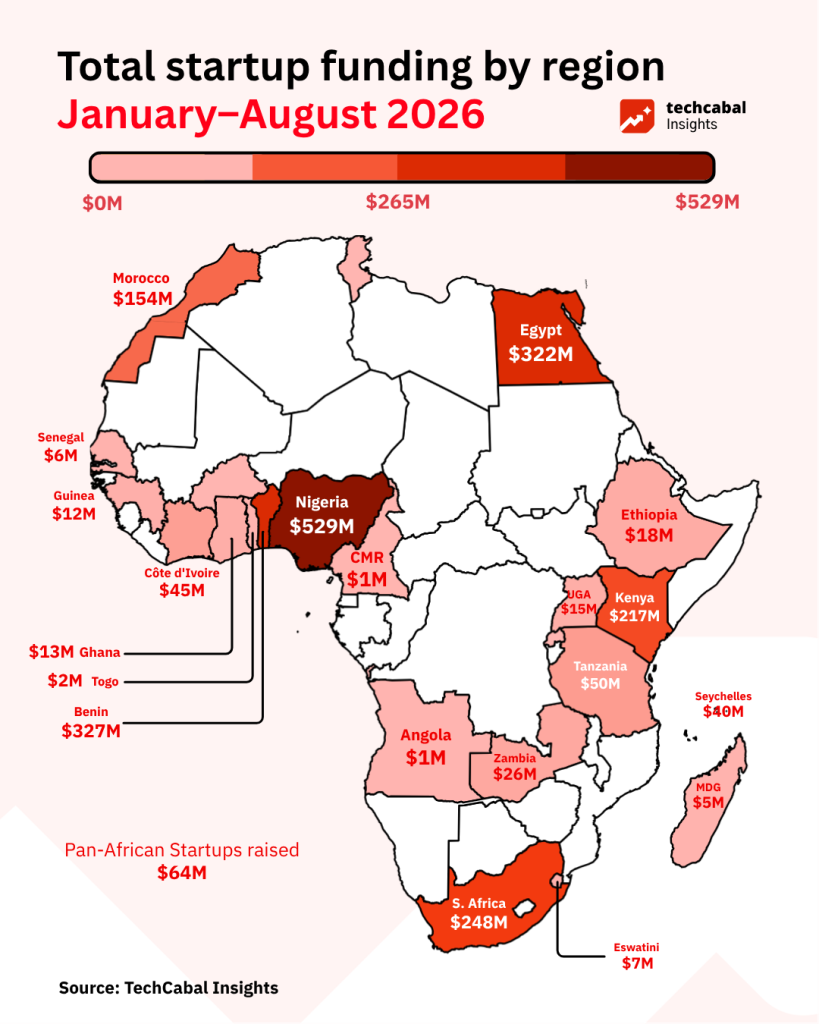
African startups raised $2.10 billion across 275 tracked funding deals between January and August 2026, narrowly surpassing the $2.07 billion raised during the same eight-month period in 2025. Of the 275 transactions, 255 disclosed their figures while 20 startups kept their funding amounts private.
Year-on-year, overall funding in 2026 remained virtually flat, with a slight 1.4% increase over 2025. The plateau comes after African venture funding contracted sharply from its 2021–2022 peak, when annual totals exceeded $3 billion, meaning the ecosystem has stabilized at a materially lower level rather than recovered. Month-on-month activity, however, fluctuated significantly, driven by major spikes in February ($361.7 million), June ($334.7 million), and August ($438.0 million) — surges of 209%, 56%, and 368% respectively over their 2025 monthly baselines.
Top markets and mega-deals
Nigeria leads the continent in capital attraction in 2026 so far, pulling in $528.6 million. Benin ranks second with $327.1 million, propelled largely by Spiro's $215 million debt and equity round in June. Egypt ($322.0 million), South Africa ($248.2 million), and Kenya ($216.6 million) round out the top primary markets — the same four-country cohort (the "Big Four" plus Benin's surge) that has historically attracted the bulk of venture capital on the continent.
Capital distribution remains concentrated in a handful of markets, as investors prioritize established startups in high-volume, asset-heavy sectors such as mobility, e-commerce, and clean energy that offer proven unit economics and large customer bases. Mega-deals from these platforms — such as Moove's $250 million Series C and Jumia's $50 million investment from IFC and Axian — represented 57% of all capital raised across Nigeria, Egypt, and regional platforms in August. The composition of these checks also reflects where capital is coming from: development finance institutions (IFC, AfDB) and strategic corporates (MultiChoice, Canal+, Standard Chartered's SC Ventures) now feature prominently alongside traditional venture funds, a shift consistent with the global pullback in venture capital since 2022 that has left DFI and corporate capital playing a larger role in African growth-stage rounds.
August 2026: Moove, e-commerce, and crypto lead a $438 million surge
August 2026 recorded $438.01 million in total funding, driven by large growth rounds and strategic debt facilities.
- Moove secured a $250 million Series C led by Abu Dhabi's Mubadala, Woven Capital, and Ion Pacific to expand its mobility-fintech operations.
- Jumia raised $50 million in equity backed by the International Finance Corporation (IFC) and Axian.
- Yellow Card completed a $40 million funding round backed by SC Ventures (Standard Chartered), Sony Innovation Fund, Polychain Capital, and Blockchain Capital.
- Moment raised a $22 million Series A from AlphaCode Venture Partners, General Catalyst, MultiChoice, and Canal+.
- Terra Industries secured $18 million to complete its $52 million seed round, backed by 8VC and Silent Ventures.
- Biovac secured a $15 million loan from the African Development Bank (AfDB) for vaccine manufacturing.
- Swvl secured $14.5 million in post-IPO equity led by Coefficient LP and Sofico Holdings.
- Naran raised $10 million in debt and equity from Landel.
- Jem pulled in $8.4 million in Series A funding led by Quona Capital.
- ThriveAgric raised a $3.93 million debt facility.
Undisclosed August rounds
Several startups secured capital in August without publicly disclosing their cheque sizes. These include Yellow (Series C led by Convergence Partners), Flowt (pre-seed backed by Delta40, Impacc, and Argidius Foundation), Mathesis Analytics (backed by Sewa Capital), Dawa Mkononi (backed by Africa Health Ventures), and Powered by People (backed by BESTSELLER Foundation and Susa Ventures).
Gender-lens fund Five35 Ventures also deployed equity cheques into an array of portfolio startups including Fincart, BuuPass, Daleela, Pricepally, and Malaica.
The early-stage funding squeeze: grants and non-equity capital step in
While August's top-line number jumped to $438 million, the ecosystem's structural split widened further. Over 90% of all equity capital deployed in August concentrated into just two mega-deals — Moove's $250 million Series C and Jumia's $50 million round — while early-stage startups increasingly relied on small government grants and Web3 ecosystem checks under $150,000 to survive. This barbell — mega-rounds at one end, sub-$150,000 grants at the other, with a thinning middle — has defined African venture since the 2022 downturn, and 2026's data shows the pattern persisting rather than reversing.
Early-stage startups face a drastically higher bar than in previous years. Investors no longer underwrite pure potential or user growth; they demand clear evidence of unit economics, customer retention, capital efficiency, and a demonstrable path to revenue. For early-stage founders, this shift means extending runway through leaner burn rates, pursuing non-dilutive debt or grants, and prioritizing early revenue generation over aggressive scale to avoid running out of cash before becoming investable.
As traditional venture capital thins out at the $50,000 to $500,000 level, alternative capital models are stepping up:
- Government grants and fellowships: In August alone, regional government programs like the Edo State Government in Nigeria funded 11 early-stage ventures including Safebox Energy, IVIE, and Zummey Technologies. Simultaneously, the CcHUB and Mastercard Foundation EdTech Fellowship awarded $100,000 grants each to 12 African edtech startups, including TrainDTrainer, Talktu, and Efiwe.
- Web3 ecosystem grants: Ecosystem funds like the Stellar Community Fund backed multiple early-stage African builders in August, including Seevcash ($149,000), Remi ($135,000), and Yolat ($110,000).
- Accelerators and debt: Programs like Cascador's ScaleUp Accelerator are supporting growth-stage businesses through its $5 million Catalytic Fund, providing local-currency debt and guarantees to help founders navigate the venture winter without heavy equity dilution.
Building resilient, revenue-generating businesses — rather than companies built solely to raise the next VC round — has become the defining strategy for African tech founders navigating the second half of 2026. Whether the remaining months of 2026 can sustain the momentum of the August and February spikes — or whether those months prove to be mega-deal outliers in an otherwise flat year — will be the key signal for how the ecosystem enters 2027.
