Africa's Tech Sector Records 84 M&A Deals Worth $11.4 Billion in Disclosed Value in 2026
Key Takeaways
- •Africa's tech sector recorded 84 M&A deals with an estimated $11.4 billion in disclosed value between January 1 and August 17, 2026, exceeding the 68 deals logged across all of 2025.
- •Financial Services led all sectors with 27 deals, roughly 32% of total activity, while South Africa (22), Nigeria (12), and Egypt (12) accounted for over half of the target companies acquired.
- •Six disclosed mega-deals, led by MTN's proposed $6.2 billion purchase of a 75% stake in IHS Towers and Vodacom's $2.1 billion Safaricom stake acquisition, make up more than nine-tenths of disclosed value, leaving the typical deal far smaller and unpriced publicly.
- •Fintech-bank consolidation is following two paths: fintechs such as Selcom and Moniepoint acquired bank stakes while founders kept operational control, whereas banks like Nedbank and Capitec bought fintechs outright and assumed full authority over strategy and management.
- •OPay is preparing a $4 billion US listing and PalmPay is pursuing a $200 million Hong Kong listing at a valuation above $1 billion, though both plans remain at an early, unscheduled stage.
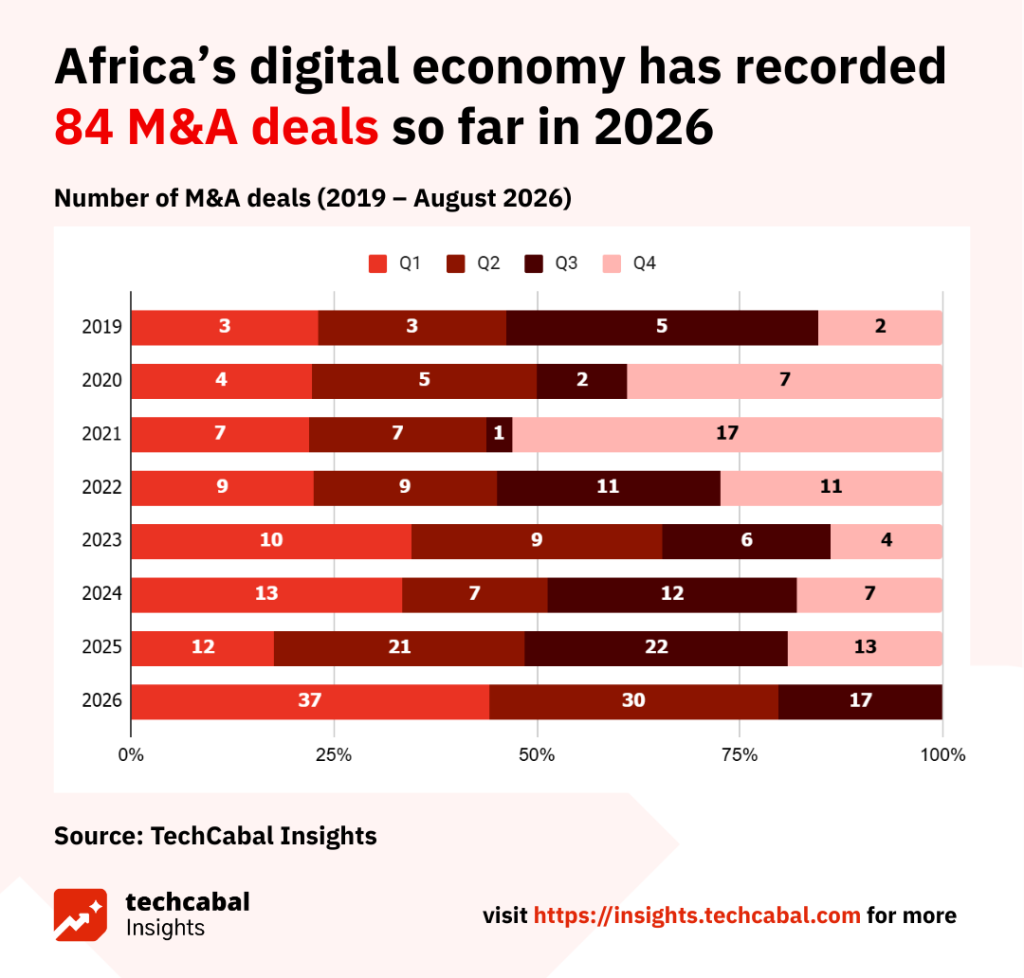
Mergers and acquisitions (M&A) have doubled in Africa's digital economy within the past year. As of August 17, 2026, TechCabal Insights has tracked 84 M&A deals worth an estimated $11.4 billion in disclosed value. While startups raised $1.44 billion in H1 2026, M&A has transformed from a rare exit route into a primary strategy for companies looking to scale, acquire banking licences, and stay afloat.
84 M&A deals logged so far in 2026
Between January 1 and August 17, 2026, company buyouts across Africa's tech ecosystem exceeded the totals recorded in previous years, marking the busiest stretch of M&A activity the market has seen. Led by a busy first quarter, 2026 has already notched 84 deals, surpassing the 68 recorded across all four quarters of 2025.
The uptick in activity, which began with 37 deals in Q1, points to a market in which companies are consolidating to combine balance sheets, share licences, and survive in a tough operating environment.
Geographic footprint: where the deals are happening
Southern Africa (24 deals) and Northern Africa (18) lead regional M&A activity in 2026. At the country level, South Africa (22), Nigeria (12), and Egypt (12) account for over half of all target companies acquired as of August 17. That concentration tracks the continent's biggest consumer markets and financial centres: Nigeria and Egypt are Africa's two most populous countries, while South Africa hosts several of its largest banks.
African tech companies are also looking beyond the continent for growth. Local businesses acquired eight targets outside Africa — in the UK (4), the US (1), France (1), Germany (1), and Canada (1) — to build direct operations in international markets.
Sector performance: financial services leads with 27 deals
Most acquisitions are concentrated in heavy sectors where licences, agent networks, and high volumes of daily customer transactions matter most. While more than 12 sectors recorded buyout deals, Financial Services led with 27 deals, accounting for roughly 32% of all activity. That lead mirrors the broader ecosystem, where payments, lending, and banking infrastructure have consistently drawn the largest share of startup funding.
Disclosed deal values: most numbers remain hidden
Even though the total number of M&A deals reached a record high this year, most companies continue to keep their deal sizes secret. Disclosure tends to follow listed companies — MTN, Vodacom, and Nedbank are publicly traded groups whose exchanges require them to inform investors of material transactions — while deals between private companies rarely publish a price. Of the 84 deals tracked so far in 2026, the estimated total value of disclosed transactions stands at roughly $11.4 billion as of August 17, 2026. A few mega-deals account for the vast majority of this figure:
- MTN Group's $6.2 billion proposed deal to buy 75% of IHS Towers
- Vodacom Group's $2.1 billion stake deal in Safaricom
- Pepkor Holdings' $1.29 billion (R21.3B) merger of Flash with Shop2Shop
- Nedbank's $850 million acquisition of Kenya's NCBA Group
- Beltone's $197.6 million buyout of Baobab Group
- e-Finance's $99.8 million (EGP 5B) acquisition of Egyptian microfinance lender Tamweely
Together, these six transactions represent more than nine-tenths of the disclosed total, meaning the typical deal among the 84 is far smaller — and its value undisclosed.
Fintechs and banks joining forces: who stays in charge?
One of the biggest stories in African tech is fintech companies and traditional banks coming together. Over the last 18 months, six major deals across five countries show two very different paths that companies are taking:
Fintechs buying banks (founders stay in charge). In Tanzania, Selcom acquired 65% of Access Microfinance Bank. In Kenya, Moniepoint acquired 78% of Sumac Microfinance Bank. In Nigeria, Flutterwave secured its own microfinance banking licence from the Central Bank. In Senegal, Wave set up Wave Bank Africa with $30.5 million in capital. In all of these deals, the fintech founders stayed in control and kept running the business their way. The licence itself is the prize: it brings deposit-taking rights, direct settlement, and regulatory standing that would otherwise require a fresh, often lengthy application.
Banks buying fintechs (banks take control). Nedbank acquired South African fintech iKhokha outright for $92.4 million (R1.65B), while Capitec acquired Walletdoc for up to R400M. In these deals, the traditional bank assumes full authority over product roadmaps, board seats, executive management, and strategic direction.
The core insight is not simply whether a fintech acquires a banking licence, but whether the founders retain operational control after the deal closes.
Listing on foreign stock markets: why big fintechs are looking abroad
Beyond private buyouts, some of the top African fintechs are preparing to sell shares on public stock markets. Two of the biggest payment platforms are planning to list abroad: OPay is preparing a $4 billion listing in the US, while PalmPay is eyeing a $200 million listing in Hong Kong at a $1 billion+ valuation. Both remain at the planning stage rather than priced or scheduled, and their outcomes will be among the most closely watched public-market tests for African payment platforms.
While some advocate for local or dual listings — which would allow African retail investors to trade shares in domestic markets alongside global ones — the decision to list primary shares abroad comes down to capital depth, valuation multiples, and currency mechanics. Foreign exchanges in New York and Hong Kong offer deeper pools of growth equity, higher valuation multiples, and dollar-denominated liquidity that large-scale cross-border expansion demands. For local exchanges in Lagos, Nairobi, and Johannesburg to attract primary or dual listings from tech giants, they must deepen institutional liquidity, streamline multi-exchange compliance, and reduce foreign exchange repatriation risks for investors.

