AFIS 2026: Luanda Summit Calls on Africa's $100 Billion Banking Sector to Fund the Real Economy
Key Takeaways
- •African banking revenues surpassed $100 billion in 2024, yet roughly 85% of the continent's workforce remains in the informal economy and private-sector credit to agriculture, manufacturing, and small businesses remains limited.
- •IFC Managing Director Makhtar Diop said Africa's estimated 4.5% GDP growth is insufficient and the continent must exceed 6% for structural transformation, urging a shift from dollar-denominated debt toward equity and local-currency lending.
- •The IFC now conducts 75% of its African lending in local currency and targets $100 billion in annual commitments, supported by a 3.4-to-1 mobilisation ratio and a $25 billion credit-guarantee goal.
- •Angola presented strong macroeconomic results, including public debt falling from 115.9% of GDP in 2020 to 51.2% in 2026, inflation dropping to 8.43% by September 2026, and BODIVA's market capitalisation rising 202% in 2025 to $4.3 billion on the back of the BFA and Unitel IPOs.
- •Angola's Minister of State for Economic Coordination José de Lima Massano urged faster operationalisation of the Pan-African Payment and Settlement System (PAPSS) and integration of continental stock exchanges to lower cross-border settlement costs under the AfCFTA.
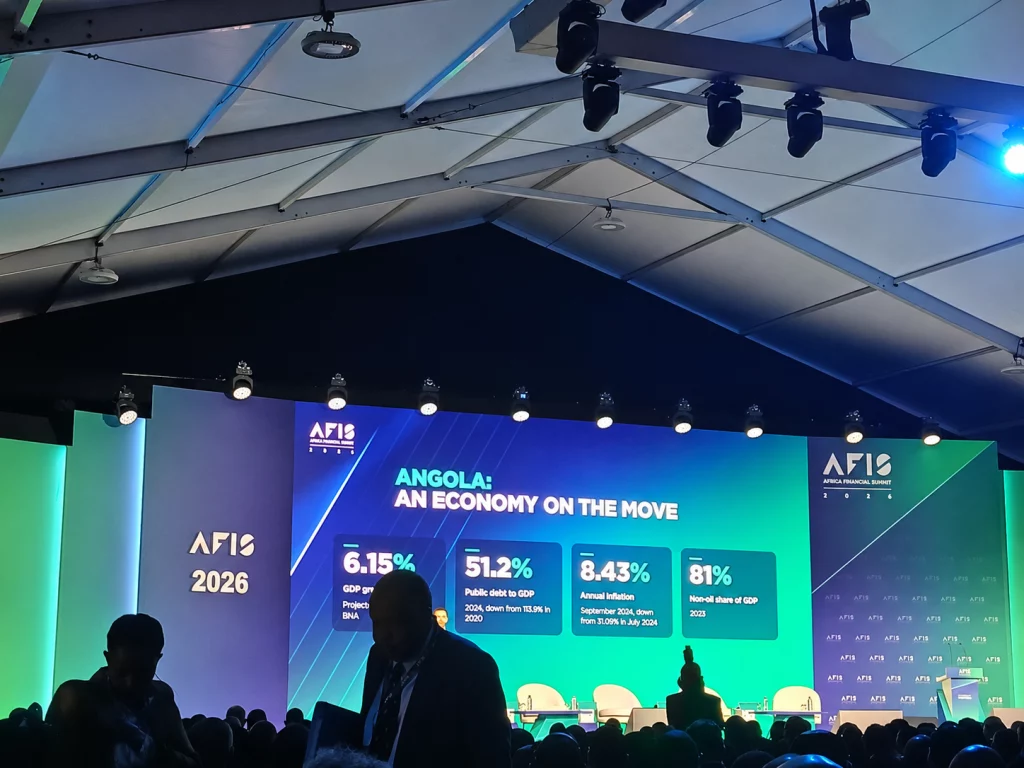
At the Africa Financial Summit (AFIS 2026) in Luanda, Angola, a stark consensus emerged among leaders of the International Finance Corporation (IFC) — the World Bank Group's private-sector lending arm — Jeune Afrique Media Group, and the Angolan government: Africa's financial institutions are booking record profits, but until capital flows away from dollar-denominated debt and paper assets into local-currency credit, micro, small and medium-sized enterprises (MSMEs), and infrastructure, continental growth will remain stuck.
The central paradox of modern African finance was laid bare inside the summit's plenary halls: the continent's banking industry has never been more profitable, yet the businesses, infrastructure, and entrepreneurs driving real economic activity have rarely felt more starved of credit.
Addressing a room of central bank governors, finance ministers, institutional investors, and fintech executives, Amir Ben Yahmed, CEO of Jeune Afrique Media Group and co-founder of AFIS alongside the IFC, framed the stakes in blunt terms. “Over the past two decades, Africa's finance is stronger, but it still underfunds the real economy,” Ben Yahmed said. “The question is no longer simply how to make African finance stronger. It's how to make African finance matter more.”
That question defines this year's summit theme, “Making Capital Count: Unlocking Growth Through African Finance.” The gathering marks the summit's first foray into Southern Africa and the Lusophone world.
The narrative running through the opening addresses was clear: with African banking revenues breaching $100 billion in 2024 and delivering returns on equity rivalling the world's most lucrative emerging markets, the financial system can no longer justify retreating behind risk-averse balance sheets while roughly 85% of the continent's workforce remains confined to the informal economy.
High returns, low credit
Opening the summit, Angola's Minister of State for Economic Coordination, Dr José de Lima Massano, took direct aim at the dislocation between financial liquidity and real-sector productivity. He acknowledged that continental banking revenues show encouraging signs of commercial maturity, but argued that the transmission mechanism into commercial output remains jammed.
“We have increasingly profitable financial institutions on the continent, but credit to the private sector remains limited in many of our economies,” Massano said. “Sectors such as agriculture, manufacturing, and small and medium-sized operators remain insufficiently financed.”
The consequence, Massano explained, is an economic model operating with one hand tied behind its back. With roughly 85% of African employment concentrated in the informal economy, national treasuries suffer from an eroded tax base, while millions of micro-entrepreneurs are effectively locked out of formal banking halls that demand classical physical collateral.
Bridging this divide, Massano stressed, requires a radical shift toward digital finance and alternative underwriting models: “The digitalisation of financial services, including the use of solutions based on artificial intelligence, can help lower costs, create new risk-assessment instruments, and expand access to financial services for enterprises and citizens who lack the formal collateral conventionally demanded by the banking system.”
IFC's mandate: de-dollarisation, equity, and cash-flow underwriting
Makhtar Diop, Managing Director of the International Finance Corporation, picked up the gauntlet. Africa is currently expanding at an estimated 4.5% GDP growth rate, Diop noted, but that pace is fundamentally insufficient to absorb the millions of young people entering the job market annually. To achieve structural transformation, the continent must accelerate past 6% growth — a feat that demands a complete overhaul of how capital is deployed.
“Africa has capital. It has entrepreneurs. It has extraordinary talent,” Diop said. “Our task is to connect these strengths through financial systems that can deliver on the continent's ambitions. The conversations we have, the partnerships we forge, and the commitments we make over the next two days at AFIS will help determine whether African savings become the capital that builds African businesses, African infrastructure, and African jobs.”
For Diop, the continent's capital mismatch is deeply structural: African firms are choked by short-term, dollar-denominated debt while their revenues are earned in volatile domestic currencies. “African companies need more equity. We need more local currency. Borrowing in dollars creates a mismatch,” he argued, stressing that local capital markets must be mobilised to intermediate domestic pension and sovereign savings into real-economy assets. In practice, that mismatch means the local-currency cost of servicing dollar debt climbs whenever domestic currencies weaken — a dynamic that can squeeze even operationally sound businesses, and one that local-currency lending is designed to neutralise.
Diop outlined the operational shifts underway at the IFC under its 2030 strategy, designed to dismantle these bottlenecks. On local-currency financing, he noted that the IFC now executes 75% of its continental lending in local currency, insulating borrowers from foreign-exchange shocks. Having scaled up from mobilising $32 billion, the IFC is targeting $100 billion in annual commitments, backed by a 3.4-to-1 mobilisation ratio, along with a $25 billion target for risk-mitigating credit guarantees.
On collateral-free MSME underwriting, Diop said the IFC is moving away from land-title-heavy underwriting toward cash-flow and transaction-data lending, using fintech rails and telematics to underwrite small businesses based on operational performance rather than immovable assets.
The institution is also reorganising its institutional footprint across financial capitals — including Tokyo, New York, and Sydney — to channel sovereign wealth funds and offshore pension pools into African private equity and infrastructure. In Angola alone, Diop confirmed he would sign two new agricultural financing agreements during his visit, advancing the continent's food security agenda.
Above all, Diop cautioned against financial engineering that loses sight of demographic realities: “The main reason we are mobilising resources in the financial sector is to create jobs. We need to focus totally and utterly on job creation for African youth.”
Angola's 'aggressive' macro and financial pivot
That AFIS 2026 is convening in Luanda is no coincidence. Both Ben Yahmed and Diop pointed to Angola as a live laboratory of macroeconomic stabilisation, fiscal restructuring, and capital-market revitalisation.
Sharing personal reflections from his first professional flight to Luanda decades ago during a turbulent era, Ben Yahmed highlighted how Angola has dismantled its post-war structural handicaps to emerge as Africa's sixth-largest economy, with an estimated nominal GDP of approximately $152 billion — and the third-largest in Sub-Saharan Africa, according to April IMF projections.
Data presented during the opening session mapped an aggressive transition from an oil-dependent petrostate into a diversified economy. The Banco Nacional de Angola (BNA) projects 6.15% GDP growth for 2026. Real GDP surged by 8.74% in Q2 2026, with the non-oil sector expanding by 9.24%. Public debt as a share of GDP has collapsed from 115.9% in 2020 to 51.2% in 2026, while headline inflation plummeted from 31.09% in July 2024 to 8.43% by September 2026.
The non-oil sector contributed 81% of GDP in 2025 and currently commands roughly 85% of the productive structure, with agriculture and livestock generating 23% of national output. Other pillars of the diversification drive include the multi-billion-dollar Lobito Corridor — linking the mineral wealth of the DRC and Zambia directly to Angola's Atlantic port — alongside national rail modernisations and early green-hydrogen investments.
This structural macro cleanup has triggered an explosion in Angola's domestic financial sector. Total banking assets expanded 11.5% year-on-year to $28.2 billion in 2025, while sector net profits reached an all-time record of $1.08 billion, up 23%. Gross written insurance premiums rose 21% to approximately $620 million.
On the capital markets front, the Luanda-based stock exchange, BODIVA, saw its market capitalisation skyrocket by 202% in 2025 to $4.3 billion, anchored by two historic initial public offerings (IPOs): the September 2025 listing of Banco de Fomento Angola (BFA), which raised roughly $240 million, and the July 2026 listing of telecoms giant Unitel, which raised $321 million — the largest equity float in Angolan history. Reflecting this renewed institutional confidence, Diop confirmed that the IFC's investment portfolio in Angola has surged from less than $150 million to over $1 billion in just two years.
Building a new African financial architecture
Beyond national balance sheets, the opening plenary examined the systemic integration required to create a friction-free internal market under the African Continental Free Trade Area (AfCFTA), the continent's flagship single-market initiative. Minister Massano noted that high cross-border settlement costs and regulatory fragmentation continue to suppress intra-African trade. He urged commercial lenders and central banks to accelerate the operationalisation of the Pan-African Payment and Settlement System (PAPSS) — the continental mechanism for settling cross-border trade in local currencies — and advance the ongoing integration of continental stock exchanges to allow cross-border capital mobilisation.
Ben Yahmed highlighted that the summit will spotlight new institutional blueprints from the continent's major development institutions: Dr Sidi Ould Tah, President of the African Development Bank (AfDB), who is set to unveil a framework for a New African Financial Architecture for Development; George Elombi, President of Afreximbank; and Samaila Zubairu, CEO of the Africa Finance Corporation (AFC). For readers tracking follow-through, those presentations — along with the pace of PAPSS operationalisation and stock-exchange integration urged by Massano, and the two agricultural financing agreements Diop committed to signing during his Angolan visit — are the concrete markers to watch as the summit's remaining sessions unfold.
Drawing inspiration from Latin America's digital banking evolution, Ben Yahmed pointed to Brazil's Nubank — which grew from zero to become the country's second-largest financial institution in less than 15 years — as a case study for African lenders navigating high-interest-rate environments and legacy branch networks.
As delegates dispersed into closed-door bilateral sessions and panel tracks, the mandate delivered from Luanda was unequivocal: balance-sheet health without real-economy impact is no longer a viable benchmark for African finance. The continent has accumulated the institutional heft, banking profits, and sovereign resources to self-fund its development. The task now is engineering the domestic rails, equity instruments, and digital tools necessary to make that capital work for the millions of young Africans waiting at the gate.
Source: TechCabal

