AfD's Saxony-Anhalt Election Breakthrough Strengthens Its Hand in Germany's Bitcoin Tax Fight
Key Takeaways
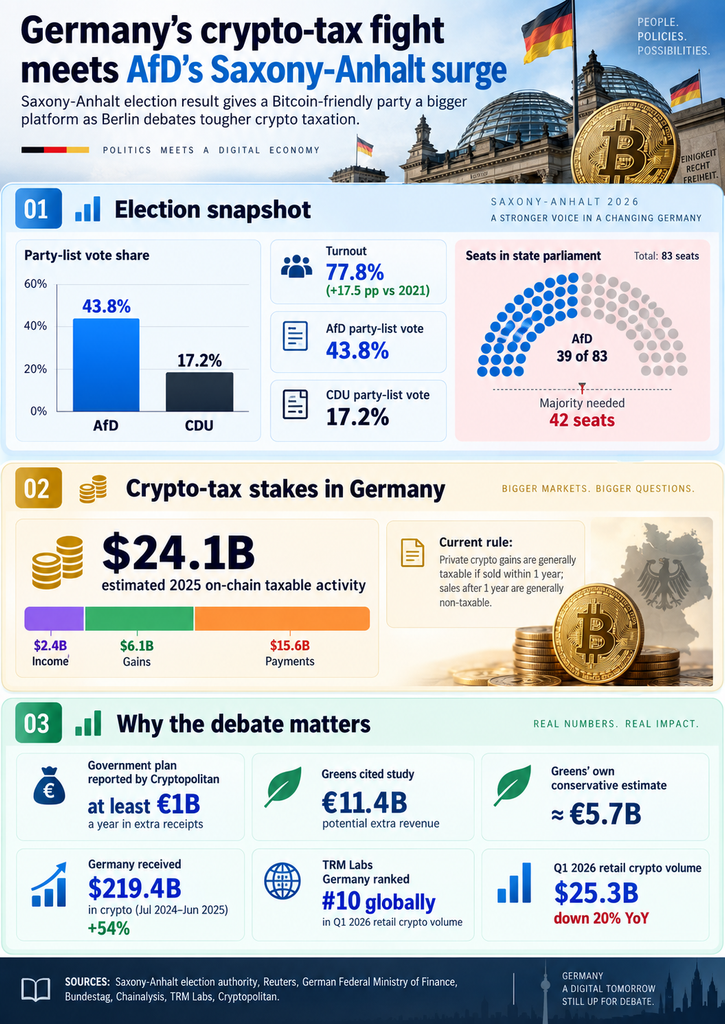
- •The AfD won the Saxony-Anhalt state election with 43.8% of party-list votes, securing 39 of 83 parliamentary seats, three short of an outright majority.
- •Chancellor Friedrich Merz's CDU dropped to 17.2% of party-list votes, down nearly 20 percentage points from 2021, and Merz ruled out cooperation with the AfD.
- •Berlin's cabinet-approved 2027 budget plan introduces new crypto tax regulations, with reports indicating the government intends to abolish the one-year holding-period exemption to raise at least €1 billion per year.
- •The AfD's October 2025 Bundestag motion called for preserving the 12-month holding period, excluding Bitcoin from MiCA, and not classifying private mining and Lightning-node operation as commercial activity.
- •A Green Party bill that would have taxed private crypto disposals regardless of holding period failed in committee on May 20, after citing a Frankfurt School estimate of €11.4 billion in potential additional revenue.
Germany's debate over cryptocurrency taxation has taken on a sharply political dimension. The right-wing Alternative for Germany (AfD), a party that has drawn attention for its call to preserve Bitcoin's favorable 12-month tax treatment, has won the state election in Saxony-Anhalt.
The state-level result does not change federal law or add seats to the AfD's Bundestag contingent, but it hands the party a bigger platform for its agenda at a moment when Berlin is preparing new tax regulations for a market that generated $24.1 billion in on-chain taxable activity in 2025, according to Chainalysis estimates.
The AfD took 43.8% of party-list votes and 44.3% of first votes across 2,661 polling districts, while Chancellor Friedrich Merz's CDU fell to 17.2% of party-list votes — a drop of nearly 20 percentage points compared with 2021. Voter turnout climbed 17.5 points to 77.8%.
A far-right first place that rattled Berlin
According to Reuters, Merz ruled out any cooperation with the AfD, saying the outcome had shaken the CDU "to its very foundation."
The AfD won 39 of the state parliament's 83 seats, just three short of an outright majority. Co-head Tino Chrupalla urged CDU lawmakers to help build what he described as "a center-right conservative majority," increasing pressure on the traditional "firewall" against cooperation with the radical right. That firewall — an informal cross-party commitment maintained by Germany's mainstream parties since the AfD entered the Bundestag in 2017 — has so far kept the party out of coalition positions at federal and state level, despite its growing vote shares in eastern states.
Reuters describes the AfD as anti-immigrant and pro-Russia. The party's Saxony-Anhalt branch has been classified as right-wing extremist by the state's domestic intelligence agency. Co-head Alice Weidel called the result a breakthrough and confirmed the party aims to win at least 40% in the 2029 federal elections.
Where the AfD stands on Bitcoin
The AfD's stance on cryptocurrency predates its recent electoral success. In a Bundestag motion dated October 23, 2025, the party described Bitcoin as "decentralized, non-manipulable, and limited-availability," arguing it should therefore be treated differently from other cryptocurrencies.
The motion called for Bitcoin to be excluded from the EU's MiCA framework, for the 12-month holding period to remain in place, and for private mining and Lightning-node operation not to be classified as commercial activity. The exclusion demand is notable because MiCA, the EU's Markets in Crypto-Assets regulation, has been fully applicable across the bloc since the end of December 2024 and currently treats crypto-asset issuers and service providers under a single rulebook, without a carve-out for any individual asset.
That position resurfaced in May, when the AfD opposed a Green Party bill to remove the holding period. The party argued that the state should tax fewer activities and concentrate spending on core government functions.
The exemption Berlin wants to scrap
Guidance from Germany's Finance Ministry states that gains on privately held crypto are taxable when acquisition and disposal occur within one year. Disposals after that period are generally tax-free. The one-year rule extends a long-standing principle for private disposals to crypto assets, and the Finance Ministry first set out detailed administrative guidance on applying income tax to cryptocurrencies in a 2022 letter to the tax authorities.
The 2027 budget plan approved by the cabinet says new cryptocurrency tax regulations will be introduced, though the published summary does not specify the mechanism. As Cryptopolitan previously reported, based on reports from Germany, Berlin intends to abolish the one-year exemption and raise at least €1 billion per year.
The Greens had already attempted the change, advancing a bill on May 6 that would have imposed personal income tax on private crypto disposals regardless of holding period. The bill failed in committee on May 20. In its calculations, the party drew on a Frankfurt School study estimating €11.4 billion in additional revenue but counted only half that figure to remain conservative.
Why the stakes reach beyond one state
Germany is a major crypto market. Chainalysis estimated $24.1 billion in taxable activity for 2025, comprising $2.4 billion in income, $6.1 billion in gains, and $15.6 billion in payments.
Separately, Chainalysis recorded $219.4 billion received in Germany between July 2024 and June 2025, up 54%. TRM Labs ranked Germany tenth globally in Q1 2026 retail crypto volume at $25.3 billion, down 20% year over year.
That scale gives the tax dispute relevance beyond Germany's borders. Removing the holding-period exemption could alter long-term investor behavior and sharpen competition among European jurisdictions for crypto capital and users, some of which — such as Switzerland and Portugal at various points — have promoted lighter private-holding tax regimes. What to watch next is whether the AfD's Bundestag motion gains traction as the government drafts the implementing rules for its 2027 budget, and whether the firewall against cooperation with the party holds at state level after the Saxony-Anhalt result. Saxony-Anhalt cannot set federal tax policy, but the AfD's result hands one of the loudest opponents of the change a stronger political megaphone just as the debate moves ahead.
